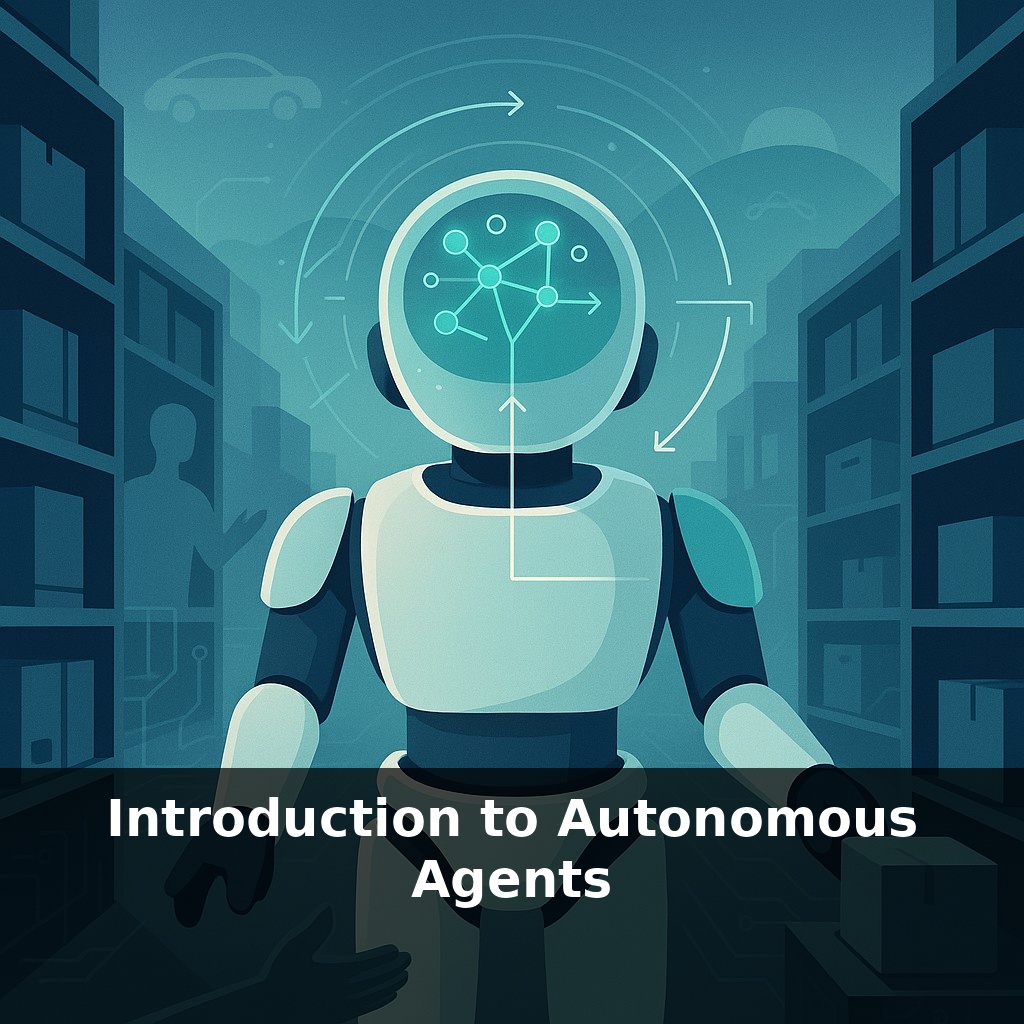
Introduction to Autonomous Agents
📝 Transcript
A robot in an Amazon warehouse quietly tripled how fast workers could grab items from shelves. No hype, no sci‑fi—just software making choices on its own. In this episode, we’ll step inside that kind of mind and ask: when software can decide, what’s left for us to do?
Autonomous agents aren’t just faster tools; they’re a different category of collaborator. Instead of waiting for a button click, they notice, decide, and move—inside markets, codebases, warehouses, and even Martian air. Waymo cars rack up miles with no one at the wheel, AutoGPT scripts spin up research and prototypes, and Ingenuity decides in real time how to stay aloft on another planet’s thin atmosphere.
What unites all of these? A loop: sense the world, choose among options, act, then learn from the result. That loop can live in a robot, a trading bot, or an AI that quietly refactors your codebase at 3 a.m.
In this episode, we’ll pull that loop apart, see how today’s agents are built, and trace where humans still sit in the system—designing goals, setting boundaries, and deciding what “good enough” actually means.
To work with agents, it helps to zoom in on the ingredients rather than the magic. Under the hood, every real system has three constraints: what it can notice, what it’s allowed to do, and how it measures progress. Change any one of those, and you get a very different “personality”—a cautious trading bot, an aggressive debugging agent, or a conservative warehouse robot that always yields to humans. In this series, we’ll keep returning to those dials so you can design agents that are powerful, predictable, and actually useful in your own projects.
If you strip away the branding—“AI co‑pilot,” “autonomous worker,” “self‑driving X”—most real agents today fall into a few practical patterns. Understanding these patterns is the fastest way to see where they actually fit into your work.
First, there are **single‑shot agents**. You give them a clearly bounded task and they run one tight loop, then stop. A code‑fixing agent that takes a failing test and returns a patch lives here. So does a research agent that compiles a briefing from a set of URLs. They’re like specialist sprinters: narrow lane, intense focus, fast finish.
Next are **multi‑step planners**. Instead of just responding once, they break a goal into sub‑tasks, call tools or APIs, and revise as they go. Many “AI dev” systems fall in this bucket: they read an issue, propose a plan, edit files, run tests, adjust. They don’t just answer—they orchestrate.
Then you have **persistent agents** that run over time. These might watch a codebase for regressions, track a portfolio for risk shifts, or monitor a logistics network for delays. They react to evolving conditions, not just one prompt. Here, what they’re allowed to touch becomes crucial; a misconfigured ops agent can do real damage in minutes.
Finally, there are **multi‑agent systems**: collections of agents with different roles that coordinate—or compete. One agent might generate ideas, another critique them, another verify facts or run simulations. In industry, this shows up in complex trading desks, large‑scale recommendation systems, and emerging “AI teams” for software delivery.
Across all these types, three design decisions quietly shape behavior:
- **Information routing**: who sees which data, and when? - **Tooling surface**: which APIs, databases, or actuators they can call. - **Guardrails**: human approval steps, rate limits, and rollback paths.
A helpful way to design is to think architecturally: you’re not “summoning intelligence,” you’re laying out rooms, doors, and locks that determine how the intelligence can move.
Your challenge this week: pick one workflow you touch regularly—ideally something digital, repeatable, and mildly annoying. Map it as if you were designing an agent: list the inputs it would monitor, the tools it would need, the decisions it would face, and the signals that mean “doing well.” Don’t build anything yet; the goal is to practice seeing your work as a system an agent could inhabit.
A good way to feel the difference between tools and agents is to look at how they behave under pressure. In high‑frequency trading, for example, agents constantly scan order books, weather data, and news feeds, then quietly rebalance positions in milliseconds. No human could sit there clicking “buy” or “sell” that fast, or keep all those shifting signals in their head. In logistics, routing agents reshape delivery paths on the fly as traffic, fuel prices, and last‑minute orders collide—sometimes shaving entire days off shipping windows. Software teams are starting to use “code health” agents that roam through repositories at night, spotting duplication, risky dependencies, or security drift and opening issues before anyone notices a bug. One useful mental model is an architectural one: you’re less “hiring a digital employee” than adding an active, semi‑independent subsystem to your stack, one that can change state without you staring at a dashboard. That shift forces clearer choices about trust, visibility, and override.
As more of your stack becomes agent-shaped, the bottleneck shifts from raw capability to governance: who grants access, sets priorities, and arbitrates conflicts when two agents want opposite things? Expect “agent config” to become as strategic as database schema design. Teams will prototype tiny, low‑risk agents first—like a rookie in a sports league—before promoting them to roles where their decisions can move real money, people, or infrastructure.
As you sketch that first agent-shaped workflow, treat it less like wiring a gadget and more like drafting blueprints for a new wing on your product “building.” Small structural choices now—where it plugs in, how visible its moves are, who can lock the doors—decide whether future agents feel like graceful extensions or awkward add‑ons bolted to the side.
Try this experiment: Pick a simple, repetitive task you do online—like checking crypto prices or summarizing daily tech news—and wire up a basic autonomous agent in something like AutoGPT or LangChain to handle it end-to-end for 24 hours. Give it a clear goal (e.g., “Every morning between 8–9am, gather the top 5 AI headlines, summarize them in under 200 words, and email them to me”). Let it run with minimal interference, but keep a log of every time it gets stuck or does something weird, and only step in when it’s clearly broken. At the end of the day, compare the agent’s output and time spent vs. how you used to do that task manually, and decide whether to scale up, tweak its prompts/tools, or abandon that particular use case.
From this course
Building Your First Autonomous Agent
6 episodesUnlock all episodes
Full access to 6 episodes and everything on OwlUp.
Subscribe — $1.99/monthLess than a coffee ☕ · Cancel anytime

