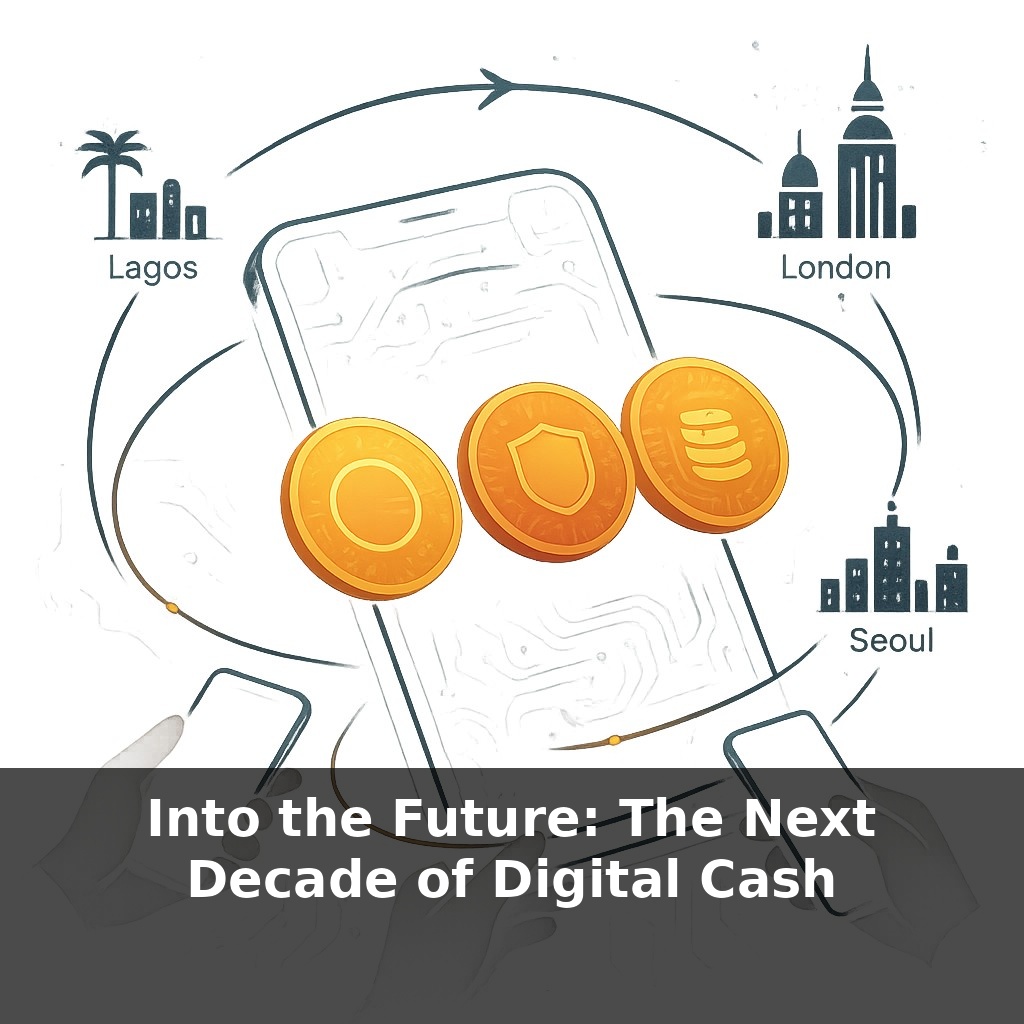
Some of the fastest-growing “currencies” on Earth don’t come as paper bills at all. They travel as code. A shopper in Lagos pays a designer in London, a gamer tips a streamer in Seoul—no bank in sight. The twist? Over the next decade, that invisible money won’t stay so invisible.
By the time today’s first‑graders hit college, “digital cash” will likely come in three flavors that quietly coexist in your wallet app. One behaves like an open highway: public cryptocurrencies racing ahead with faster, cheaper, and more private transactions. Another feels more like a branded transit card: corporate stablecoins pegged to dollars, euros, or gold, accepted across apps and platforms. The third carries a national emblem: state-issued CBDCs, spendable at the supermarket, but also programmable for instant tax refunds or targeted stimulus. These streams won’t stay in separate pipes. As standards mature, you might pay a friend’s rent using a public token, while their landlord receives a dollar stablecoin, and the tax office settles in CBDC—all in one tap, behind the scenes.
By 2035, the question won’t be “crypto or cash?” but “which rail did this payment take?” The same $20 could hop from a trading app to a game, then to your tax bill, without you picking a network. That’s where the three streams start to matter less individually and more as shared plumbing. New rules, identity layers, and interoperability standards will decide who can plug into that plumbing—and on what terms. The stakes go beyond finance: they touch data ownership, financial surveillance, and who gets priority access to tomorrow’s global “money internet.”
A decade from now, those three streams of digital money will feel less like frontier experiments and more like layers of an upgraded financial stack.
On the open side, fully public networks are racing to fix their early flaws. Scalability is no longer just a buzzword: Ethereum’s shift to Proof‑of‑Stake slashed its electricity use by about 99.9%, and “layer‑2” networks are batching thousands of transactions into single on‑chain updates. Bitcoin’s Lightning Network quietly passed 5,000 BTC in capacity, turning what was once a “digital gold” vault into something that can move sub‑cent payments. That lets entirely new behaviors emerge—machine‑to‑machine payments for API calls or bandwidth, pay‑per‑article journalism, streaming wages by the second instead of twice a month.
In parallel, regulated stablecoins are burrowing into the mainstream. Their pitch is simple: the price stays near a dollar (or euro), but settlement behaves like software. Where banks still skim around 6% from many remittances, stablecoin corridors can drop the cost to under 1% while cutting multi‑day delays to minutes. Fintechs in Latin America, Africa, and Southeast Asia are already using dollar‑linked tokens as a kind of “dollar account in your phone” for people who’ll never qualify for a U.S. bank account.
Governments aren’t watching from the sidelines. China’s digital yuan pilot has already logged tens of billions of yuan in transactions, hinting at what happens when official money goes programmable at scale. Other central banks—from Europe to the Caribbean—are testing everything from offline payments to automatic tax collection at the point of sale. The tension will be how far they push programmability without turning money into a remote‑controlled allowance.
The converging point is where these forms can swap value seamlessly. Think of it like a high‑speed interchange where three previously separate highways now connect: a merchant might accept a payment initiated in a public token, confirmed in a stablecoin, and settled on a central bank ledger, all within seconds.
Who wins in this landscape? Likely the builders of the “translation layers”: wallets, compliance tools, liquidity networks, and new legal frameworks that let each stream keep its character while still talking to the others.
A practical way to see the next decade is to zoom into specific moments. A street vendor in Manila gets paid by a tourist using one rail, but her savings app quietly diversifies it: some value parked in a low‑risk, yield‑bearing pool, some auto‑swapped into local currency before prices move overnight. A game studio in Warsaw runs weekly tournaments where entry fees arrive from dozens of countries and settle in minutes, with tax‑ready records exported straight to their accountant. A charity responding to floods in Bangladesh receives funds that unlock only when satellite data confirms water levels, cutting waste without slowing urgency. In each case, the “cash” isn’t just moving; it’s adapting to rules, risks, and goals in real time. Architecturally, it’s closer to a smart building whose lighting and temperature constantly adjust than a fixed blueprint: policies, contracts, and limits embedded directly into the flows, not bolted on afterward as paperwork.
Governments may discover that instead of changing tax codes every few years, they can “patch” rules monthly, like updating an app. Unions might negotiate contracts where overtime, hazard pay, and bonuses trigger automatically, reducing disputes. Households could use rule‑based wallets that split income like a smart thermostat allocates heating: adjusting savings, debt payments, and spending limits as conditions change, creating a quieter, more automated background to economic life.
As these systems mature, expect wallets to feel less like bank apps and more like personal operating systems: auto‑comparing fees, swapping assets mid‑transaction, even nudging you toward options that fit your risk settings. Like a GPS that quietly reroutes around traffic, your money flows will adapt in the background—while you still choose the destination.
Start with this tiny habit: When you open your banking or payment app, swipe to your last 3 transactions and ask yourself, “Could any of these have been done with digital cash (like a privacy-respecting wallet or stablecoin) instead?” Then, once per day, tap to bookmark or screenshot one real-world place or situation (like tipping, subscriptions, or donating) where digital cash would give you more privacy or control. Finally, once this feels easy, pick just ONE of those situations and spend 2 minutes researching a specific tool mentioned in the episode (like a particular wallet, protocol, or stablecoin) that could actually work for that use case.