Your smartphone, a self‑driving car, and a bank’s trading algorithm all rely on the same thing: a symbol for “nothing.” Yet the Romans never had it, and even today your computer quietly tracks two different versions of zero. How did “nothing” become the most powerful idea in technology?
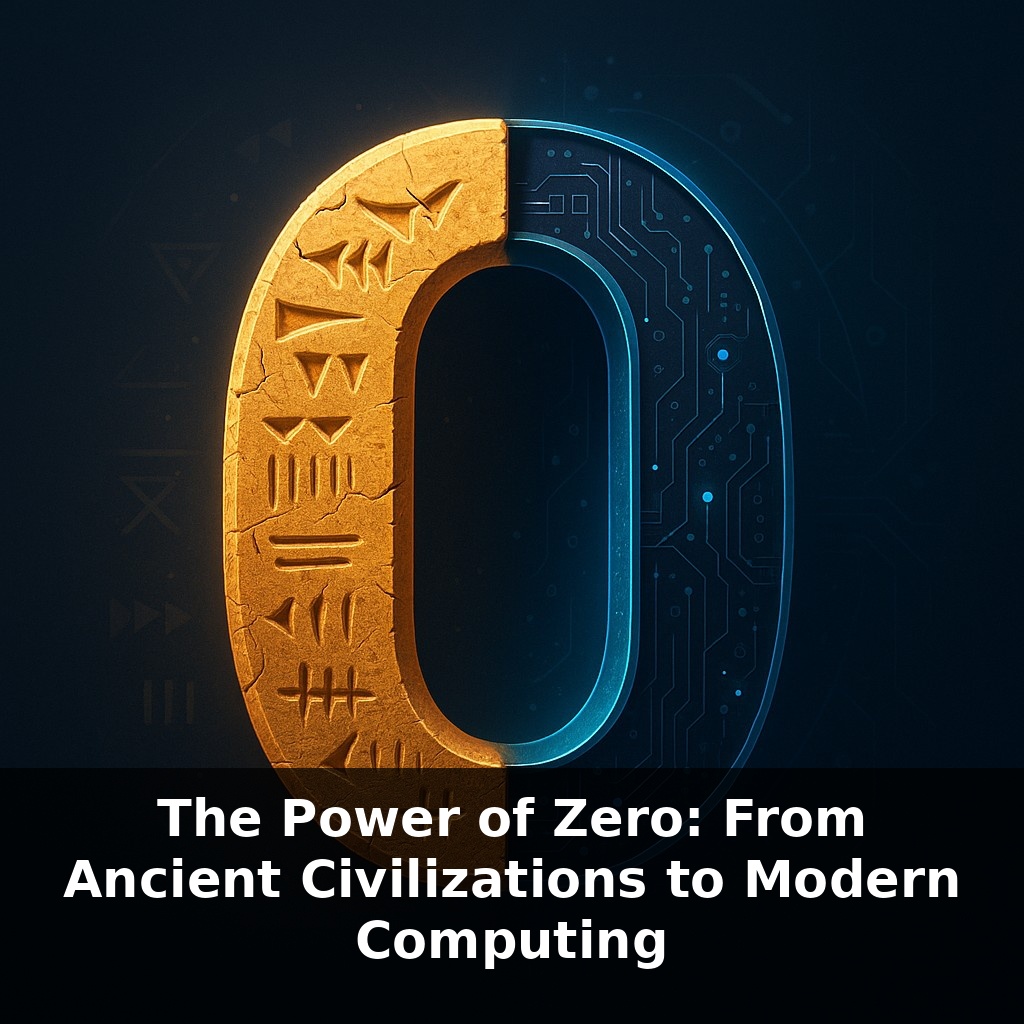
Long before cloud servers and crypto wallets, merchants with clay tablets were wrestling with a quieter problem: how do you record that *something* is missing without messing up the entire count? Early scribes in Mesopotamia used little wedge marks in cuneiform to keep their number columns from collapsing, a bookkeeping hack that foreshadowed a revolution they couldn’t yet see. Centuries later, along the trade routes that ferried spices and silk, another cargo was moving: a new way to write and manipulate numbers that would eventually eclipse cumbersome systems like Roman numerals. As these ideas flowed from India through the Islamic world to Europe, they equipped scholars, navigators, and eventually engineers with a far more compact numerical “interface.” That compactness is precisely what modern algorithms exploit when they compress images, train models, or synchronize data across continents.
Merchants and astronomers weren’t the only ones affected. Once Indian mathematicians promoted this humble symbol from placeholder to full‑fledged number, it unlocked entirely new moves in the “game” of math. You could now write equations that balanced gains and losses, model motion as speeds waxing and waning, and speak clearly about debts, temperatures, and sea level. When Brahmagupta set down rules for arithmetic with zero in 628 CE, he wasn’t just tidying notation; he was handing future scientists a tool kit that would shape everything from navigation to physics. Later, algebra and calculus quietly baked it into their foundations.
When Indian mathematicians promoted this symbol to a full number, they didn’t just add a new toy to the box; they changed the rules of the game. Suddenly, positional notation could stretch effortlessly to represent gigantic values and tiny fractions with a handful of digits. Instead of inventing new symbols for each larger quantity, you could reuse the same ten and let place do the heavy lifting. Traders could compare prices across long distances, astronomers could tabulate planetary cycles, and tax officials could manage empires without drowning in bespoke marks and ad‑hoc shortcuts.
But that upgrade wasn’t universally welcomed. Greek geometry had flourished without a written zero, and Roman administrators ran armies and aqueducts perfectly well using numerals that never left a gap. For many intellectual traditions, granting “nothing” equal status with “something” seemed philosophically suspect, even dangerous. It took centuries of cross‑cultural translation—through Sanskrit, Arabic, and Latin manuscripts—before European scholars began to trust this strange mark that let you write 10, 100, or 1,000 with the same symbols in new positions.
Once that trust was in place, algebra took off. Equations like x + 3 = 0 let you talk coherently about negative quantities. Later, calculus leaned on the idea of approaching zero to talk about instantaneous speed and changing rates. Engineers could reason about equilibrium—forces summing to zero—as a precise condition, not a vague balance.
Fast‑forward to the 20th century, and zero quietly reappears wearing a new costume: the binary digit. Claude Shannon’s 1937 thesis showed that circuits flipping between two stable states—low and high, 0 and 1—could implement the same symbolic manipulations that algebraists do on paper. Logical statements like “A and not B” became wiring diagrams. That insight powered digital electronics, from early relays to modern chips.
Deep inside those chips, the story gets subtler. The IEEE‑754 standard for floating‑point numbers even distinguishes between +0 and −0, a bookkeeping trick that preserves direction information in delicate calculations. Your processor may spend billions of cycles each second juggling different “kinds” of zero so your simulations, graphics, and cryptography stay numerically stable.
Open a spreadsheet and notice how cells can be blank, yet formulas still run. That quiet “gap” lets software distinguish between “no value yet” and “actual value,” echoing how mathematicians distinguish different flavors of zero in advanced calculations. In video games, physics engines constantly check when a character’s velocity crosses through zero, flipping from moving left to moving right. Miss that exact crossing and animations jitter, collisions fail, or objects slowly “sink” into floors.
In cryptography, protocols track events like failed logins; counters may be reset to zero, and reaching precisely zero remaining attempts can trigger lockouts or alarms. That same idea powers rate‑limiters in web APIs and quota systems in cloud platforms.
In signal processing, filters are often designed so their response is exactly zero at certain frequencies, surgically muting hum from power lines or whine from motors. Even in machine learning, gradients are nudged toward zero while training; when change dwindles to almost nothing, optimization halts, freezing a model that can recognize faces, voices, or handwritten digits.
Zero also marks boundaries in systems we rarely notice. In networks, “zero downtime” targets push architects to design services that survive hardware failures without users feeling a blip. In sustainability, “net‑zero” data centers juggle energy use against on‑site generation. And in quantum labs, researchers wrestle with how classical zeros in control hardware steer fragile qubits, where absence and presence of signals blend—turning zero into a steering wheel for probabilistic machines.
Having explored how zero weaves through diverse advancements, zero keeps sneaking into new frontiers: programmers use it to mark the “ground level” of memory, game designers let scores fall back to it to signal defeat, and network packets reserve all‑zero addresses for special routes. This week, try a real coding exercise: use a platform like Codecademy to write a simple script that initializes and resets variables to zero, actively observing how zero functions as both a null state and a starting point for operations.