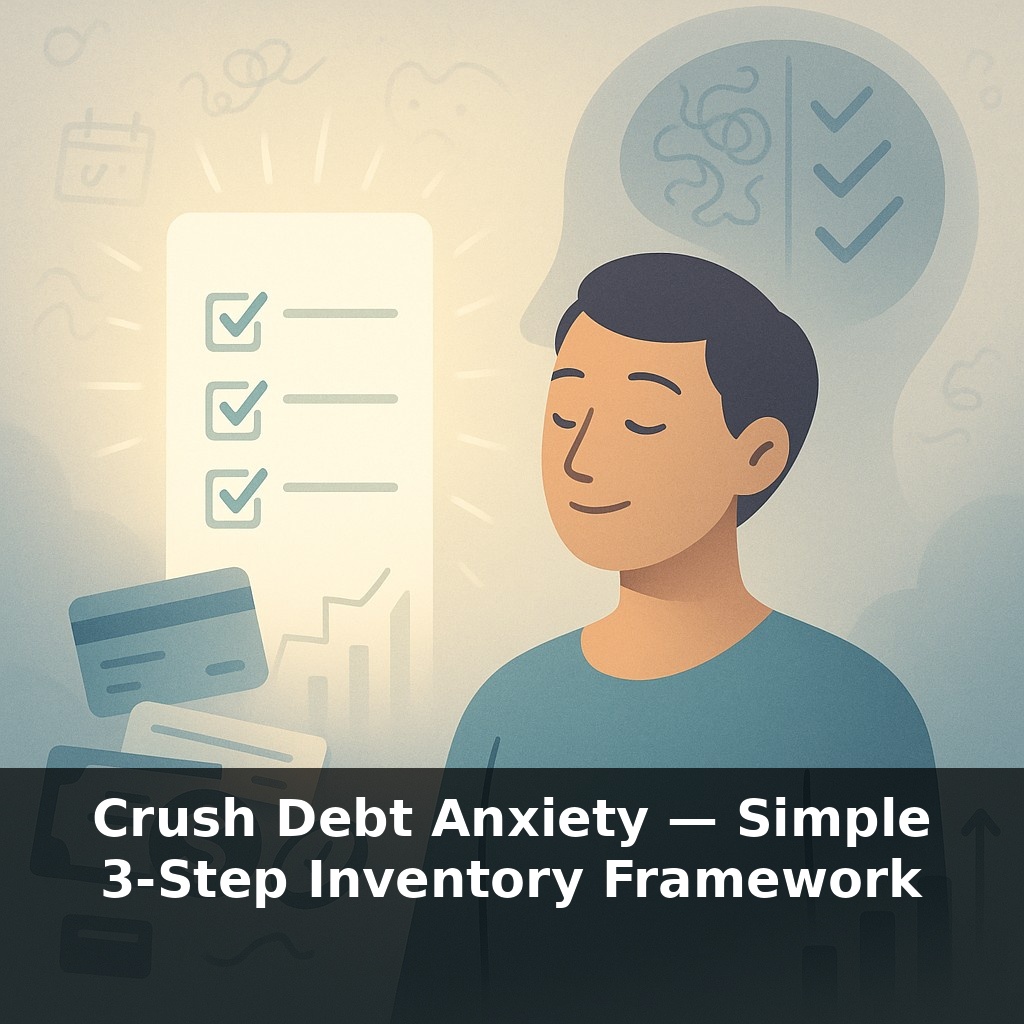
Right now, someone with a typical credit-card balance is saving real money this month—not by earning more, but by writing one short list. Strange, right? Same income, same debts, but way less anxiety. The only thing they changed was how clearly they could see what they owed.
So why does a simple list have that much power? Behaviour researchers call it “killing the fog.” When money stress spikes, your brain quietly starts dodging bank apps, unopened envelopes, even casual thoughts about due dates. That’s information avoidance—and it keeps your stress high because every bill feels like a jump scare. A clean inventory flips that script: instead of random alerts ambushing you, you choose when and how to look.
Think of it like checking a weather radar before you leave the house. The storm doesn’t disappear, but you know whether to grab an umbrella, delay a trip, or take a different route. In the same way, an inventory turns a vague feeling of “I’m drowning” into specific, sortable entries: this card, that loan, this due date. Once you can stack them in order—by size, by interest rate, by urgency—you’re not just coping with debt, you’re actually steering it.
Here’s where the research gets interesting. When people go beyond a mental tally and create a concrete inventory, behaviour shifts fast. NFCC data shows missed payments drop once that list exists, because bills stop feeling like random ambushes and start acting like scheduled appointments. A Cambridge study even measured lower stress just one month after people listed out their debts in detail. And this isn’t a weekend-long project: Tally’s research found most folks are done in under an hour, especially if they use an app aggregator to pull balances, limits, APRs, and due dates into one place.
Here’s where this gets practical: your inventory isn’t just a list—it’s a decision engine. Once everything lives in one place, you can ask three crucial questions of each debt: “How much?”, “How fast is it growing?”, and “How soon do they want their money?” Those translate into balance, APR, and due date. The magic isn’t in seeing those numbers once; it’s in lining them up so your next dollar has a clear job.
Start by marking which debts are actually dangerous right now. Not all red feels the same. A small store card at 32% APR can quietly cost you more than a bigger, low-interest loan. This is where payoff methods plug in: avalanche (highest APR first) isn’t just a theory—CFPB simulations show it can shave 15–20% off interest when you’re over about $5,000 in total balances. You don’t have to commit today, but your inventory lets you *simulate* different paths instead of guessing.
Next, look at your minimums row as a single number: the “cover charge” to stay current this month. Many people realize the real source of panic isn’t the total balance; it’s that this cover charge keeps creeping up unnoticed. With everything side by side, you can see whether the problem is one runaway account or death by a thousand cuts. That matters, because the fix is different: one giant balance might call for negotiating a lower rate or exploring consolidation; a dozen tiny ones might be better attacked in quick bursts to free up cash flow.
Now add one more column: “Freedom date.” Roughly estimate, “If I only paid the minimum, when would this be gone?” then, “If I add $25 extra to this one account, how much sooner?” You’re not looking for perfect math; you’re looking for leverage—where an extra sliver of money creates the biggest shift in time or interest.
This is also your BS-detector for habits. If you see multiple cards with similar balances and APRs, but one keeps creeping up month after month, that’s likely where lifestyle and emotion are hooked in—travel, late-night clicks, stress spending. The inventory doesn’t shame you; it points to the lever that, if pulled, changes your *future* list.
Finally, treat this as a living document, not a one-off purge. Update it once a month. Circle any balance that went *up*, even by a little. That visual cue quickly teaches you which “harmless” charges are sabotaging progress, and which small wins—like paying off a $300 card—free up cash you can redirect to the next target.
Think of your inventory as a lab notebook for your money experiments. One person might colour-code debts by “emotional weight” instead of size: red for the card that triggers shame, yellow for the annoying store card, green for the small loan they barely notice. When they chose a payoff order that knocked out the “red” items first, they reported sleeping better even before the numbers moved much. Another person added a column called “leverage score” where they simply ranked each debt from 1–5 based on how much extra payment would speed things up. That quick gut rating helped them spot a mid-sized balance with a weirdly high rate that became their main target. A third person treated their list like an art sketch: rough, not perfect, with arrows, circles, and scribbled notes like “call to negotiate?” or “close after payoff.” The point wasn’t beauty—it was getting comfortable editing the picture, month after month, until it started to look how they wanted.
A simple list on your phone is about to feel old-school. As banks open their data pipes and AI gets better at pattern-spotting, that inventory you built becomes more like a living chart in a doctor’s file than a one-time worksheet. Your future self might review debt vitals the way athletes scan training stats: projected “pressure points,” early warnings, and suggested “treatment plans” that adapt as soon as you tap your card, not weeks later when the statement finally lands.
Your list is really a launchpad: once it exists, you can start testing tiny adjustments—like shifting $20 from a “meh” purchase toward the most punishing balance—and watch how the whole picture tilts. This turns money from a hallway of locked doors into a series of knobs you can actually turn, learning which ones move fastest with every small experiment.
Start with this tiny habit: When you open your banking app to check your balance, say out loud the name of just **one** debt (like “Visa card” or “car loan”) and tap the “transactions” tab for that account. Don’t organize, don’t spreadsheet—just glance at the most recent payment and the current balance, then close the app. Do this with one debt per day until you’ve peeked at them all. This tiny inventory pass keeps your brain in “observer mode” instead of “panic mode,” and gently builds the 3-step inventory muscle without overwhelming you.