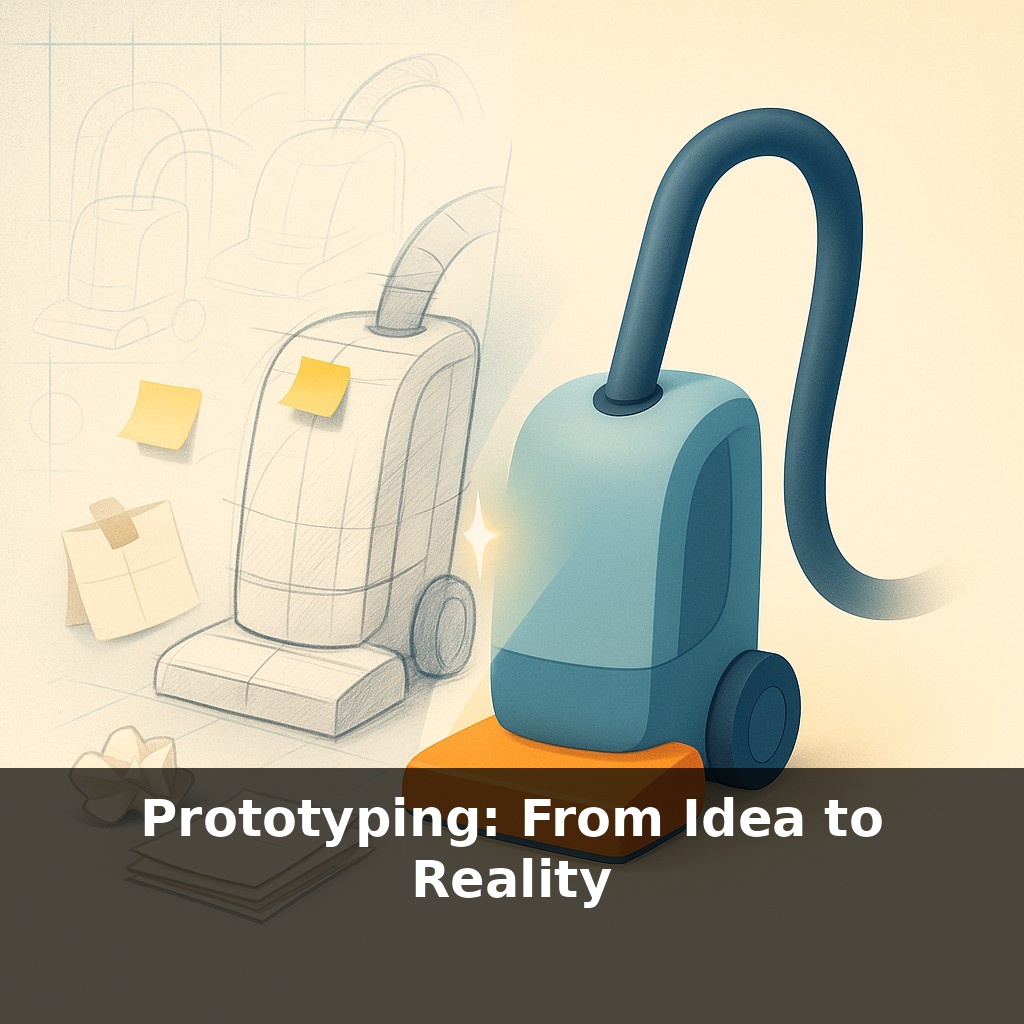
A designer once built over five thousand versions of a single vacuum before it ever hit a store shelf. Now jump to you, standing over a rough sketch and a roll of tape. Is this scrap paper… or the first, quiet proof that your wild idea might actually work?
McKinsey found that teams who prototype weekly are twice as likely to hit launch targets—not because they’re smarter, but because they’re willing to be wrong faster, in smaller, safer ways. That’s the quiet superpower of prototyping: it lets you borrow a little bit of the future and hold it in your hands long before you commit real budgets, reputations, or timelines.
In this phase, the question is no longer “Is my idea good?” but “What’s the smallest, cheapest thing I can build to learn the next important truth?” Sometimes that’s a paper interface you test in a hallway. Sometimes it’s a cardboard “device” with a person secretly pressing buttons behind the scenes. Increasingly, it might be a quick 3-D print that exposes a fatal flaw in how two parts connect—months before a factory ever spins up.
The goal isn’t polish. It’s evidence. Evidence of what users actually do, what breaks under stress, and what unexpectedly delights.
So in this phase, instead of defending ideas in meetings, you’re putting something on the table people can actually poke, break, and react to. That’s why even rough models—paper dashboards, clickable slides, taped-together objects—suddenly change the conversation from “I think” to “I see.” Dyson didn’t make 5,127 PowerPoints; he made 5,127 things he could test. And you don’t need a lab. A service prototype might be you acting out a check-in script in a hallway. A policy prototype might be trialing new rules with one team for one week, then adjusting based on what really happens.
There’s a reason usability experts say five users can uncover about 85% of major issues: a prototype acts like a magnifying glass for reality. But the magic isn’t in the artifact itself—it’s in what you choose to learn with it.
Think of three layers you can probe:
1. **Desirability** – Do people even want this? 2. **Feasibility** – Can we actually make it work? 3. **Viability** – Does it make sense for our context or business?
A landing page with a fake “Sign up” button tells you desirability long before you’ve built the full product. A taped-together “device” with a hidden human doing the hard work backstage (a classic “Wizard of Oz” test) tells you where feasibility will break. A pilot with just one team or one neighborhood exposes viability: who pushes back, what it really costs, where regulations or politics bite.
The trick is to prototype *one risky assumption at a time*, not everything at once. Before you build anything, ask: *What would have to be true for this to succeed—and which of those feels most fragile?* That fragile piece deserves its own cheap experiment.
This is where formats matter:
- **Role-play and scripts** for conversations, services, or sales pitches. - **Storyboards and comics** for complex journeys over time. - **3-D prints or foam models** for ergonomics, assembly, and scale. - **Clickable slides** for flows, not engineering.
Each format lets you “spend” fidelity wisely. You can obsess over realism where you’re learning something important and stay unapologetically crude everywhere else. A hospital team, for example, might print only the handle of a new tool to test grip and comfort while ignoring electronics entirely.
And remember: your first version isn’t a mini product, it’s a focused question made tangible. When people react—by hesitating, misusing, or lighting up—you’re not getting judgment on your worth as a creator. You’re getting data. The faster you translate that data into the next, smarter version, the more your idea stops being a fantasy and starts behaving like something that could actually survive contact with the real world.
A startup founder once “built” her first hardware product by sketching it on a cereal box, cutting it out, and taping it to her laptop. She walked into coffee shops, set it on the table, and simply watched: Did anyone ask about it? Did it get in the way? The cardboard wasn’t the point; the real artifact was the reactions she collected.
Think smaller than you’re used to. Testing a new onboarding flow? Grab three colleagues and act it out, switching roles halfway through to see where people stumble. Wondering if a new community program would fly? Draft a one-page flyer as if it already exists, post it in one place, and track responses for a week.
Artists do this instinctively: they fill whole sketchbooks with half-formed ideas, thumbnails, and color tests long before a final canvas appears. Treat your idea the same way—like a series of quick sketches you can discard, layer, or combine—so the “final piece” feels almost inevitable by the time you commit.
As tools evolve, the frontier shifts from “Can we build this?” to “What should we explore next?” You’ll soon be able to spawn dozens of options with a prompt, then “walk through” them at life-size scale in your living room. That means your real advantage won’t be sketching or coding, but asking sharper questions. Treat emerging tech like a trail guide in unfamiliar terrain: it can suggest paths, but you still choose where to head, where to pause, and what’s worth mapping.
Treat this phase like scouting side trails off a main hike: each quick build reveals a new overlook you couldn’t see from the map. Over time, you’ll notice your “rough drafts” growing bolder, not safer. That’s the signal you’re shifting from defending ideas to discovering them—and that’s where original work quietly starts to emerge.
To go deeper, here are 3 next steps: (1) Open Figma (or sign up free) and build a one-screen, tappable prototype of your core idea using their “Mobile Wireframe” template, then run through it on your phone with Figma Mirror to see how it actually feels. (2) Grab a copy of *Sprint* by Jake Knapp and block off one 90-minute session this week to follow the “Map” and “Sketch” steps for your idea, treating it like a mini design sprint instead of a vague brainstorm. (3) Set up a free account on UserTesting, Maze, or Lookback, upload your prototype, and create one concrete test task (e.g., “Find and book a yoga class for tonight”) so you can watch 3 real people try it and learn where your prototype breaks.