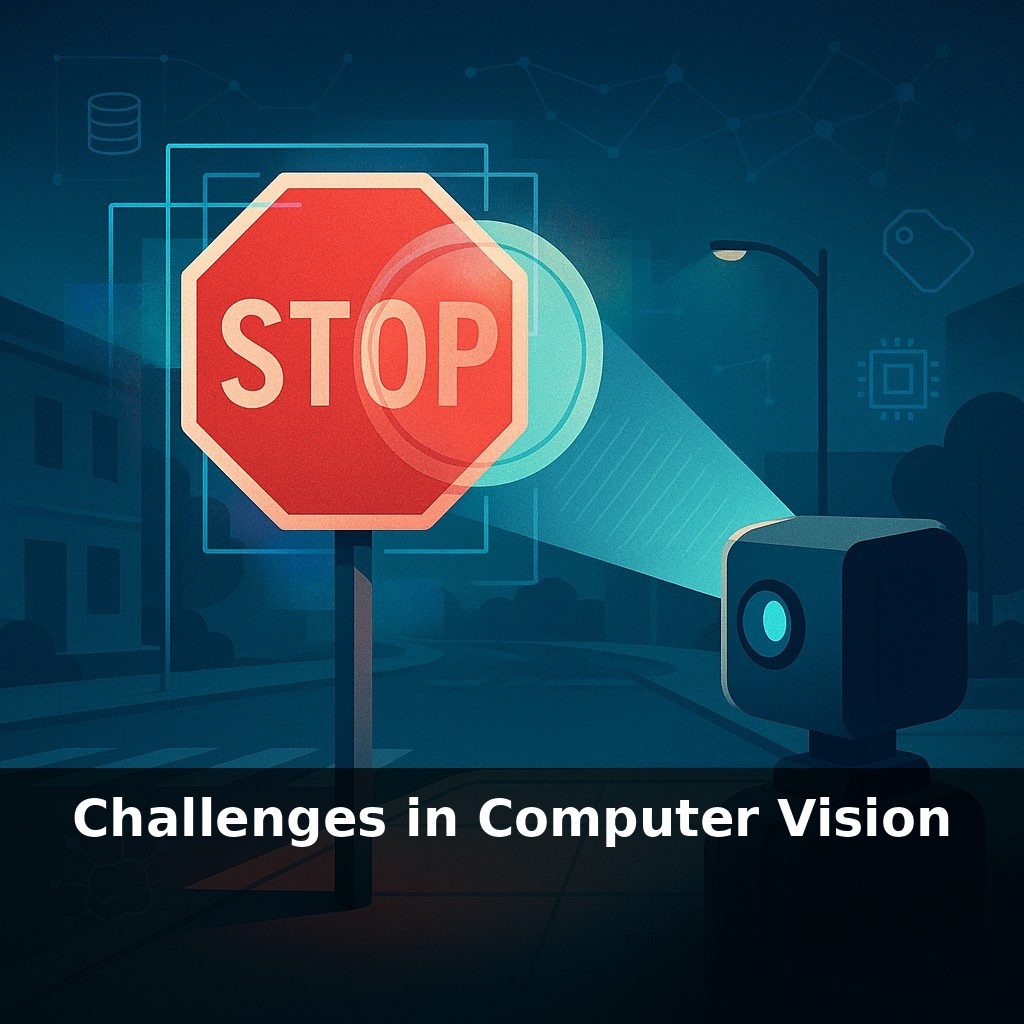
A camera spots a stop sign on a quiet street… and confidently decides it’s a speed limit sign. Same pixels, totally different meaning. Today’s mystery: how can machines be so “good” at seeing in the lab, yet so strangely fragile on the streets we trust them to navigate?
Four quiet troublemakers sit behind that bad stop-sign prediction: biased data, messy labels, limited compute, and the chaos of the real world. Each one can subtly warp what a model “learns” to see. For instance, many famous vision datasets are frozen snapshots of the internet from a decade ago—millions of images, but skewed toward certain countries, objects, and styles. That “frozen past” then shapes how new systems behave in the present.
Researchers are now discovering just how fragile this pipeline is. A few mislabeled training images here, a missing weather condition there, and even state‑of‑the‑art models can lose their footing. Meanwhile, the push toward ever‑larger vision architectures demands staggering computation and energy, putting practical limits on how often we can retrain or repair them.
A useful way to see where things stand is to follow the money, the data, and the errors. On the data side, landmark datasets like ImageNet now hold tens of millions of labeled images, yet still need regular updates just to stay relevant to how the world looks today. On the compute side, training frontier‑scale models can quietly burn through exaflop‑days of processing and significant carbon budgets before they ever see a real‑world camera feed. And on the accuracy side, even tiny cracks—like a couple percent of mislabeled objects—can suddenly widen into double‑digit drops in detection performance.
A 2022 study from MIT quietly underscored how precarious today’s systems really are: slip just 2–5% bad labels into an object‑detection dataset and mean average precision can crash by up to 15 points. That’s the difference between “production‑ready” and “we need to roll this back now.” And those aren’t absurd, worst‑case numbers—that’s the kind of noise you can get from a hurried annotation sprint or a poorly supervised outsourcing vendor.
The hard part is that these four challenges—data shifts, annotation issues, compute budgets, and real‑world robustness—don’t show up one at a time. They stack.
Take a retailer trying to deploy a shelf‑scanning robot across thousands of stores. They may start with a carefully curated dataset from a flagship location. Six months later, packaging designs change, seasonal products appear, lighting differs between regions, and some labels from the initial dataset turn out to be wrong. Retraining from scratch on every shift would be ideal—but retraining a modern vision model can mean days of expensive GPUs, not a quick afternoon job.
This is where the field is leaning on three big levers:
First, smarter data curation: tools that automatically surface conflicting labels, under‑represented conditions, and “long‑tail” edge cases. Instead of blindly collecting millions of extra images, teams prioritize the few thousand that actually stretch the model in new directions.
Second, efficient model design. Stanford’s DAWN project showed that pruning and distilling large networks can cut vision training costs by around 10× on benchmarks like ImageNet without hurting accuracy. That’s not just a nice engineering trick—it means more frequent updates become financially and environmentally possible.
Third, continual and test‑time learning strategies. Rather than freezing a model after one big training run, newer approaches let it adapt incrementally to new warehouses, hospitals, or intersections while monitoring for drift and failure modes.
Training a vision model is a bit like managing an investment portfolio: if you never rebalance, early choices and external shocks quietly dominate your future. The frontier now is building systems that can keep “rebalancing” what they see—carefully, efficiently, and under tight real‑world constraints.
A hospital network rolls out an AI system to flag anomalies in X‑rays across dozens of sites. One city uses older machines with lower contrast, another recently upgraded scanners, a third compresses images more aggressively to save bandwidth. The underlying model is the same, but its “view” of the world quietly fractures, and sudden drops in detection rates only show up when radiologists complain.
A logistics company faces something similar in warehouses. New barcode formats, reflective packaging, and occasional lens smudges push cameras into regimes never covered in the carefully staged pilot. They discover that weekly, tiny, targeted updates—guided by failure logs rather than random new data dumps—deliver more stability than massive retrains.
Your challenge this week: pick one computer‑vision‑powered tool you use (filters, auto‑crop, document scanning) and deliberately “stress” it—odd angles, low light, cluttered scenes. Notice which failures feel silly versus risky. That pattern is exactly what teams try to map before deploying vision to cars, clinics, or factories.
As these systems mature, the real shift may be social more than technical. Vision models will quietly arbitrate insurance claims from dashcams, triage patients from phone photos, and approve factory parts from a single snapshot. Think less “smart camera,” more “visual auditor” sitting in every workflow. The open question is who gets to tune those auditors—engineers, regulators, or the people most affected by their judgments.
As models seep into doorbells, claim forms, even classroom proctoring, the stakes shift from “does it work?” to “who does it serve?” Visual AI will nudge which products are “well stocked,” which patients are “urgent,” which streets feel “safe.” Our next task isn’t just sharper algorithms, but shared norms for when seeing becomes deciding.
Start with this tiny habit: When you open your code editor or notebook, spend 60 seconds typing one concrete failure case your current computer vision model struggles with (e.g., “occluded faces in low light” or “small objects at the edge of the frame”) as a comment at the top of your file. Then, add exactly one line of code that logs or visualizes just that type of example the next time you run training or inference. This way you’re nudging your workflow toward real-world robustness without overhauling anything—just one clearly named challenge and one tiny probe into it each day.