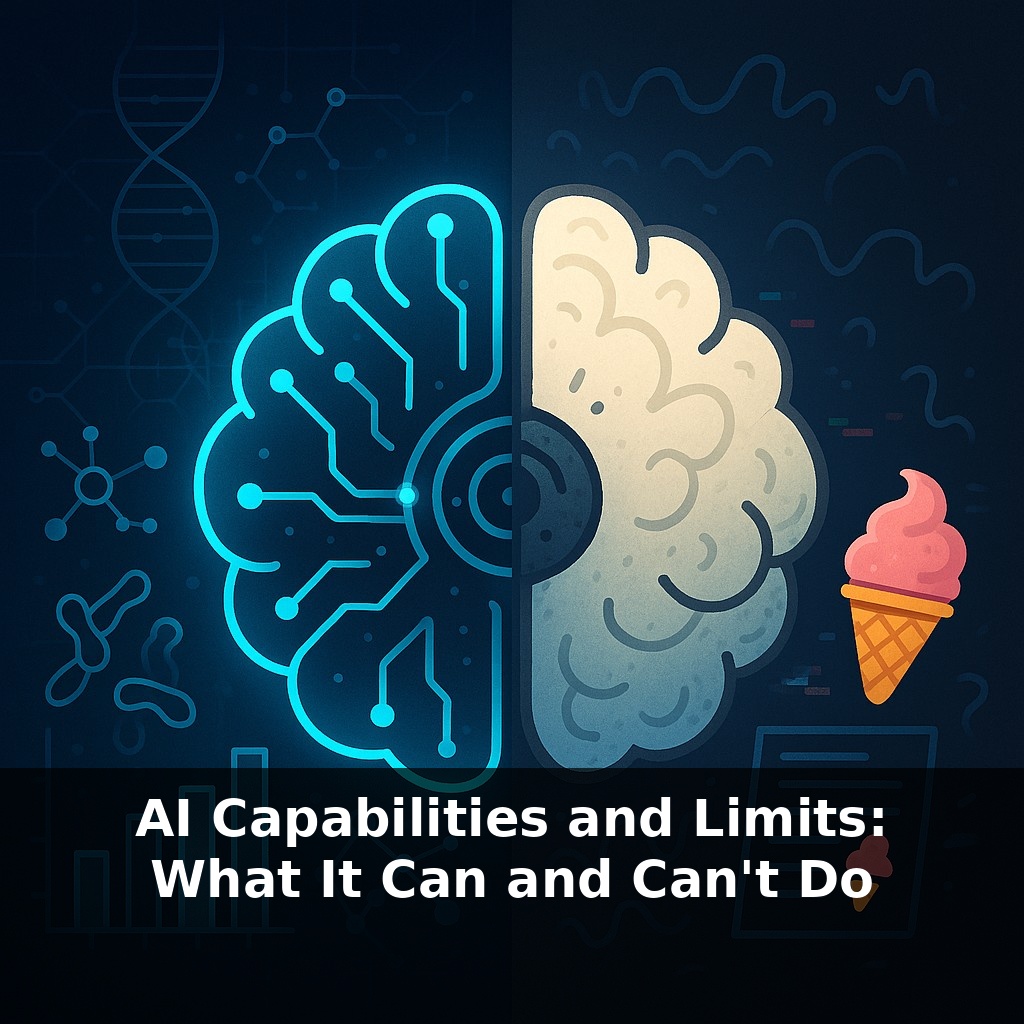
An AI just mapped nearly all human proteins before most of us finished our morning coffee—yet it still can’t reliably understand a simple joke. In this episode, we’ll step into that gap: where AI is shockingly powerful, and where it quietly falls apart.
AI’s weirdness shows up most clearly when you mix the ordinary with the unexpected. Ask it to summarize a legal contract? It’s calm and precise. Slip in a subtle trick clause or a joke about the contract’s “favorite ice cream,” and it might respond with total confidence to something no sane lawyer—or comedian—would accept.
That gap between “superhuman on benchmarks” and “oddly fragile in real life” is where most of the real risk and opportunity lives. The same systems that help write code, draft research, and speed up design work can also fabricate sources, misread basic context, or break when a problem looks slightly different from their training data.
In this episode, we’ll look closely at that boundary: which jobs AI can already do reliably, which tasks still demand human judgment, and how to tell the difference before it fails in your hands.
To see where that boundary lies in practice, follow where AI actually performs well at scale. Logistics firms lean on it to route thousands of trucks through shifting traffic. Hospitals use it to flag suspicious scans long before a human radiologist could review them all. Banks run models over oceans of transactions to spot fraud patterns no analyst would ever notice in time. These are tightly scoped, data-rich situations with clear success metrics. The trouble starts when we quietly slide from those well-lit arenas into fuzzier territory: values, context, and real-world consequences.
Here’s the uncomfortable middle of the story: for all the hype, most frontier systems are still glorified specialists. They shine when the world looks like their training data—and they quietly wobble when it doesn’t.
Start with what they *are* good at. Pattern-heavy, feedback-rich work is their home turf. AlphaFold didn’t “understand biology” in a human way; it learned to map sequence patterns to shapes so well that it could predict 98.5% of human proteins. Similar pattern engines now forecast demand at retailers, rank search results, and generate passable code or marketing copy in seconds. In domains like these, scale is a superpower: more data, more compute, more repetition.
But transfer that skill to a new domain, and things get shaky. Ask a model trained mostly on English legal and technical text to reason about, say, rural land-use conflicts in a low‑resource language, and its competence collapses in subtle ways. This brittleness under “distribution shift” is why 73% of AI researchers in that Stanford survey flag it as a core weakness: the system hasn’t failed loudly; it’s just confidently wrong in a slightly different world.
The costs and stakes of this gap are rising. Training GPT‑3 already burned through about 1.287 GWh of electricity—roughly what 120 U.S. homes use in a year—and GPT‑4 likely required orders of magnitude more compute and money. When each frontier model may cost tens or hundreds of millions of dollars to train, you want it to generalize well, not crumble on edge cases.
That’s also where governance and economics collide. McKinsey’s estimate—$2.6–$4.4 trillion in potential annual value from generative systems—hinges on them being not just powerful, but reliable enough for workflows that touch law, medicine, finance, and critical infrastructure. In practice, this means pairing models with guardrails: human review, domain‑specific checks, and narrow deployment scopes.
Think of today’s best systems less as autonomous agents and more as high‑throughput, high‑variance tools. They can draft a thousand options, surface nonobvious correlations, and stress‑test ideas—but deciding which outputs are safe, fair, or even sane still lands squarely on us.
In practice, the difference between “useful tool” and “quiet disaster” often comes down to how tightly you frame the job. A customer‑support bot that only suggests answers from an approved knowledge base, and logs every “I’m not sure” case for a human to review, can safely deflect thousands of routine tickets. Let that same system freestyle refunds or legal promises and you’ve created a liability generator.
You see the same divide in healthcare pilots. A triage model that simply ranks which cases a nurse should review first can work well; a system that tries to *replace* that nurse’s judgment tends to hit regulatory walls fast.
One useful way to think about deployment scope is budget: not just money, but also error tolerance and supervision time. A marketing team may accept a 5% nonsense rate in draft copy; an air‑traffic control system cannot.
Think of today’s models as a master recipe follower in a busy kitchen: fantastic at scaling dishes it’s seen before, but still needing a head chef to set the menu and catch bad substitutions.
Regulation will likely harden around *uses*, not algorithms: high‑stakes decisions may demand audit trails, model “nutrition labels,” and fallback plans when outputs drift. Teams that treat these systems like junior colleagues—reviewed, corrected, and periodically re‑trained—will squeeze out steady value, while those chasing full automation risk headline failures. The deeper shift is cultural: we may need to teach *reading AI* as seriously as we once taught reading code.
So the real question isn’t “Can AI do X?” but “Under what conditions would I trust it with X?” Treat it less like autopilot and more like a power tool: you get leverage, but also sharper failure modes. Your challenge this week: pick one workflow you care about, and map which pieces are safe to automate—and which must stay decisively human.