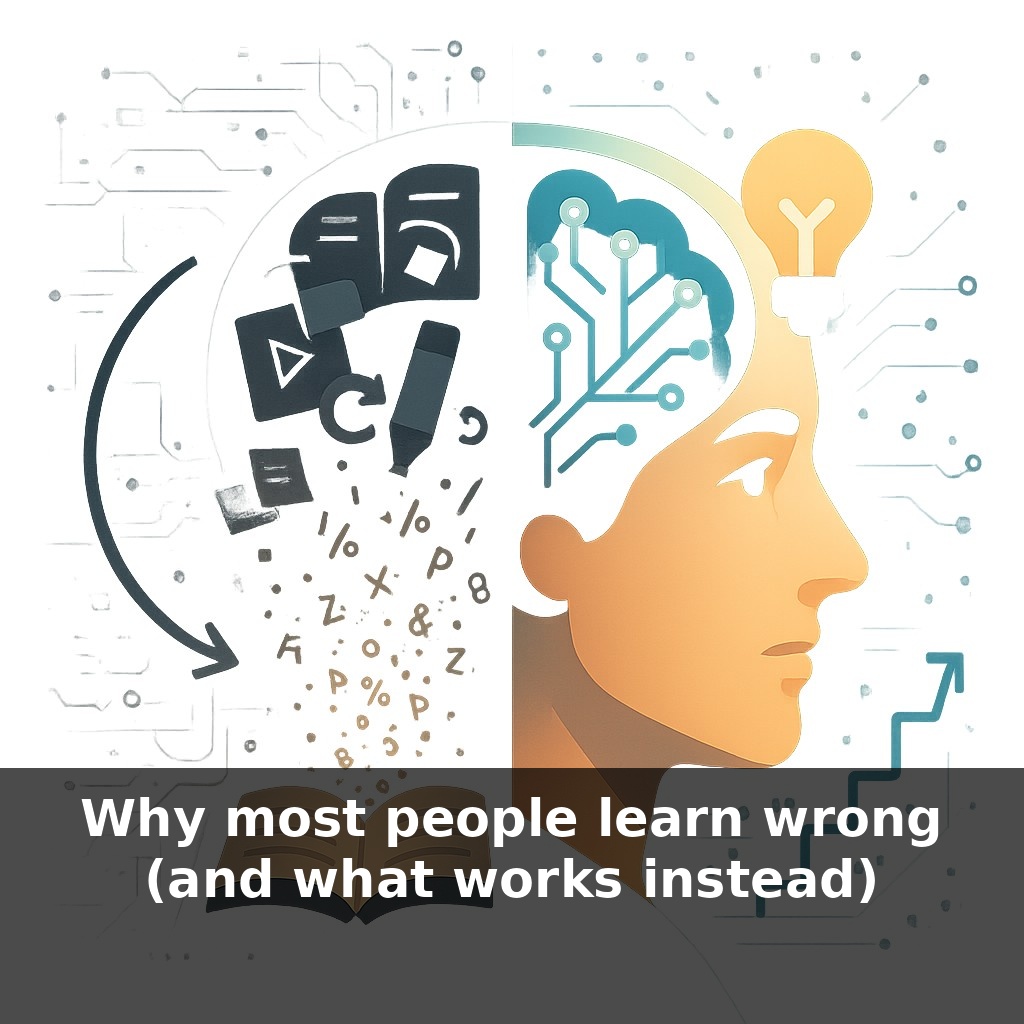
About half of what you study today will quietly vanish from your mind by tomorrow. Yet most of us keep using the same study habits that cause that leak. You’re highlighting, rereading, watching videos… and accidentally training your brain to forget faster.
So if the usual “study harder” tactics quietly backfire, what actually works? Consider the moment when you finally grasped a tricky guitar riff, mastered a new programming concept, or navigated a foreign city with ease. It wasn’t by accident.tare at instructions; you wrestled with them. You tried, messed up, adjusted, and tried again. That struggle wasn’t a flaw in the process—it *was* the process.
Cognitive scientists keep finding the same pattern: your brain strengthens memories when it has to reach for them, not when information is spoon-fed. Techniques like spacing, quizzing yourself, and mixing up problem types feel slower and more frustrating at first, yet they build knowledge that actually survives exams, job interviews, and real-world pressure.
In this episode, we’ll unpack why “feels easy” often means “won’t last,” and how to swap in habits your future self can rely on.
Think about how you actually *experience* learning during a tough course or new job. At first, everything feels sharp—you leave a lecture or meeting sure you’ve “got it.” Then a day later, details blur, steps vanish, and you’re shocked by how much slipped away. That gap between how prepared you *feel* and what you can actually *do* on demand is where most people go wrong. Psychologists call this overconfidence a metacognitive error: we misjudge what’s in our heads. The danger isn’t just forgetting; it’s not realizing we’re forgetting until it’s too late to fix.
Most people never see how badly their instincts betray them because ineffective learning *feels* productive. Your notes are neat, the page is full of yellow, the video is at 2x speed—you walk away with the pleasant sense that “I did a lot.” But feeling busy is not the same as building brain changes you can depend on.
The core problem is that your brain uses *ease* as a fake signal for “I know this.” When something is right in front of you—open book, visible solution, fresh from a lecture—your mind recognizes it instantly and mistakes that familiarity for mastery. Recognition is cheap. The real test is: can you *recreate* it without the support?
That’s why the most powerful learning episodes often feel awkward and slow in the moment. When you force yourself to produce an answer, your brain has to search, assemble, and refine. Those few seconds where you’re not sure you’re right—that’s where new wiring gets laid down. It doesn’t feel like progress; it feels like doubt.
Concrete example: two programmers leave the same workshop on a new framework. One re-reads the sample code and slides until it all “looks clear.” The other closes everything and attempts to rebuild a tiny feature from memory, checking docs only when stuck. A week later, the first dev remembers almost nothing beyond vague terms. The second may still be fuzzy on details, but can actually *use* the framework under pressure.
Something similar shows up in language learners. A student who keeps Google Translate open and nods along with subtitles feels fluent in the moment—until they have to hold a real conversation. Another learner stumbles through voice messages without a script, then corrects their mistakes. The second path is more embarrassing, but also far more durable.
Here’s the paradox: the practices that feel safest and most comfortable *lock in* overconfidence, while the ones that feel slightly humiliating are usually giving you the only honest feedback you have. When you can’t retrieve, you’re seeing the leak in real time.
Your job isn’t to seek methods that feel smooth; it’s to engineer situations where you’re forced to find out what you *can’t* yet do, while the stakes are low enough that failure is cheap.
A medical intern gives us a clean illustration. One intern “studies smart” by walking the wards with a pocket manual open, skimming drug names while seniors talk. Everything sounds familiar in the moment, but on call, their mind blanks when a real patient needs a dose calculated fast. Another intern closes the manual between rounds and quietly quizzes themselves: “If this next patient had pneumonia, what antibiotic and dose would I pick?” They check after answering, not before. Later, when the pressure spikes at 3 a.m., the second intern’s brain has already rehearsed those exact decisions.
Or consider a pianist preparing for a performance. One plays the piece straight through, always with the score in front, correcting slips as they go. The other isolates tricky bars, looks away from the sheet, and tries to reconstruct each phrase from memory, then drops those fragments into mock run-throughs. The second approach feels slower, but when nerves hit under stage lights, those repeatedly retrieved fragments hold.
Most people will soon have a “coach in the loop” while they learn. Instead of guessing when to review, your tools will quietly track how shaky each idea is and surface just‑hard‑enough challenges right before you’d lose them. Like a GPS that reroutes when you miss a turn, these systems will notice when your recall slips and adjust the path—shorter sessions on busy days, deeper dives when you’re fresh—so progress feels lighter but sticks longer.
The real turning point is noticing when your learning feels smooth and asking, “What am I not testing here?” Treat each topic like a city you’ll soon navigate alone: check the map less, walk the streets more, and let yourself get a little lost. Those small, honest frictions today are the toll you pay for calm confidence when it actually counts.
Before next week, ask yourself: 1) “If I look at something I’m currently trying to learn (a language, a skill, a course), where am I mostly just re-reading, re-watching, or highlighting instead of actually testing myself—what’s one concrete way I can turn that into a retrieval task today (e.g., closing the book and explaining the idea out loud, doing a no-notes quiz, or teaching it to someone)?” 2) “Where can I deliberately make my practice a little harder and more ‘desirable’—for example, by spacing out study sessions, mixing different problem types instead of batching similar ones, or switching from watching tutorials to solving problems cold—so that it feels slightly uncomfortable but clearly more like real performance?” 3) “The next time I ‘feel’ like I understand something, what quick, specific check will I use to prove it—like solving a fresh problem without hints, explaining the idea with a concrete example from my own life, or predicting the next step before I see the solution—and what did those checks reveal about what I actually know versus what just felt familiar?”