Right now, as you listen, your brain is throwing away most of what you’ve seen and heard today—on purpose. Later tonight, it will quietly rewrite some of your memories while you sleep. The paradox is this: forgetting isn’t a bug in your brain. It’s one of its smartest features.
So the real question isn’t “How do I stop forgetting?”—it’s “How do I convince my brain that *this* is worth keeping?” Your days are packed with names, passwords, deadlines, and random trivia, all competing for the same limited mental spotlight. Your brain has to be selective, and most of what flashes by never makes the cut. That selection isn’t random, though. It quietly follows rules: what’s emotional, what’s repeated, what’s connected to something you already care about, what shows up right before you rest. Miss those rules, and even important things slip away; align with them, and even boring facts can stick. The rest of this episode is about learning those unwritten rules—and then turning them to your advantage, so remembering becomes less about “trying harder” and more about using the system the way it already wants to work.
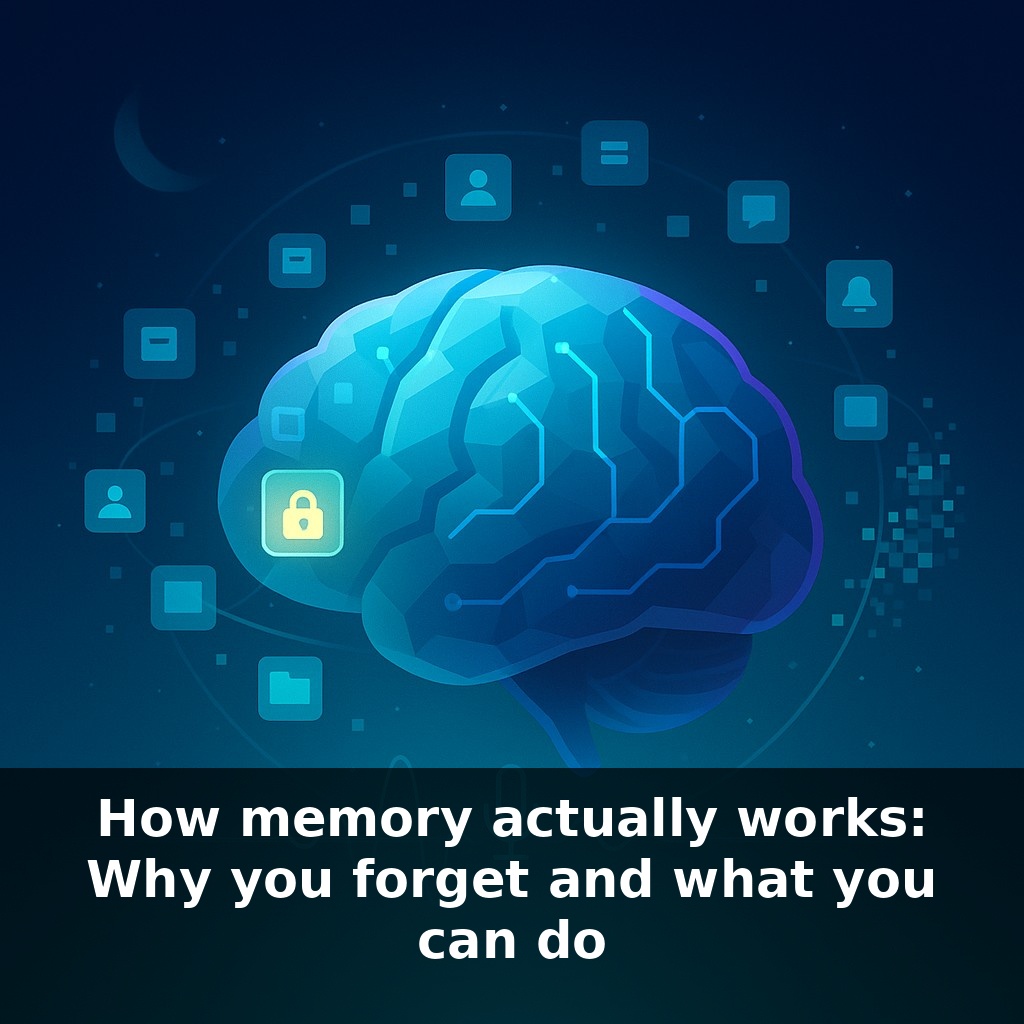
To do that, we need to zoom in on *how* an experience makes it from “just happened” to “I can still recall this next month.” Modern neuroscience breaks this into a few stages: first, your brain has to encode the moment, turning sights, sounds, and ideas into neural activity. Then, over minutes to days, that activity is stabilized and reshaped through consolidation, which literally changes the strength and pattern of connections between neurons. Finally, when you “remember,” you’re reconstructing the event by reactivating parts of that original pattern, often scattered across different regions of the brain.
Your brain’s memory system is less like a single “storage box” and more like a relay team handing information from one stage to the next, each with its own strengths and weak spots.
First up is *working memory*—the tiny mental space where you hold a phone number long enough to dial, or keep the first part of a sentence in mind while you read the end. It’s fast and flexible, but extremely limited: most people can juggle only about four meaningful chunks at once. Overload it, and things simply never move on to a more durable form.
Next is *short‑term to long‑term transfer*, where the hippocampus plays a key coordinating role. It doesn’t “store” the memory forever; instead, it helps link together the sights, words, emotions, and locations represented in different brain areas into a pattern that can later be re‑ignited. When this pattern is new and fragile, it’s vulnerable to disruption: distraction, stress, or trying to learn something very similar right afterward can interfere with the handoff.
Then there’s *consolidation over time*. As hours and days pass, your brain literally remodels synapses—strengthening some, weakening others, sometimes adding new connections. This is metabolically expensive: about 20 % of your body’s energy budget is going into keeping these networks running, which is one reason your brain can’t keep everything. It prioritizes patterns that are used, useful, or tied to strong cues.
Meanwhile, *interference* is constantly at work. Learn a new password and suddenly the old one feels shaky; meet three people in a row and their names blur. New patterns that overlap with old ones can crowd or distort retrieval, even when the original trace is still there. That’s part of why cramming similar material back‑to‑back feels confusing: you’re asking overlapping networks to reorganize all at once.
On the flip side, *spacing* similar material—coming back to it after hours or days—takes advantage of that same plasticity. Each revisit reactivates the pattern under slightly different conditions, making it more flexible and easier to find later.
Now add *state and context*. Your brain quietly records not just what you encountered, but where you were, how you felt, even whether you were rushed or relaxed. Those details become hooks. Change enough of them, and recall can drop, even though the trace exists. Match them, and memories snap into place with much less effort.
Think about yesterday: you might recall a random joke from lunch but not the exact wording of three emails you wrote. That’s not just about emotion or repetition; it’s also about *how* those bits of experience were woven into a larger story your brain cares about.
Concrete example: two students study the same article. One just rereads it. The other pauses after each section and asks, “How would I explain this to a friend who disagrees?” The second student isn’t just reviewing; they’re forcing their brain to link ideas to arguments, prior beliefs, and likely questions. A week later, they remember more—not because they “tried harder,” but because they built a richer network around the same content.
Or consider names. Meeting “Jordan from IT” and immediately asking, “What’s the weirdest bug you’ve fixed?” gives your brain extra hooks: a story, a role, a tiny burst of curiosity. Next time you see them, that cluster makes the name easier to pull up.
Analogy: it’s like learning a new song by playing it with different bands—in each setting, you discover new ways into the same melody.
Future tools may let you *steer* what sticks, not just react to what you happen to remember. Building on how our memory selects what to Building on our understanding of how memory works, neuromodulation and brain–computer interfaces hint at calendars that don’t just ping you, but sync with your mental priorities, like a smart editor quietly bolding certain lines in a draft. Your challenge this week: notice which digital tools already shape what you recall—search, photos, chats—and ask: did I choose this emphasis, or did the tool choose it for me?
So the real experiment here isn’t to “hack” your brain, but to collaborate with it. Each choice—when you review, how deeply you engage, whether you rest or rush—nudges the spotlight. Over the next episodes, we’ll layer on tools, like tuning an instrument: tiny adjustments that, together, can turn scattered notes into something you can reliably play back.
Before next week, ask yourself: 1) “If my brain only remembers what it thinks is ‘important,’ what are the 3 things I most want it to prioritize this week, and how can I quickly connect each one to a strong emotion, story, or personal goal so it actually sticks?” 2) “The next time I learn something (a fact from a book, a work concept, a name), how can I force myself to recall it later today—without looking it up first—so I’m training my brain’s retrieval muscles instead of just rereading?” 3) “Where in my day (for example, right after lunch or before bed) can I add a 3-minute ‘memory check-in’ to mentally revisit what I learned earlier, and what’s one tiny cue (a phone alarm, sticky note on my laptop) I can set up right now so I don’t forget to do it?”