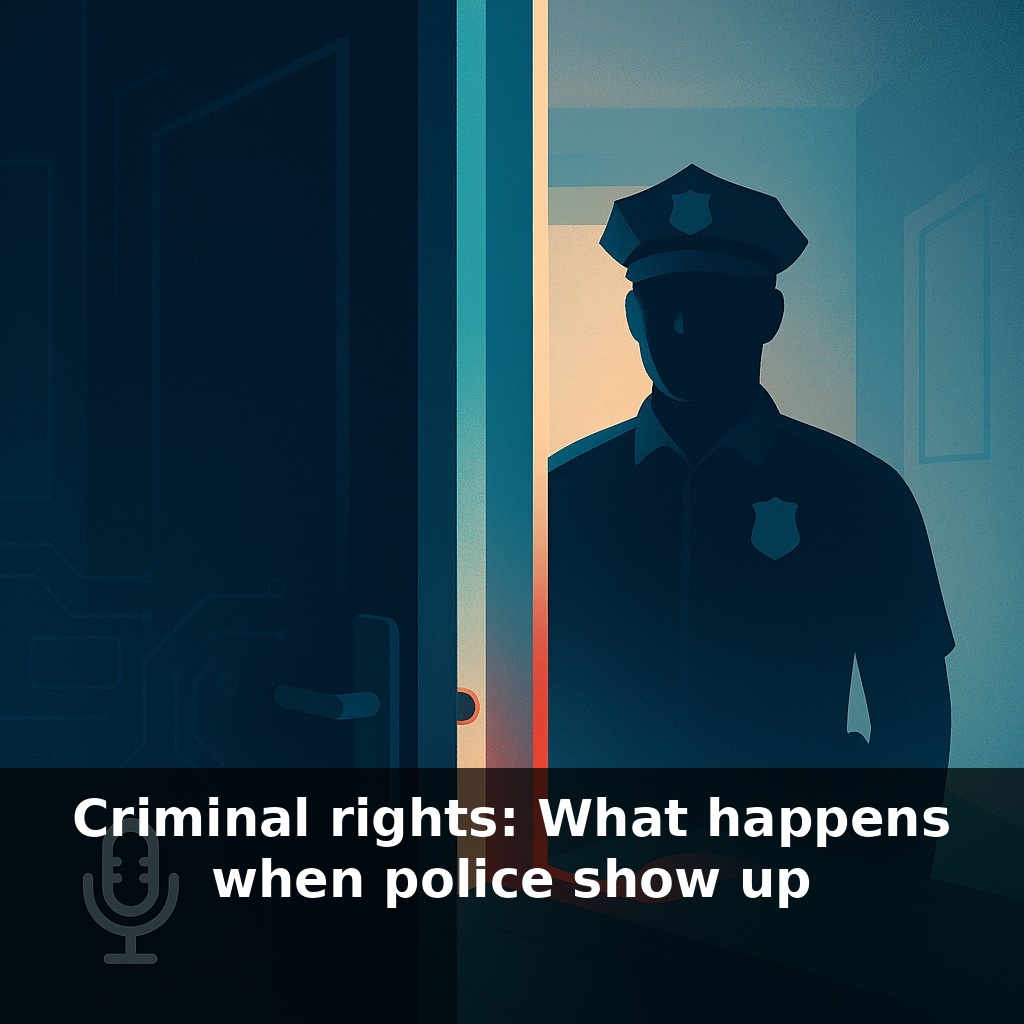
A police officer can knock on your door, ask casual questions, and walk away—without it ever being an “official” stop. But here’s the twist: the moment you don’t feel free to leave, your rights change dramatically. This episode is about that blurry line.
Roughly 95% of criminal cases in the U.S. never make it to trial—they end in plea deals, many shaped by what people said in those first tense minutes with police. In other words, what happens when officers first show up often matters more than what happens months later in a courtroom. This episode zooms in on that moment: the knock on your door, the flashing lights in your mirror, the tap on your shoulder in a parking lot. We’ll look at how a casual conversation can quietly shift into a situation where your words, your body language, and even what’s visible on your phone screen can be used to build a case. Think of it like playing in a band: once the police “set the tempo” of the interaction, you need to know when to play along—and when to stop playing entirely. Your goal isn’t to win an argument; it’s to avoid giving away the whole song.
Here’s where things get tricky: police don’t have to announce, “This is now a detention,” or, “You’re under arrest,” the moment your legal status shifts. The law focuses less on the officer’s words and more on what a “reasonable person” would think in that situation—could you actually walk away, or would leaving risk handcuffs, force, or new charges? At the same time, technology is quietly shaping these encounters. License plate readers, body cameras, and real-time database checks can turn a simple knock or traffic stop into a focused investigation in seconds, often before you realize the stakes just changed.
Most encounters start the same way: someone in uniform asks a “quick question.” What happens next depends on which of three legal buckets you’re actually in—consensual contact, detention, or arrest—and the law quietly changes the rules at each step.
In a consensual contact, officers can walk up, knock, or wave you over on the street. You can decline to talk and walk away, and they don’t need any specific reason to start that conversation. Here’s the catch: they can use anything they observe—your answers, your smell, what’s in plain view—to build a basis for moving into the next bucket.
A detention kicks in when officers have reasonable suspicion that something specific and unlawful is going on and they restrict your movement, even slightly. You might be told to sit on a curb, step out of your car, or wait by the patrol vehicle. You’re not free to leave, but you’re also not necessarily under arrest. During this phase, they’re allowed to ask focused questions and, in some situations, do a limited pat-down for weapons. Small details—nervous movements, inconsistent answers, data from a quick computer check—can be used to justify prolonging the stop or escalating it.
An arrest is the point where officers believe they have probable cause that you committed a crime. Handcuffs and a formal statement of “you’re under arrest” are strong clues, but the label can apply even without them if you’re fully restrained and being taken somewhere against your will. Once you’re in that box, the stakes rise: your statements, your phone, your bag, even your car may become targets for search, often with fewer hurdles for police to clear.
Throughout all three stages, your rights don’t appear automatically; courts expect you to assert them clearly. A calm “Am I free to leave?” helps reveal which bucket you’re in. “I do not consent to a search” draws a line if officers are probing for permission. And once questions turn accusatory, stating “I want to remain silent, and I want a lawyer” is the legal equivalent of hitting the brakes before momentum—and technology—carry the encounter somewhere you never intended.
Think of your rights like sheet music you bring to a jam session: the notes are written, but you still have to decide when to play them. For example, an officer at your door might say, “Mind if I take a quick look around?” That sounds casual, but it’s actually a legal fork in the road. A clear “No, I don’t consent” preserves options your lawyer can use later; a shrug or nervous “uh…sure” usually can’t be unwound.
On the street, an officer might say, “We can clear this up faster if you just explain.” You can respond with, “I’m not answering questions,” and then stop talking—even if the silence feels awkward. Courts pay attention to your exact words; fuzzy answers like “Maybe I should get a lawyer” don’t trigger the same protections as “I want a lawyer.”
During a traffic stop, you might be asked, “You don’t have anything illegal in the car, right?” That’s not idle chatter; it’s a probe. A calm, “I’m not discussing my day, officer,” followed by, “Am I free to go?” helps mark the boundary between cooperation and self‑incrimination.
Police encounters will soon feel less like a brief snapshot and more like a full-length documentary. As AI tools stitch together body‑cam feeds, transcriptions, and location trails, tiny slips—a stray word, a gesture, a glance toward your bag—could be replayed, slowed down, and interpreted months later. That cuts both ways: patterns of officer behavior become easier to prove, but so do patterns in your responses if you ramble instead of clearly invoking your rights.
In the end, the goal isn’t to “outsmart” officers; it’s to leave fewer loose threads for others to pull later. Treat those key phrases—“Am I free to go?”, “I don’t consent,” “I want a lawyer”—like tuning an instrument before a set: small, deliberate adjustments that keep everything from sliding off‑key once the spotlight—and the record button—turns on.
Before next week, ask yourself: If police knocked on my door tonight, what exact words would I use to clearly say “I’m not answering questions without a lawyer” and “I do not consent to a search,” and could I say them calmly twice if they pressured me? Do I actually know the difference between being “detained” and “under arrest,” and what exact question would I use—out loud—to clarify (“Am I free to leave?”) in a real interaction? Who are two people in my life (family or roommates) I should talk to this week so we’re all on the same page about what to do if police show up—what would I want each of us to say and *not* say?