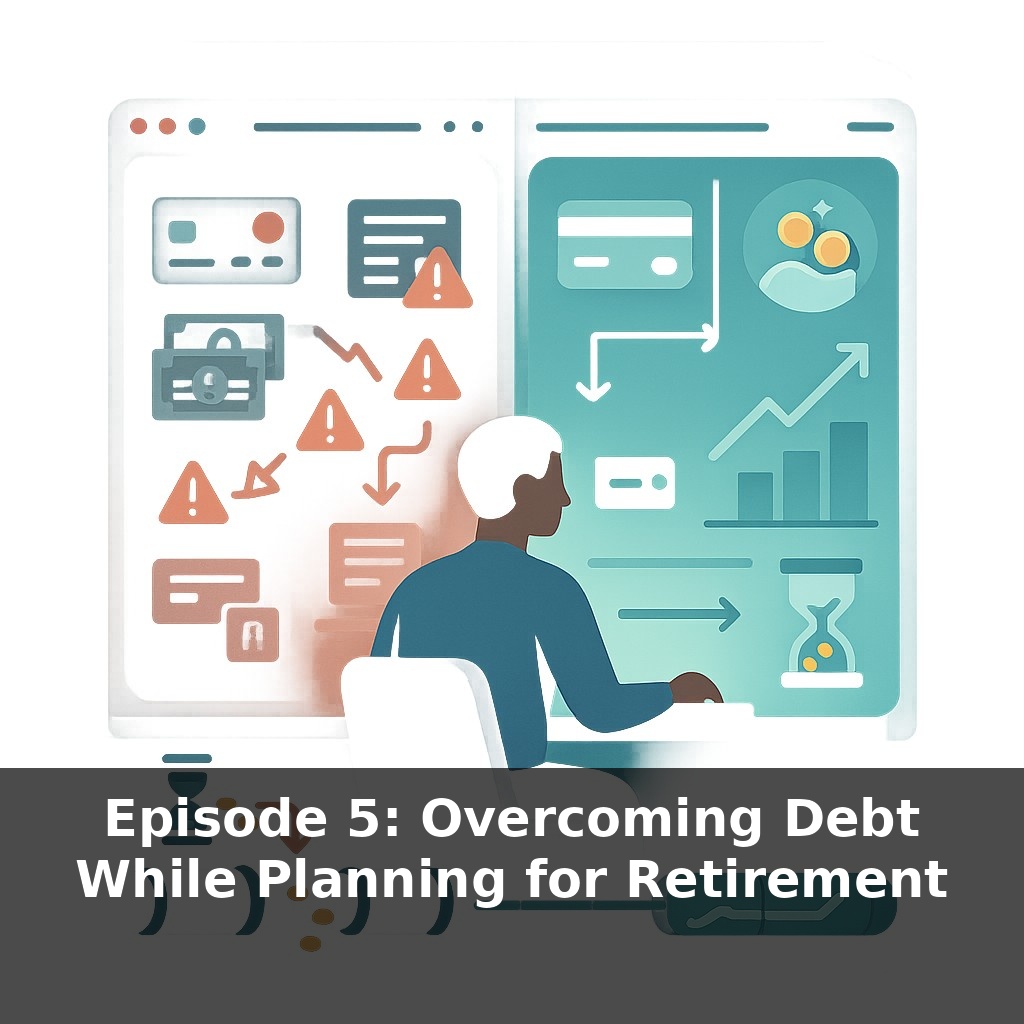
About half of people with credit card balances also say they “can’t afford” retirement saving. Yet many of them are still walking past free money from their employer match. In this episode, we step into that tension and ask: is your debt quietly stealing your future?
Here’s the uncomfortable truth: most people don’t actually have a “debt problem” or a “retirement problem” — they have a sequencing problem. Money comes in, bills go out, and whatever’s left feels too small to matter, so it just… evaporates. Over years, that pattern quietly hardens into lifestyle cement: subscriptions you forgot about, “temporary” expenses that became permanent, raises that vanished without improving your future at all.
In this episode, we’re not chasing perfection or some extreme payoff-everything-then-start-saving purity test. Instead, we’ll map out how to layer your decisions so each dollar has a job and a timeline: which debts to attack first, how to grab only the most powerful forms of saving, and how to adjust the mix as your balances shrink—without feeling like you’re living on financial hard mode.
So instead of asking “debt or retirement first?”, we’re going to zoom out and look at how fast each dollar is moving for or against you. Some parts of your money life act like wet cement that never fully dries—think variable-rate loans that can jump, or buy-now-pay-later plans that quietly reset your baseline. Other parts are more like scaffolding you can climb: digital tools that track where your cash leaks, autopay rules that move money before you see it, low-cost index funds that quietly compound in the background. In this episode, we’ll connect those moving pieces into a simple, tiered game plan you can actually run.
Think of this as building a three-story money blueprint, not choosing a single “perfect” move.
On the ground floor is stability. Before worrying about optimization, you need enough slack that one flat tire or vet bill doesn’t send you back to the card. That usually looks like: a small cash buffer (even $500–$1,000), all bills on-time, and no new borrowing to cover ordinary living. If that feels impossible on your current income, that’s a signal to zoom in on cash flow, not to abandon retirement entirely.
The second floor is where the math starts to matter more. List every debt with balance, rate, and minimum. Now sort by interest rate, not by balance or emotion. Anything above roughly the long‑term stock market return (often estimated around 7–8% after inflation) is actively undoing your future. Those are your “priority” debts. Under that line? They’re more like a fixed cost of living that you’ll phase out over time.
This is also where consolidation can be useful—not as magic, but as a tool. Moving a cluster of high‑rate balances into one lower‑rate personal loan or 0% promo card can tilt the math in your favor, especially if you lock in a fixed payoff schedule. Done right, utilization drops, payments become predictable, and your credit profile can actually improve. Done wrong—keeping old cards and reusing the freed‑up room—it just resets the trap.
On the top floor is acceleration. As each account hits zero, you don’t “get a raise” in lifestyle. You reassign that exact payment to the next target or to your future self. This is where retirement contributions start to climb from “bare minimum to not miss free money” into numbers that actually move the needle: 10%, 15%, sometimes more as income rises and obligations fall.
Here’s where timing plays a quiet but huge role. A dollar funneled into investments in your twenties or early thirties has decades to work; a dollar deferred into your forties or fifties is sprinting to catch up. That doesn’t mean you ignore expensive borrowing, but it does mean you’re looking for ways to shorten the high‑interest phase so the compounding phase gets as much calendar as possible.
The last layer is automation plus guardrails. Once you’ve sketched your three floors—stability, priority payoff, acceleration—you translate each into specific system rules: how much flows where, on what date, and under what conditions you’ll temporarily pause one goal to protect another. Over time, you’ll adjust those rules less by willpower and more by design, as if you’d pre‑programmed your future decisions while your head was clear.
Think of your money plan the way an architect thinks about converting an old warehouse into lofts. They can’t bulldoze the whole thing (that’s the “pay off everything first, then start saving” mindset), but they also can’t just slap in granite countertops and hope the foundation holds. They start by shoring up the weakest beams, then gradually re-route space and light.
For you, that might look like someone earning $70,000 with a 4.5% 401(k) match, a car loan at 5%, and a few higher‑rate balances. Instead of maxing retirement or throwing every spare dollar at every balance, they lock in the match, attack only the most punishing rates, and let the car loan just amortize quietly in the background. Each time a balance disappears, their “renovation budget” gets reassigned to either the next structural fix or extra investing.
Over a few years, the floor plan of their finances changes: fewer required payments, more optional contributions, and more daylight—space—between income and expenses.
A quiet shift is coming: policy, software, and culture are starting to treat debt payoff and retirement saving as one connected system instead of rival goals. Picture future paychecks sliced like a smart pie chart—AI tuning the mix in real time as rates, income, and even your stress levels change. As student‑loan norms fade and high‑school finance courses spread, the “I’ll start later” story may sound as outdated as paper stock certificates. Your edge is practicing that future logic now.
Your finances won’t change in one dramatic montage; they’ll shift through small, repeated experiments. Try treating each raise, bonus, or side‑gig dollar like a limited ingredient: some goes to flavor today, some gets slow‑cooked for later. Over time, those quiet tweaks reshape your options—more flexibility at work, less pressure at home, and room to choose, not just cope.
Before next week, ask yourself: What’s one high‑interest debt I could realistically commit to paying an extra $25–$50 toward this month, and what specific expense (like eating out, streaming, or impulse Amazon buys) am I willing to cut to free that money up? If I set a target retirement age and a ballpark monthly income I’d like to have then, how does that compare to what I’m currently saving in my 401(k)/IRA, and what exact percentage bump (even 1–2%) could I start with on my very next paycheck? Looking at both my debt payoff and retirement goals together, which matters most to my peace of mind right now, and how can I consciously balance them this week—rather than letting the loudest worry make the decision for me?