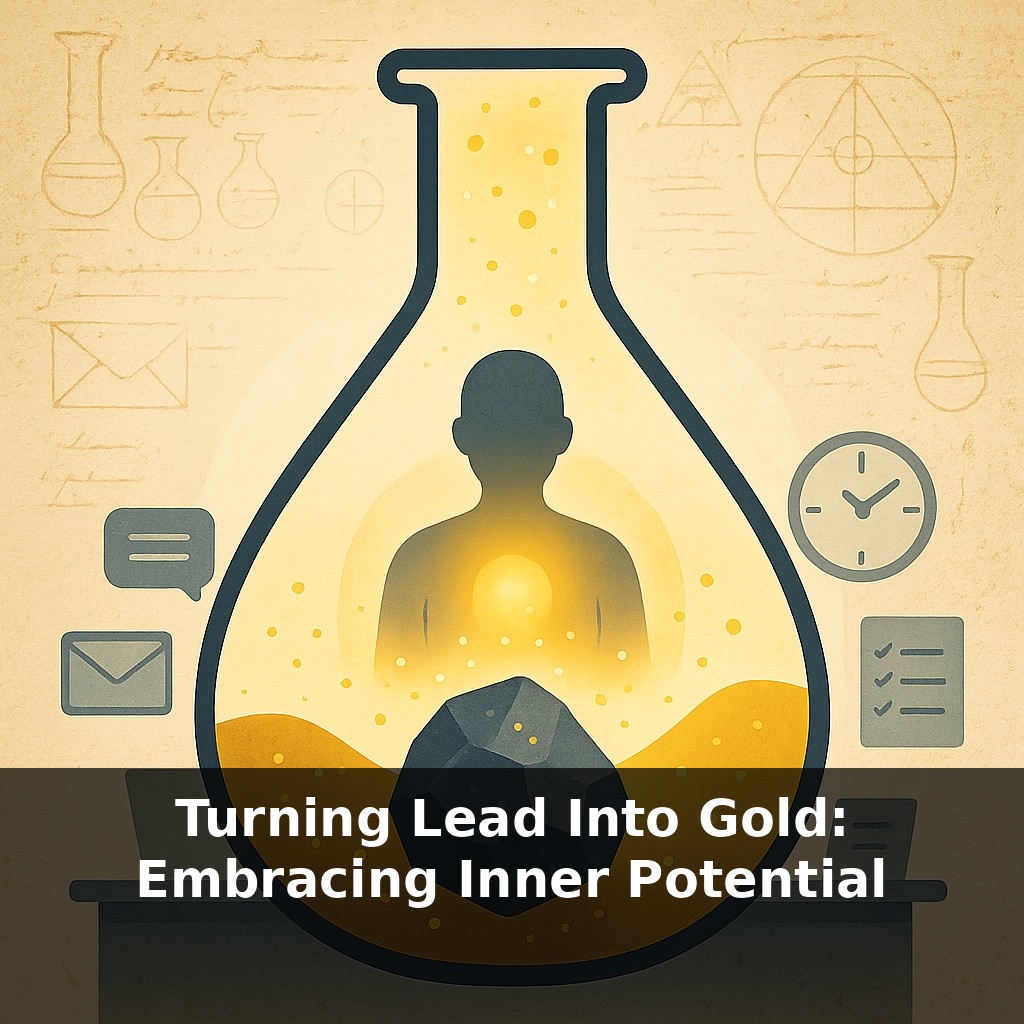
A lab once turned lead into gold—and lost money doing it. Now, jump to you: racing between emails, second-guessing yourself, sensing there’s more in you than your daily routine shows. Here’s the twist: the “lead” in your life might be the raw material you’ve been avoiding.
Most people think transformation arrives as a lightning bolt—an epiphany on a mountaintop, a life-changing book, a perfect mentor who finally “sees” them. In reality, it usually starts with something less glamorous: noticing the patterns that quietly run your days. The way you shut down in conflict. The project you never quite finish. The compliment you instinctively deflect. These aren’t random quirks; they’re clues.
Modern neuroscience shows your brain is constantly rewiring itself in response to how you focus, choose, and recover. Every time you respond differently—pause instead of react, ask instead of assume—you’re nudging that wiring. Over time, those tiny nudges add up, often faster than you’d expect.
In this episode, we’ll treat your fears, frustrations, and unused talents as signals, not defects—and begin mapping where they’re trying to steer you next.
So where do we actually start? Not with fixing yourself, but with learning to read yourself. Think of your day like a medieval city map: busy markets, quiet alleys, gates that slam shut at night. Certain people, tasks, or situations reliably pull you toward tension, boredom, or a strange surge of energy. Those are not accidents; they’re coordinates.
In this series, we’ll borrow from historical alchemists, modern psychology, and real reinvention stories to decode those coordinates—so you can spot where your “lead” piles up and where the first glints of “gold” already leak through.
Most people rush past their own “coordinates” because they don’t look important while they’re happening. You’re in a meeting, someone questions your idea, and your chest tightens. You’re halfway through a creative project and suddenly feel an urge to reorganize your files instead of finishing. A friend praises your work and you hear yourself say, “Oh, it’s nothing.” Moments like these are usually dismissed as mood, stress, or personality. They’re actually entry points.
Here’s a simple way to work with them: separate signal from story.
The signal is what your body and behavior are doing right now: a knot in your stomach, a racing mind, going silent, talking too much, opening ten tabs, reaching for your phone. It’s concrete and observable.
The story is the instant explanation that rushes in: “They think I’m stupid,” “I always mess this up,” “If I slow down, everything will fall apart.” Stories feel like facts, but they’re more like old scripts you’ve rehearsed so often they play automatically.
Alchemy, at its best, wasn’t about denying base material; it was about subjecting it to heat, separation, and recombination until something new emerged. Psychologically, “heat” is the willingness to stay with a signal long enough to notice it clearly, without immediately obeying the story it drags in.
Three useful questions in the moment:
1. What is my body doing right now? (List specifics.) 2. What action am I about to take next if I don’t interrupt this? 3. What story am I telling about what this means about me?
You’re not trying to erase the reaction; you’re trying to see the pattern while it’s live. That’s where choice becomes possible.
Think of an artist studying rough charcoal sketches before starting an oil painting. The smudges and stray lines aren’t failures; they reveal where the hand naturally moves. Your “lead” shows up the same way: in the tendencies you don’t consciously choose but keep repeating.
You might notice, for example, that every time you’re close to finishing something important, you suddenly remember smaller tasks that “must” be done first. Or that when someone is upset with you, you default to fixing, joking, or disappearing.
Once these micro-moments are visible, we can begin experimenting with tiny, deliberate shifts—not to become a different person, but to uncover a truer version of the one who’s already there.
A useful clue is how your “default setting” shows up in different environments. At work, maybe you’re the reliable one who never says no. With friends, you’re the listener who rarely shares what’s really going on. Alone, you suddenly feel drained and strangely irritated. Those aren’t random moods; they often sit on top of something you haven’t given language to yet.
Notice the situations that leave you with emotional “aftertaste.” A quick check-in: do you feel heavier or lighter than before? Heavier usually means you crossed an inner line—agreed to something you didn’t want, held back a question, or pretended not to care. Lighter often follows when you take a small risk that matches your values, even if the moment itself was awkward.
Real change tends to hide inside these subtle shifts: the email you send five minutes earlier instead of stalling, the honest sentence you add at the end of a conversation, the moment you stay present instead of escaping into your screen. Tiny moves, but repeated, they redraw your internal map.
Future implications stretch beyond self-observation. As neurofeedback tools shrink and soften into everyday wearables, your subtle shifts could be mirrored back like a live weather report for your inner climate, nudging course-corrections in real time. AI systems may eventually suggest “next experiments” based on thousands of similar journeys—more like a wise trail guide than a drill sergeant—while ethical research explores safe catalysts that accelerate insight without overriding your own pace.
Treat this week like entering a new city at dusk: streets familiar, details newly sharp. Let odd tensions or sparks of curiosity be your streetlights. Follow one each day—ask a bolder question, leave one thing imperfect, say no once. These small detours, repeated, quietly redraw where your life is actually heading next.
Start with this tiny habit: When you notice your “inner critic” say something like “I’m not talented enough” or “Who am I to do this?”, quietly add the words “...and I’m still learning to turn this into gold” right after it. Do this once a day, even if you don’t fully believe it yet. Over time, you’ll train your mind to see your self-doubt as raw material, not a verdict.