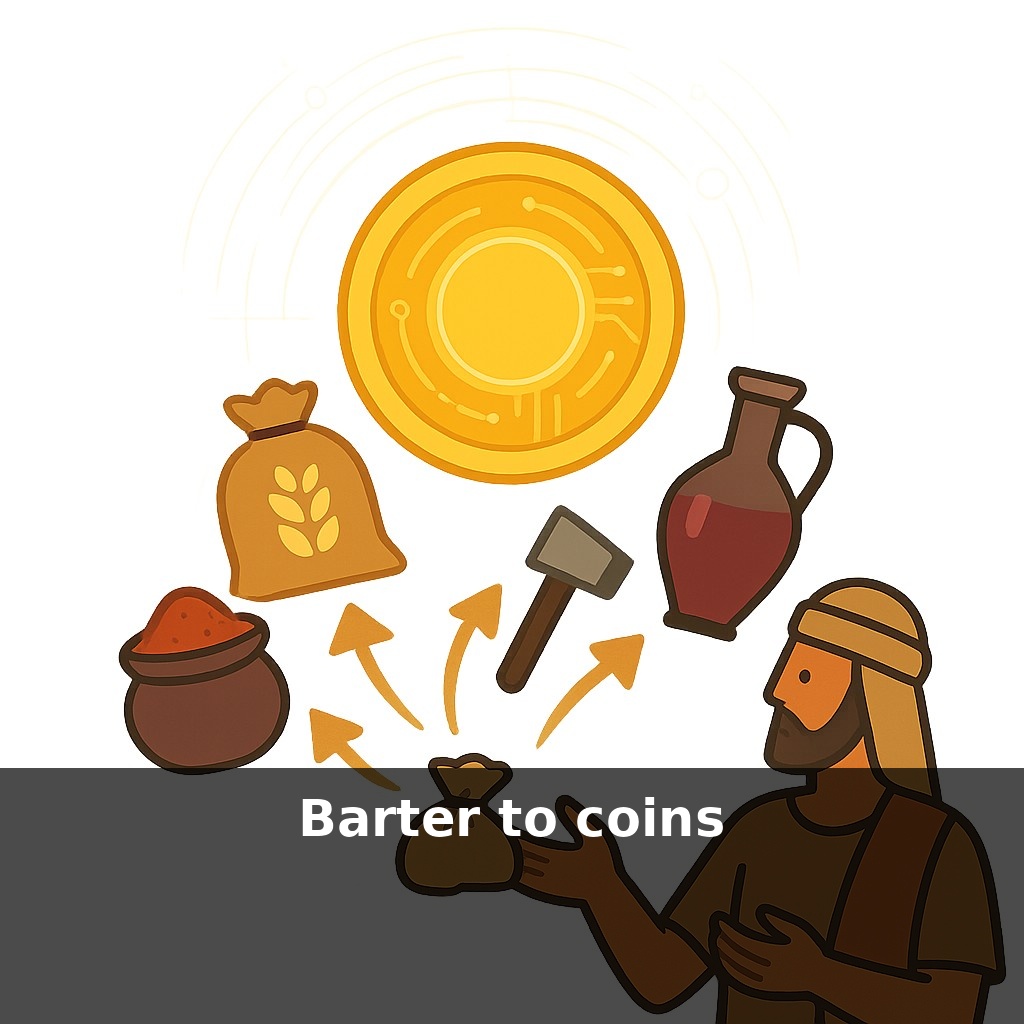
A merchant stands at a crowded port, holding grain no one nearby wants—yet spices, wine, and tools surround him. Trade is booming, but he’s stuck. Here’s the puzzle: how did ancient societies turn this kind of daily frustration into the first real “money technology”?
At first, people tried to solve the merchant’s problem by stretching barter rather than replacing it. Villages kept running tabs in clay tablets, temples recorded who owed grain after harvest, and palaces acted like giant clearing houses. Debt and credit appeared long before coins—more like a permanent “tab” at your local café than a pile of cash on the counter. But as caravans pushed across deserts and ships crossed open seas, these local promises stopped working. A Sumerian trader in Dilmun couldn’t rely on a temple back home to guarantee his deal. Long-distance exchange needed something portable, durable, and widely trusted. That’s when societies began to lean on special goods—grain, cattle, shells, metals—not just as things to use, but as tools to settle accounts across distance and time.
So different cultures started treating certain goods as better “tickets” into the trading system. In Mesopotamia, weights of silver and barley became standard entries in contracts; in early China, strings of cowrie shells showed up in tombs and ledgers; in the Aegean, lumps of bronze circulated alongside livestock and grain. These weren’t yet coins, but they were more than ordinary stuff. Authorities began setting official weights and fines in these units, quietly turning everyday objects into shared measuring sticks for value and obligation that could stretch across regions and generations.
The next leap wasn’t just picking special goods—it was learning to **standardise, package, and brand** value.
Early on, that standardisation stayed abstract. In Mesopotamia, the “shekel” wasn’t a coin you could jingle; it was a weight. Scribes might write that someone owed “30 shekels,” meaning a precise mass of silver, but in practice people paid with whatever pieces they had, weighed out on scales. The unit was fixed; the form was loose. Similar patterns appeared elsewhere: Chinese officials counted out cowries in fixed bundles; Near Eastern contracts listed obligations in carefully defined measures of metal and grain.
That flexibility worked—until it didn’t. Weighing every payment slowed markets. Shaving tiny curls off metal bits invited fraud. And as rulers raised armies and built walls, they ran into a bottleneck: how do you collect predictable taxes and pay thousands of soldiers using only weighed scraps and local customs?
Some states tried tightening control over raw materials. Athens, for example, leaned hard on the silver from the Laurion mines. By the 5th century BCE, that flow was so steady it could underwrite a fleet of roughly 200 warships. Silver wasn’t just treasure; it was a logistics system. Yet even there, weight-based payments and miscellaneous ingots created friction. The material was powerful, but the interface was clumsy.
Sometime around 630–600 BCE in Lydia, officials pushed the idea further. Instead of leaving each transaction to the scales, they pre-weighed lumps of electrum and stamped them with a royal mark. Now a piece didn’t just *contain* metal; it carried a promise: “This mass, this quality, guaranteed by the state.” Traders no longer had to test and haggle over every nugget. They could read value at a glance.
From that point, innovation accelerated. Neighbouring cities minted their own pieces, often with symbols instantly recognisable in foreign ports. Units like the stater, drachma, and later the denarius tied abstract accounts to tangible, countable objects. Crucially, the imprint on the surface could matter as much as the substance beneath. Over time, rulers experimented with cheaper alloys, smaller fractions, and different designs, exploring how far political trust could stretch the metal.
As coins spread, they linked distant markets into something new: a world where obligations, prices, and even social status could be expressed in numbered units that fit in a purse, crossed borders, and outlived their makers.
Across regions, coins turned abstract promises into something you could count, stack, and move fast. A Lydian stater could pass through many hands in a week: a miner’s wage on day one, a horse on day three, rent on day five. Each transfer silently updated who owed what, without a scribe in sight. Greek poleis took this further. Athenian owls, struck from local silver, didn’t just fund trireme crews; they became a trusted unit in foreign ports from Egypt to the Black Sea, smoothing deals between strangers who shared no language or law.
In early China, bronze spade and knife money linked farmers, artisans, and officials into the same accounting web. Even when shapes varied wildly, consistent markings let markets treat them as interchangeable units rather than curiosities. Over centuries, rulers learned they could alter alloys or reduce precious content yet keep the face value—until trust snapped. The Roman denarius shows this arc clearly: as silver content slid, people began hoarding older pieces and discounting new ones, revealing that the real power of coinage lay not only in metal, but in belief that the stamp still meant what it claimed.
Lydian-style coinage hints at our own trajectory. Today’s “coins” may be lines of code, but they still need visible standards, quick verification and a shared story of why they’re worth anything. Think of how app store ratings guide you toward trusted software; symbols on money do similar cultural work. As CBDCs or new tokens emerge, whoever controls those symbols and the rules behind them will quietly shape which exchanges flourish—and which retreat into the shadows.
Coins didn’t end the story; they set its rhythm. Once value could jingle in a pouch, rulers could time taxes like harvests and traders could “score” profits across seasons, much like musicians riffing within a shared scale. The next twists—paper, ledgers, digital wallets—keep asking the same question: who gets to write the notes everyone else must trade to?
Before next week, ask yourself: “If I had to ‘barter’ my current skills or time today, what three concrete things could I realistically trade for value (e.g., tutoring, design help, fixing something, introductions)?” Then ask: “Looking at those three, which one could most naturally be turned into a ‘coin’—something people would actually pay cash for instead of trading favors—and what tiny, real offer could I put in front of one person this week to test it?” Finally: “If someone did pay me for that, what simple, repeatable ‘price tag’ or package could I create so it doesn’t stay a one-off barter-style deal but starts to look like an actual mini-business?”