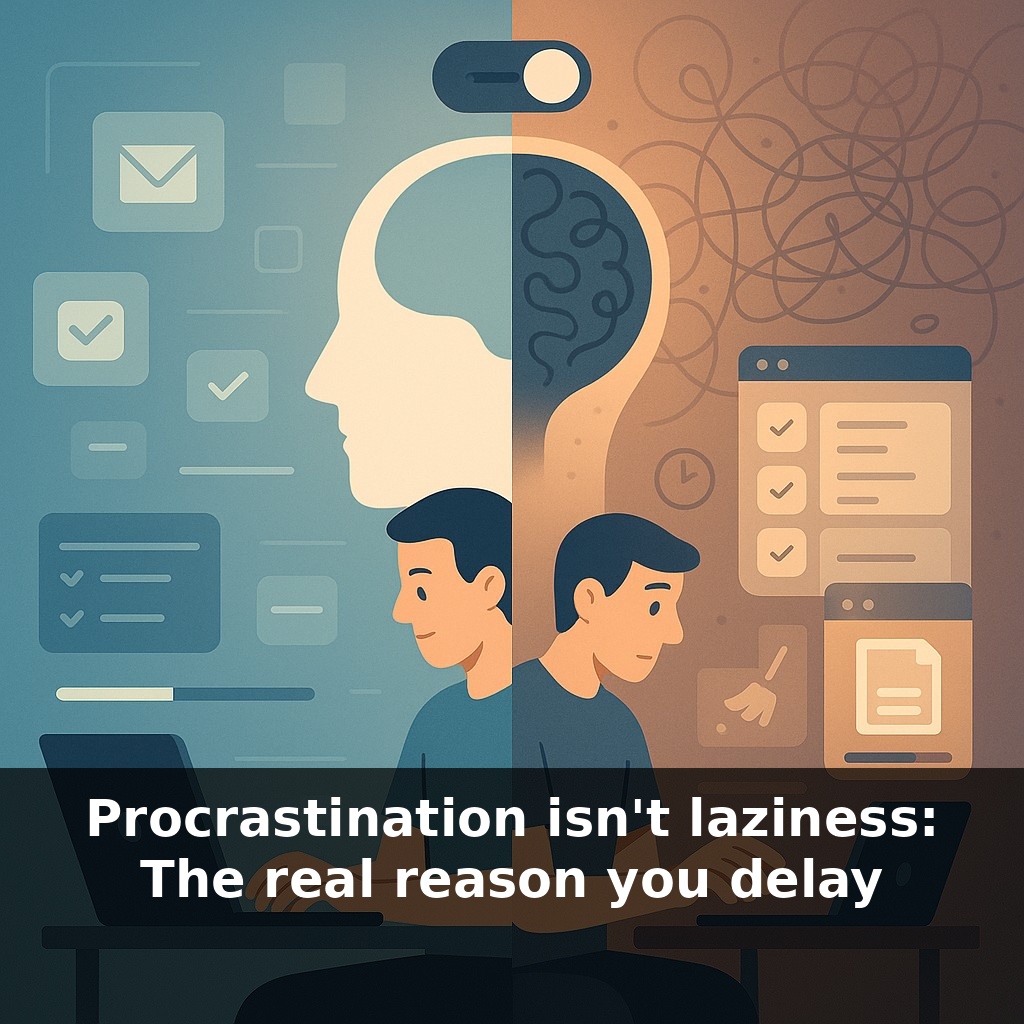
About one in five adults regularly delay important tasks—even when it clearly makes life harder. You’re not lazy at work, then heroic at the gym, then “broken” with your side project. Same brain, different emotions. So why does your motivation flip like a light switch?
Maybe you’ve noticed the pattern: you reply to every email instantly, but that one important proposal sits untouched for days. Or you’ll scrub the kitchen floor instead of opening a blank slide deck. Same workload, same brain—yet certain tasks seem coated in mental glue. That’s because your brain doesn’t treat all “later” the same. It quietly scans each task and asks, “How will this make me feel in the next five minutes?” If the answer is “stressed, stupid, exposed, bored,” delay becomes strangely attractive. So you drift toward tasks that feel smoother, like water following the easiest path downhill. Over time, this doesn’t just shift your schedule; it shapes your identity. You don’t just postpone a report—you start calling yourself “someone who never finishes things.” In this series, we’ll challenge that story and treat delay as data, not a diagnosis.
So if delay is data, what is it actually measuring? Researchers suggest it’s not “how disciplined you are,” but how safe a task feels to your nervous system. That untouched proposal might sit in the same folder as ten finished reports, yet your body tags it as risky: “What if this exposes me? What if I fail publicly?” Your brain quietly runs cost–benefit math on stress, not just on success. That’s why you can cruise through tedious chores yet freeze on one email that really matters—it’s less like poor time management and more like an internal fire alarm going off at the faintest smell of social or personal threat.
Here’s the twist modern research adds: the “data” in your delay isn’t just about fear or stress—it’s also about how your brain’s reward system is wired right now. Two people can look at the same task and feel totally different internal “pull,” not because one is morally stronger, but because their brains expect different payoffs.
Neuroscientists see this in brain scans: when you consider doing something unpleasant-but-important, one set of circuits lights up for the future reward, and another reacts to the immediate discomfort. When the discomfort signal is louder, you don’t just think, “I don’t want to do this”—your body quietly prepares to escape. That escape might look respectable (answering “quick” emails) or silly (scrolling videos), but under the hood it’s the same move: trade long-term benefit for short-term relief.
This is why people who love urgent deadlines swear they “work better under pressure.” The deadline doesn’t magically improve skills; it cranks up the short-term reward. Finishing now suddenly feels as immediately relevant as checking your phone. The work hasn’t changed. The timing of the payoff has.
Your history matters too. If, in the past, starting hard things often led to shame, criticism, or burnout, your brain learns a very reasonable rule: “Avoid that.” It’s not sabotaging you; it’s protecting you based on old evidence. So when you sit down to write, your heart rate jumps, your chest tightens a bit, and anything else—snacks, laundry, one more tab—seems wiser. The pattern is learned, not fixed, which means it can be retrained.
This also explains why self-attack backfires so reliably. When you call yourself lazy, you’re adding even more negative emotion to the task. Now starting doesn’t just risk boredom or failure; it also threatens another round of self-criticism. Your brain updates the file: “This task = pain squared.” No wonder you open a different app.
A more accurate question than “What’s wrong with me?” is “What does my brain think it’s protecting me from right now?” That shift sounds small, but it moves you from judge to investigator—and investigators can experiment their way into new evidence.
Think of two people facing almost the same project. One opens the file, feels a twinge of dread, but their mind quietly adds: “Last time you powered through something like this, your manager praised your creativity.” The other remembers only the red-ink critique and the sleepless night. Same task category, totally different emotional forecast, and their behavior diverges before a single sentence is written.
You can watch this in small, ordinary moments. A designer tweaks a logo for hours but keeps postponing the pitch where they must present it. A developer happily refactors old code yet sidesteps the new feature that would finally showcase their skills. A student color-codes a study plan while the actual reading waits untouched. In each case, the visible “stall” points to an invisible history: previous wins, hits to confidence, or unspoken expectations.
Artists fear “ruining” a promising idea, parents postpone tricky conversations, founders delay sending investor updates. The surface excuse varies—timing, energy, clarity—but underneath, your past outcomes quietly vote on whether starting feels safe enough today.
Procrastination will matter more, not less. As work gets flexible and project-based, tNow that we understand procrastination isn't about laziness, thNow that we've explored why procrastination isn't simply about laziness, it's important to consider how we can take control. There's no bell ringing to tell you when to start; you become your own timekeeper and coach. Rather than asking “How do I force myself?”, the better question becomes “How do I design my day so starting feels safer and more rewarding?” Expect future tools to feel less like timers and more like thermostats, gradually nudging your environment, energy, and expectations toward small, kinder beginnings.
Instead of promising a future “perfect you,” try treating each stall like a notification, not a verdict. Curiosity is your debugger here: zoom in, tag the trigger, and log what nudged you off track. Over time, these tiny field notes become a personal user manual—less like a strict schedule, more like sheet music tailored to how you actually play.
Before next week, ask yourself: “When I’m about to do that task I keep delaying (like answering that email, working on that project, or making that appointment), what *exact feeling* shows up in my body first—tight chest, knotted stomach, racing thoughts?” “If I quietly admitted the *real fear* underneath my procrastination (looking stupid, being judged, failing, losing control), what would I be most embarrassed to say out loud—and what tiny way could I experiment with being ‘good enough’ instead of perfect?” “Next time I catch myself scrolling or ‘researching’ instead of starting, what 10-minute ‘good enough’ version of the task could I try right then, just to gather information about how it actually feels compared to the story in my head?”