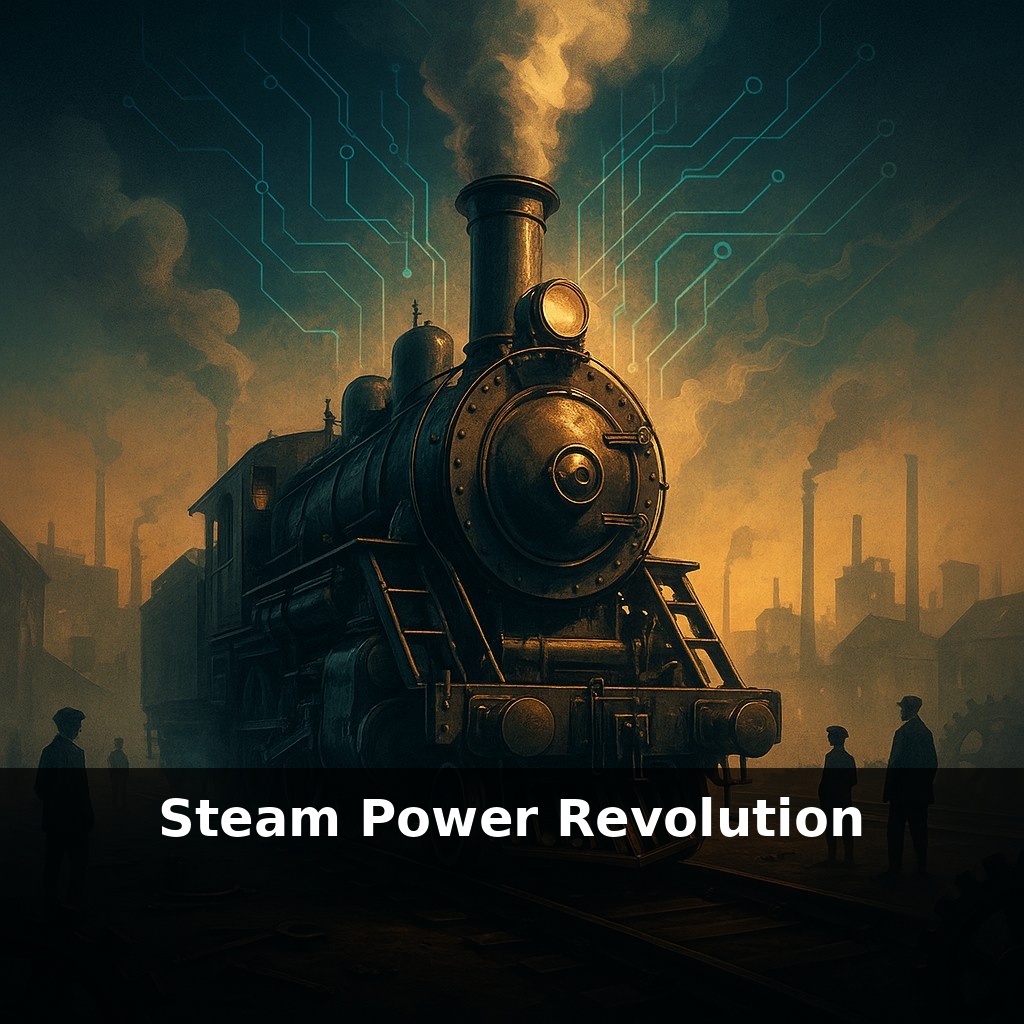
Steam engines in 1850 Britain did the work of more people than actually lived there. In this episode, we drop into sooty workshops, crowded train platforms, and roaring ship decks to follow one question: how did boiling water quietly rewrite what humans believed they were capable of?
Factories didn’t just get louder; they got stranger. Tasks that once needed a dozen skilled hands were suddenly run by one operator pulling a lever. A spinner who had trained for years could be replaced by a teenager in a few weeks. Streets swelled with people leaving farms, not because they stopped knowing how to grow food, but because a new kind of power made their old skills feel small, slow, almost embarrassing.
This was more than an upgrade in tools; it was a quiet earthquake in identity. A village blacksmith might wake up as a cog in a city workshop. A ship’s crew, once reading stars and winds, now followed timetables pinned like musical scores to the wall. The world didn’t ask, “Are you ready?” It simply moved the tempo faster—and anyone who clung to the old rhythm felt left behind, even if nothing was “wrong” with them.
Some people adapted by treating this new power like learning a new instrument: clumsy at first, then gradually finding a rhythm. Others froze, convinced the “real work” was still what their grandparents had done. City records from the 1820s show workers refusing higher-paying factory jobs because “no honest day’s sweat” was involved; they feared becoming the kind of person who watched gauges instead of swinging tools. Inventors, too, wrestled with this shift—James Watt agonized over critics who said his engines would “unman” labor, hollowing out character along with calluses.
Some of the loudest resistance didn’t come from technophobes, but from people who had built their entire sense of worth around being needed in a particular way. A master carpenter whose hands had always been his résumé now watched machine-cut boards slide out faster and more uniform than his best work on a good day. Town records show guilds petitioning against factories not just to “protect wages,” but to defend what counted as “real skill.”
Steam’s spread wasn’t smooth; it arrived in lumpy, uneven patches. One street might thrum with engines while, two miles away, everything still moved at the pace of boots and hooves. That unevenness produced a strange psychological gap. A weaver visiting a new mill could step into a building where a single contraption matched the output of an entire village—and then walk home to a cottage where nothing had changed. The dissonance wasn’t only economic; it forced people to hold two identities at once: capable in one context, obsolete in another.
The numbers made the shift harder to ignore. Reports from the 1830s show factory owners timing output in minutes instead of days, measuring humans against machines: “X workers per loom, Y yards per hour.” Success and failure were suddenly expressed as ratios, charts, and costs per unit. For many, this was a new and unnerving mirror. Instead of being “John, known for steady hands,” you became “output 17% below target this quarter.”
And yet, some people quietly used that same mirror to renegotiate who they could be. Clerk positions, maintenance roles, scheduling, logistics—jobs that barely existed before—opened doors for those whose bodies couldn’t endure twelve-hour shifts of lifting or standing. Parliamentary inquiries note injured soldiers and chronically ill workers moving into supervisory or technical posts that only existed because steam had centralized work under one roof.
A subtle pattern appears in letters from the period: those who adapted well often stopped describing themselves by their old trade and started naming what they contributed that the engines couldn’t—judgment, coordination, problem-solving. Instead of “I am a spinner,” you begin to see phrases like “I keep the frames from wasting thread” or “I make sure late deliveries don’t halt the line.” The job title stayed small; the sense of agency grew around it.
For anyone today who feels trapped in a fixed role—especially one defined by limitation—that historical pivot matters. It shows that external power didn’t automatically free people; what changed futures was the moment individuals stopped arguing with the existence of the new system and started asking a scarier, more creative question: given that this power is here, what becomes possible for me that wasn’t before?
Some of the most interesting shifts showed up in side rooms, not grand factories. Early railway offices needed clerks who could juggle timetables, coal deliveries, and ticket sales without derailing the whole system. Many of those hires weren’t star apprentices from old trades; they were people whose bodies or backgrounds had kept them on the margins. A former farmhand with a bad leg might become the person who now “makes sure trains don’t collide on market days.”
Think of a small town where the new depot arrives. One sibling takes a job shoveling coal; another, who faints in heat and can’t keep up physically, ends up in the telegraph corner, routing messages that keep hundreds of tons of metal moving safely. On paper, the coal-shoveler looks “stronger.” Yet when a storm hits, it’s the telegraph operator who reroutes everything and prevents a pileup.
Medicine offers a similar twist: a surgeon’s steady hands matter, but it’s often the planner who designs checklists and schedules that actually cuts complication rates.
Some of today’s “steam moments” are quiet: an app that predicts your pain flares, a wearable that flags exhaustion before you crash, a therapy protocol that turns vague fear into specific experiments. Early users don’t become “less sick” overnight; they become better system designers of their own lives. Your role shifts from patient to strategist—tuning schedules, meds, and boundaries like levers—while tech handles more of the raw effort in the background.
Your challenge this week: Run a seven-day “power audit” on your life, but with a twist. Each evening, list just three moments: 1) When you spent energy protecting your “sick person” role (e.g., turning down help you actually wanted). 2) When a tool or system quietly made something easier (med reminder, transit app, meal kit). 3) One tiny place tomorrow where you could let the system do 5% more, and your identity do 5% less.
You don’t have to rename yourself overnight. Think more like revising a map: old paths stay inked, but you draw new routes where trains now run. Let your tools be like extra musicians joining your band—filling in parts you’re tired of carrying alone. Over time, the question gently shifts from “What’s wrong with me?” to “What can this new arrangement help me do next?”
Before next week, ask yourself: 1) “If I suddenly had access to a cheap, reliable ‘steam engine’ of my own (a technology that dramatically multiplies my effort), which part of my work or life would I ‘mechanize’ first—research, repetitive admin, physical chores, or something else—and what specific tool could I test today to mimic that effect?” 2) “Looking at how steam power reshaped entire cities, what’s one ‘coal-burning factory habit’ in my life—an outdated, energy-intensive way of doing things—that I could start phasing out this week in favor of a more scalable, tech-assisted system?” 3) “If my career were at the pre-steam stage right now, what’s the ‘James Watt upgrade’ I’m avoiding—a skill, automation, or collaboration—that could radically increase my output, and what’s the smallest real-world experiment I can run with it before the week is over?”