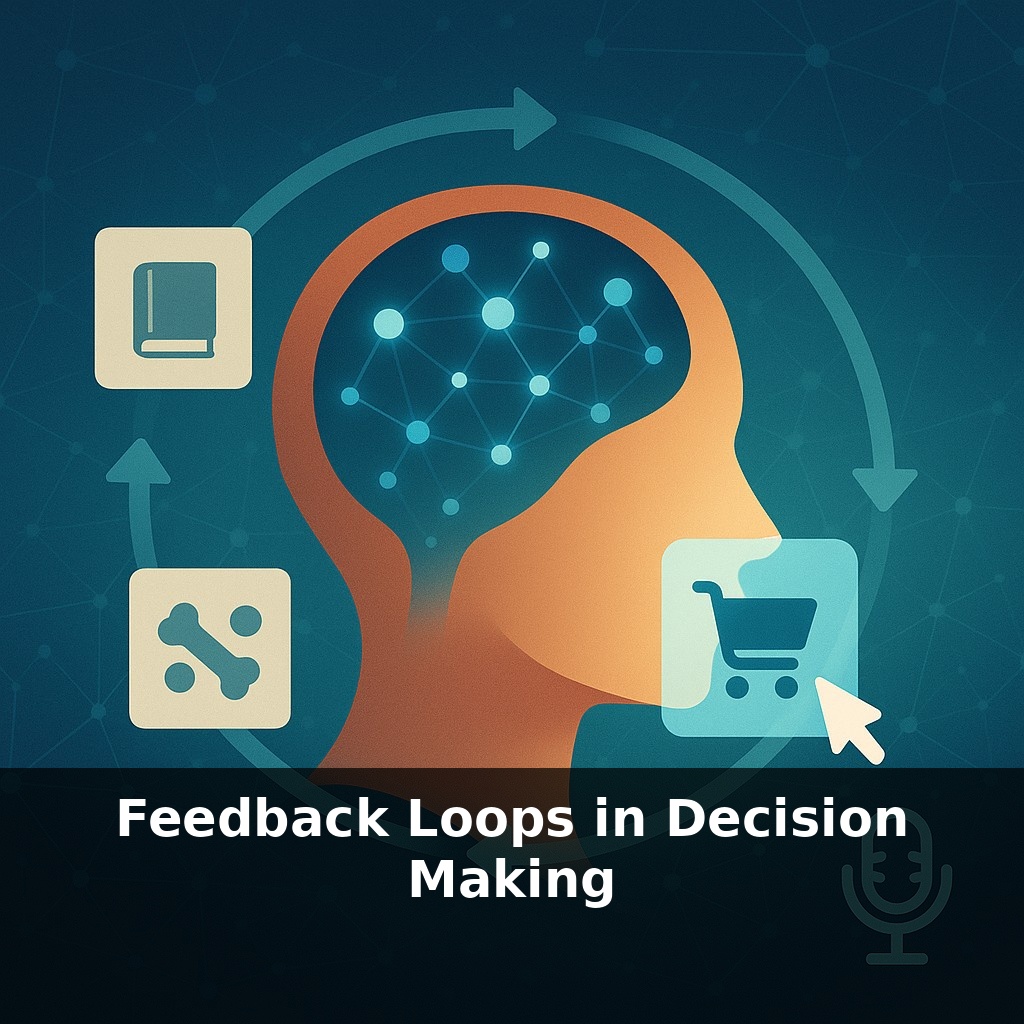
About a third of Amazon’s retail sales reportedly come from something most customers barely notice: its recommendation engine. You’re browsing books—or dog toys—and, quietly, an invisible loop is watching what you do, updating its guess, and nudging your next click.
About a third of Amazon’s retail sales reportedly come from something most customers barely notice: its recommendation engine. You’re browsing books—or dog toys—and, quietly, an invisible loop is watching what you do, updating its guess, and nudging your next click.
Today’s episode is about building that same kind of loop into your own decisions. Most of us treat choices like one‑way doors: think hard, decide, move on. But high performers—from fighter pilots to product teams at Microsoft—treat decisions as experiments that must report back. John Boyd’s OODA loop was designed to be completed in under two seconds because whoever learns faster, wins.
In everyday life, we usually stop at “decide.” We rarely measure, we almost never compare to a clear target, and we adjust only when pain forces us to. This episode is about shrinking that gap—on purpose.
Most of us *say* we want feedback, but in practice we design our lives to avoid it. We choose goals that are fuzzy (“get healthier,” “be better with money”) and timelines that are vague (“this year,” “when things calm down”). That’s like launching a project with no metrics and no deadline—there’s nothing concrete for reality to push against.
To turn feedback into an asset, you need two things: a target precise enough to compare against, and signals frequent enough to course‑correct. Without those, even the best loop stays theoretical, and you’re left guessing whether a decision was actually any good.
Most people interact with feedback in two unhelpful ways: either as a rare performance review (“once a year my boss tells me how I’m doing”) or as a judgment (“this went badly, so I must be bad at this”). In both cases, the loop is slow, emotional, and vague. It hardens stories instead of updating beliefs.
High‑leverage loops feel very different. They’re tight, concrete, and mostly boring. Microsoft’s Bing team doesn’t wait for a quarterly report to decide if a new feature works; they ship it to a slice of traffic, watch what changes in behavior, then either double down or roll it back. The loop isn’t about whether the team is “smart” or “talented.” It’s about whether variant A beats variant B by a measurable margin.
You can apply the same structure at human scale. Take a recurring decision—how you allocate your workday, how you eat, how you handle 1:1s with your manager. Instead of asking, “Was that good?” ask, “What would I have to *see* within 24–48 hours to believe this choice is working?” Now you have something reality can answer.
The trap is thinking feedback must be numeric dashboards. It can be, but some of the highest‑value loops are qualitative and fast: a five‑minute debrief after a sales call, a one‑sentence check‑in from a colleague, a two‑question survey after a workshop. The key is consistency. One conversation is a story; fifty, collected the same way, start to look like data.
Another trap: assuming more information is always better. Toyota’s andon system doesn’t catalog every possible defect; it escalates the *few* signals that matter most for quality, immediately. In your own loops, a small set of carefully chosen signals usually beats a sprawling list you never look at.
Over time, what you’re really building is a habit: every meaningful decision leaves behind a trace you can consult later. That trace weakens hindsight bias and overconfidence, because you’re no longer relying on memory or vibes. You’re betting, checking, and quietly updating the odds you assign next time.
A freelance designer tests this in her own calendar. Instead of blocking “focus time,” she sketches two variants for a week: Version A = three 90‑minute deep‑work blocks; Version B = one 3‑hour block plus a looser afternoon. Each day she rates two things on a sticky note: “Did hard work move?” and “How fried do I feel?” By Friday, the pattern is obvious: the long block produces more progress but also more exhaustion, especially after late‑night Netflix. She doesn’t “feel” like a morning person, but the notes say otherwise—so she nudges future client calls away from her best hours.
A fitness coach does something similar with clients who “hate tracking.” Instead of food logs, he asks them to circle one word at night: “better,” “same,” or “worse” energy than yesterday, and jot the single biggest change they made. After two weeks, one client sees a quiet villain: late‑afternoon snacks from the office vending machine. No calorie spreadsheet needed; the written trail makes the culprit unmissable and turns a vague hunch into a concrete next move.
Fast, structured loops will shape more than work; they’ll rewire careers and institutions. As data trails grow denser, the real skill won’t be collecting signals but deciding which ones to ignore. Expect roles that look less like “manager” and more like “loop architect,” tuning how teams learn. On a personal level, your future self may feel less like a fixed identity and more like a series of drafts, each revised by the last round of evidence and reflection.
Your challenge this week: turn one recurring choice into a tiny lab. Pick **one** daily decision—when you check email, what you eat for lunch, or how you start meetings. For 5 days, lock in a single tweak, jot one sentence on how it changed things, and on day 6 decide: keep, reverse, or double down. Repeat with a new tweak.
Over time, you’ll notice each small loop quietly compounding into leverage. Like adjusting a sail a few degrees, the payoff isn’t dramatic on day one—but miles later, you’re in a different harbor than the ship that never touched the rigging.