About half of what you know about tech today could be outdated before your next big career move. You’re in a meeting, and a tool you’ve never heard of becomes “the new standard.” Colleagues nod along. In that moment, you can feel it: the ground under tech skills is always moving.
Deloitte estimates the “half‑life” of many technical skills is now around five years—sometimes less. That means in the time it takes to go from junior to mid‑level in a role, a big chunk of what you rely on can quietly slide toward obsolete. But this isn’t a doom story; it’s an update to how careers work. The people who stay in demand aren’t the ones who pick the perfect tool once and cling to it. They’re the ones who treat learning like part of the job description, not an afterthought. Instead of trying to memorize every new platform, they build a core toolkit: digital fluency across areas like cloud, AI, cybersecurity and data, plus “power skills” that don’t expire—critical thinking, collaboration, the ability to learn fast. Think less “collect all the badges” and more “keep the engine tuned so you can swap parts as needed.”
Most careers used to feel like ladders: pick a role, climb the rungs, specialize deeper, retire. Today, they look more like networks of stepping stones that appear, shift or vanish as tech changes. That’s why companies like Amazon are pouring billions into reskilling programs, and why AI and cybersecurity roles keep multiplying faster than universities can keep up. The safest bet is no longer one “perfect” job title, but a way of working: learning in small, regular chunks, stacking adjacent skills, and treating every project as a chance to test‑drive the next step in your own roadmap.
A helpful way to think about “future‑proofing” is to shift from “What tool should I learn next?” to “What kind of problem‑solver am I becoming?” The tools will rotate; the kinds of problems recur: turning messy data into decisions, keeping systems safe, translating business needs into tech solutions, making humans and machines work together without chaos.
One pattern that shows up in people who stay relevant is the T‑shape: you go deep in one area, but you also keep a horizontal bar of adjacent skills wide enough that you can plug into lots of teams. A backend dev who understands basic UX and data analysis. A marketer who can write SQL and talk API endpoints with engineers. That T can change over time—five years in, you might rotate your “deep” from, say, front‑end to product, but the wide bar keeps you employable while you pivot.
Another pattern: modular learning instead of “big bang” degrees. Think of short, stackable pieces—one cloud certification, then a small AI course, then a security lab—not as random trophies, but as Lego bricks that connect. The people who win here are picky: they pick modules that line up with real problems they’re seeing at work, not just whatever’s trending on social feeds.
And then there’s the mindset piece, which is less about vague “positivity” and more about specific habits. People with real learning agility do things like: regularly read job descriptions for roles one or two steps away from theirs to spot emerging skills; run tiny experiments at work (a script to automate a boring task, a dashboard to replace a manual report); and treat confusion as a signal to dig in, not back away.
AI sits right in the middle of this shift. Yes, tools can write code, draft emails, summarize logs. But that creates new tasks: designing good prompts, checking outputs, stitching multiple tools together, deciding where automation is safe. LinkedIn’s spike in “prompt engineering” is less about a new job title and more about a new literacy spreading across many jobs.
The point isn’t to chase every wave; it’s to learn to surf one or two, while understanding the currents shaping the rest.
A practical way to spot where to grow next is to look at real people a few steps ahead of you. Think of the IT support analyst who quietly started shadowing the cloud team, took one vendor‑neutral fundamentals course, then asked to own a tiny migration script. A year later, they weren’t “the help desk person” anymore; they were the default bridge between on‑prem and cloud, because they understood the daily pain of both sides. Or the office manager who got curious about AI, learned to design better prompts, then built a handful of small “copilots” that drafted proposals and cleaned up spreadsheets. They didn’t change job titles at first, but their calendar changed—more invited strategy meetings, fewer routine tasks. One analogy: treat your skills like a diversified investment portfolio. You keep a solid core holding you trust, but you regularly rebalance—adding a small “AI index fund,” trimming a tool that’s fading, experimenting with a little “high‑growth” cybersecurity or data privacy on the side.
Soon, your “CV” may look more like a playlist than a static document: dozens of nano‑certs, projects, and experiments, constantly reshuffled by AI systems matching you to gigs, teams, or problems. Skills platforms will work like recommendation engines, nudging you toward the next tiny course or challenge, the way streaming apps suggest new artists. Your real edge won’t be knowing a specific tool, but how quickly you can turn curiosity into a new, testable skill—again and again.
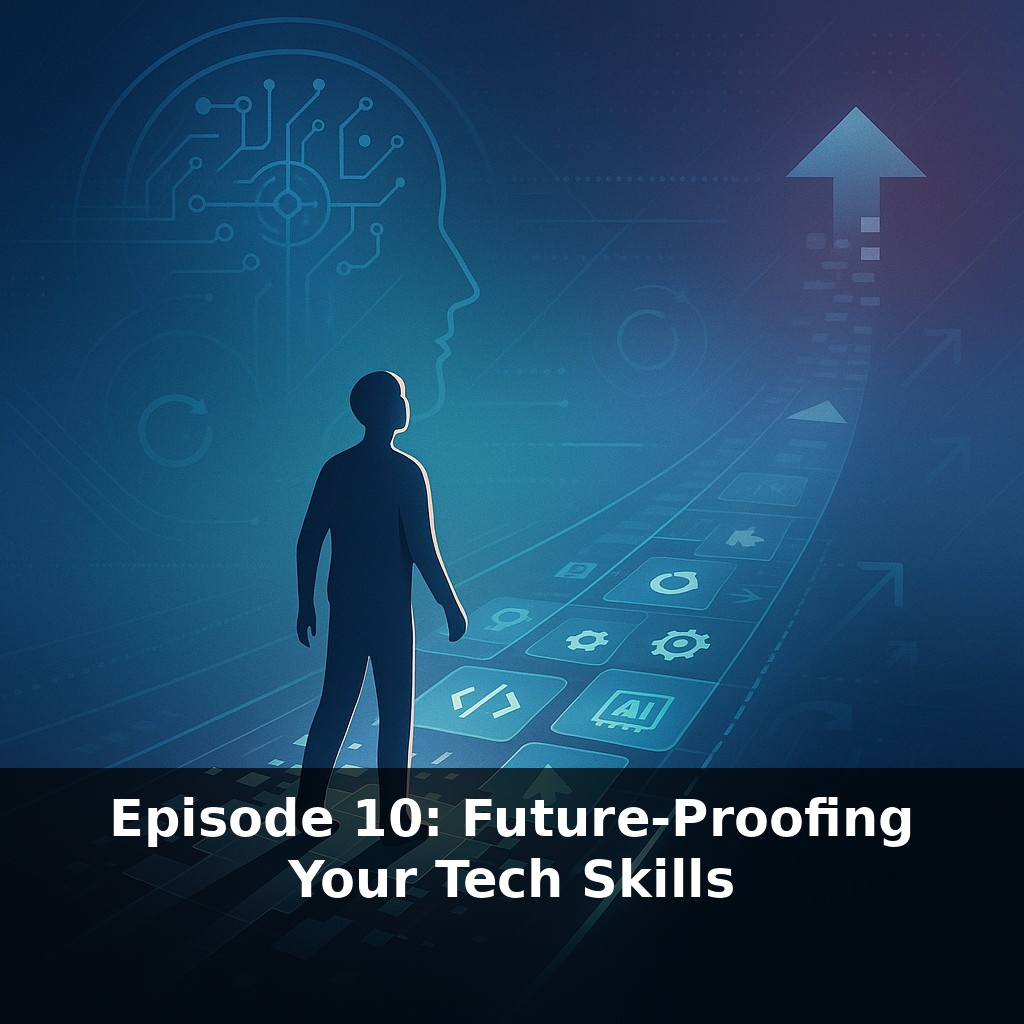
Future‑proofing isn’t about becoming a superhero; it’s about building a habit. Think of each tiny experiment—an AI prompt you refine, a security article you unpack with a friend, a cloud lab you try after work—as one tile in a mosaic. Over time, those tiles form a picture of someone who doesn’t wait for the future of tech to arrive; they keep walking toward it.
Before next week, ask yourself: Where in my current workflow could I practice AI-assisted coding or low-code tools on a real task I’m already doing, instead of waiting for a “perfect” project to start experimenting? Which one emerging skill from the episode (like prompt engineering, data literacy, or API integration) would most increase my value in my current role, and what 30-minute micro-lesson or tutorial could I complete this week to get moving? Who in my existing network is already working with the technologies mentioned in the episode, and what specific question could I ask them (by DM or quick call) to learn how they actually use those tools day-to-day?