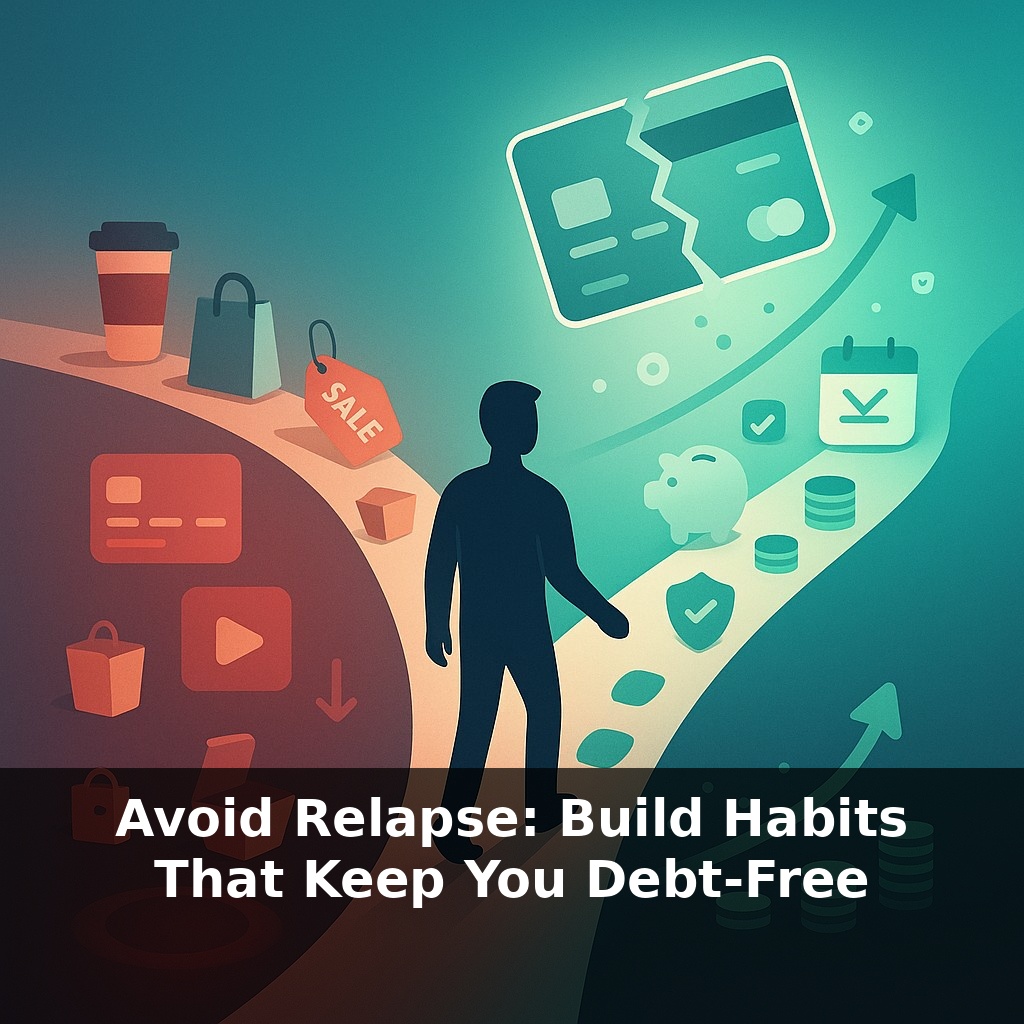
About half of people who get out of credit card debt fall back in within about a year. You’ve cut up the cards, sworn “never again,” and then… small taps: a streaming trial, a sale, a takeout splurge. This episode shows how to rewire those tiny moments so relapse isn’t the default.
U.S. revolving credit just crossed $1.08 trillion, and that number grows one $9 latte, one “only $20” sale, one impulse upgrade at a time. Getting out of debt once is hard; staying out means changing what your money does automatically when you’re not paying attention.
That’s where systems beat willpower. When 401(k)s switch from “opt in” to automatic enrollment, participation in big plans jumps from 47% to 93%. The people didn’t suddenly become more disciplined—the default changed. The same logic can keep you out of debt.
In this episode, you’ll learn how to turn three levers in your favor: (1) automatic flows that move money before you can spend it, (2) simple, visual budgeting frames that make overspending feel wrong, and (3) tiny rewards that keep you motivated during the risky 12–24 months after becoming debt‑free.
Right after people become debt‑free, their risk of sliding back up spikes for roughly the next 12–24 months. That’s when old habits quietly try to reclaim control: a “temporary” subscription here, a “necessary” upgrade there. Data backs this up—households with at least a $1,000 emergency buffer are about four times less likely to rely on high‑interest credit after a surprise bill. And in one savings app, users who bothered to name their goals (like “3‑month cushion” or “no‑panic fund”) reportedly saved about 30% more than those who didn’t, suggesting that clarity and labeling can meaningfully change behavior.
Habit change starts with making the *next* wrong move slightly harder and the *next* right move almost effortless.
First lever: where your money lands. Instead of one “giant checking” that everything flows through, split your inflows on payday. For example, if you bring home $3,000 twice a month, you might pre‑route $300 (10%) to “Future Bills,” $150 (5%) to “Annual Stuff” (car registration, holidays), and $150 (5%) to “True Emergencies.” That leaves $2,400 as your actual spendable pool. The key is that your debit card only touches that last bucket. No card access to the others; use transfers you have to *consciously* approve.
Second lever: hard caps on your flexible spending. Pick a simple rule like 50/30/20 or your own custom mix, then translate it to weekly numbers. Example: On $4,800/month take‑home, you decide $600 is your total “fun” and impulse category—eating out, random Amazon, hobbies. That’s $150 per week. You can keep it in a separate checking account or on a prepaid debit card that you top up every Friday. When it’s gone, that’s the signal, not a moral failing. The constraint protects you from death‑by‑a‑thousand‑swipes.
Third lever: pre‑planning for the non‑monthly stuff that usually sends people back to credit. List the irregular expenses you *know* will hit in the next 12 months: vet visit, car maintenance, dentist, birthdays, travel. If the total is $2,400, divide by 12: $200/month. That becomes a non‑negotiable “sinking fund” line. In dollars, this might be the difference between a $700 car repair being “annoying but covered” versus a new $700 balance at 24% APR.
Fourth lever: friction around credit use. Delete stored card details from browsers and shopping apps. Keep one credit card if you must—for benefits or building history—but store it out of reach at home, not in your wallet. You’re not banning credit; you’re forcing a 30‑second pause where you can ask, “Am I okay watching this show up on a statement 30 days from now?”
Finally, schedule a 10‑minute “money systems check” once a month. No spreadsheets, just three questions: Did I stay inside my weekly fun cap? Are sinking funds on track for the next 3 months? Did I tap credit at all—and why? The goal isn’t perfection; it’s noticing drift before it becomes new debt.
Think of this phase as calibrating your “no‑debt autopilot” with real numbers. Suppose you take home $3,600 a month. You might decide $100 goes to an “Oh-no fund,” $60 to “Car + Gear,” and $40 to “Health stuff.” Those labels live in your bank app as separate goals, not in your head. When a $180 surprise co‑pay hits, you pull from “Health stuff,” not your card. If one bucket keeps running dry—say “Car + Gear” is empty when a $400 repair shows up—that’s feedback: next month, bump that from $40 to $60 and trim $20 from non‑essentials.
This is closer to how a doctor adjusts medication: observe, tweak, re‑test, instead of blaming willpower. To reinforce it, pair each avoided debt moment with a tiny win. Skip a $35 impulse and you immediately move $10 into a “Victory” goal. Watch it hit $100, $250, $500 over months—a visible scoreboard that makes staying out of debt feel like progress, not just restraint.
Over the next decade, your “no‑debt autopilot” will increasingly plug into systems you don’t control. Store apps already push one‑tap credit; soon, AI will score each swipe against your patterns and flag risks in real time. Expect options like: “Round every paycheck up by $37 into an employer emergency vault,” or “Auto‑lock all new credit over $500.” Your edge: decide now which 2–3 rules protect you, so new tools amplify your habits instead of retailers’ profits.
Your next step is stacking habits. Pick one behavior to “level up” for 90 days: maybe raising your buffer from $1,000 to $1,500, or shrinking variable spending by $40 a week and auto‑rerouting that $160. Put a date on the calendar—90 days from today—to review: Did this rule lower stress and keep balances at $0? If yes, lock it in as permanent.
Try this experiment: For the next 7 days, “recreate” your old debt-payment schedule, but redirect that exact dollar amount into a separate, nicknamed savings account called “Future Fun (No Debt).” Any time you feel the urge to use a credit card—at the grocery store, online, or during a night out—force yourself to pause and either (a) pay with debit/cash or (b) walk away, then log what triggered the urge in your phone’s notes. At the end of the week, look at how much you’ve piled into “Future Fun” and compare it to the situations where you almost swiped; notice which habits (late-night browsing, eating out, sales emails, etc.) are most dangerous and how it felt to “pay yourself” instead of a lender.