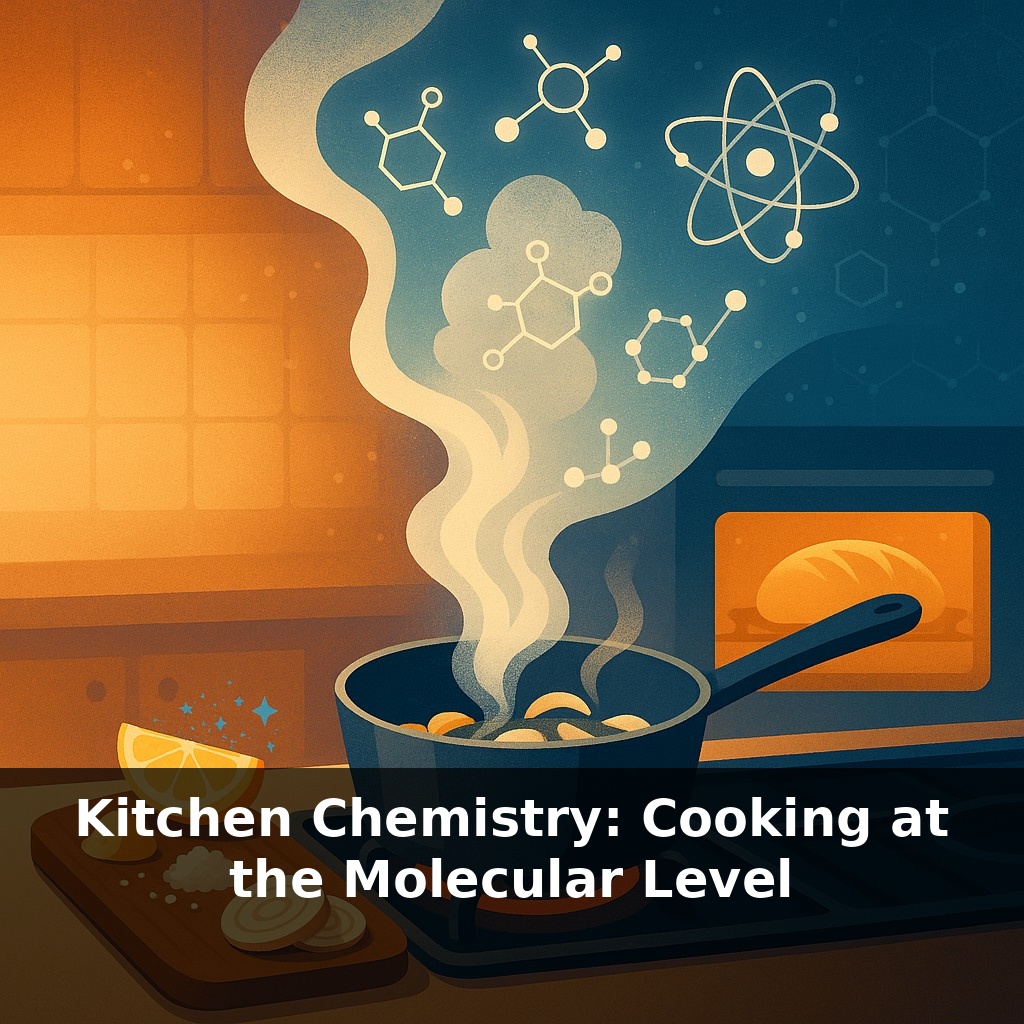
Your kitchen pulls off more chemical reactions in one dinner than a school lab does in a week. Steam roars from a pan, onions go from sharp to sweet, bread balloons in the oven. Here’s the twist: you’re not just following recipes—you’re quietly controlling molecules.
Salt tightens bread dough, sugar makes cookies spread, lemon juice “cooks” fish in ceviche, and somehow all of that is chemistry playing out on a cutting board. In this episode, we’ll zoom in on what’s actually changing inside your food as it heats, cools, and mixes—proteins reshaping, starches swelling, fats organizing, gases puffing things up, and new flavor molecules appearing out of nowhere.
We’ll connect those invisible shifts to very tangible results: why searing meat too wet ruins the crust, why an overmixed muffin turns rubbery, why onions turn sweet but garlic turns bitter if you treat them the same way. You’ll see that recipes are really just sets of conditions: temperatures, times, and ingredient ratios that steer molecules down different paths—toward chewy, tender, crisp, or burnt.
A recipe card might list “bake at 180 °C for 25 minutes,” but what it’s really doing is scheduling a series of molecular events: when starches in flour will set, when baking powder will kick out gas, when browning will finally take off. Tiny temperature shifts—10 or 20 degrees—can flip those events out of sync, turning “soft and fluffy” into “dense and dry.” In this episode, we’ll treat your oven, pan, and fridge like dials on a control panel, each one nudging proteins, sugars, and starches toward a different outcome on your plate.
Browned, crackly, flaky, creamy—most of what we call “good cooking” is your control over structure: how ingredients stick together, fall apart, or trap water and air. Zoom in far enough and you’re really playing with networks and cages.
Take gluten. As soon as wheat flour meets water, glutenin and gliadin start forming a stretchy web. Kneading lines up and links those strands; salt tightens them. That’s why a chewy sourdough gets long kneading and a rest (time lets bonds rearrange), while a tender cake recipe often says “mix just until combined.” Same building blocks, but you’re choosing between a trampoline and a sponge.
Proteins in eggs behave similarly, but they’re more delicate. In an egg white foam, you’re asking those proteins to unfold just enough to wrap around air bubbles, not so much that they clump and leak. A pinch of acid (like cream of tartar) slows down over-coagulation, which is why your meringue stays glossy instead of turning grainy and weepy. In custards, gentle heat plus constant stirring keeps the forming protein network loose and smooth instead of scrambled.
Starches contribute a different kind of architecture. In bread, swollen starch granules fill the gaps in the gluten web and “set” it as they heat. In sauces, flour or cornstarch granules swell and leak chains that thicken the liquid. Push past that sweet spot—too hot, too long—and those chains break apart again, and your once-silky gravy thins mysteriously on the stove.
Sugar pulls several levers at once. It competes for water, slowing gluten development (tender cakes), raises the temperature where mixtures set (ice cream that stays scoopable), and fuels browning. Caramelization kicks in only when the surface actually gets hot enough—why a crowded pan of onions steams pale for ages, while the same onions spread out in a wide pan turn deep brown and jammy.
Fats, meanwhile, are your structural saboteurs and lubricants. Solid fat pieces in pastry dough stay distinct if kept cold; in the oven they melt, leaving behind layers and pockets that turn into flake. In an emulsion like mayonnaise, oil droplets get locked in place by egg yolk molecules so the mixture behaves like a single, thick phase instead of separating into slick and watery.
Even bubbles have blueprints. In cakes and quick breads, double-acting baking powder doesn’t just “make things rise”—it times gas release so bubbles appear while batters are still flexible, then get locked in as starches and proteins set around them. Shift that timing with too much or too little heat and you get tunnels, sinkholes, or a gummy stripe at the bottom.
None of these structures are accidents; they’re responses to very specific conditions you set: how violently you mix, how quickly you heat, how much water, fat, and sugar you allow into the system. Change any one, and you’re quietly redrafting the blueprint of your food.
Think about how all these structures interact in a single dish. In a pan sauce, for example, you’re juggling at least three systems: browned bits stuck to the pan, liquid that will thicken, and fat that might separate or emulsify. Deglaze with wine, and you dissolve flavorful fragments into the liquid phase. Add a knob of cold butter at the end while whisking, and you’re dispersing tiny fat droplets that make the sauce glossy instead of oily. Tip the pan off the heat too late and those droplets pool, breaking the illusion of smoothness.
Or look at something simple like a chocolate chip cookie. The chill time before baking isn’t just “for flavor”—it lets flour hydrate more fully, so the dough spreads less and bakes thicker. Using browned butter instead of plain adds pre-built flavor molecules from earlier heating, so you can get deep toffee notes even at modest oven temperatures. Swap some white sugar for brown and you’re not only altering sweetness, but also introducing more acidic components that can shift how your leavener behaves.
Your challenge this week: Run two tiny “lab tests” on your own dinner. First, split a batch of roasted vegetables or potatoes between two pans—crowd one tightly, spread the other in a single layer. Roast them side by side. Compare color, texture, and flavor, and notice how the same ingredients produce different results. Second, make a basic vinaigrette twice: once by dumping oil and vinegar together and stirring lazily, once by slowly whisking oil into vinegar with a bit of mustard. Watch how the texture, cling to leaves, and even taste shift when the droplets are better organized.
In the near future, recipes may look more like “heat curves” than ingredient lists: your oven, pan, or printer following precise temperature scripts the way a DJ controls a mix. Restaurants already test time–temperature “profiles” to lock in textures; home gadgets will likely do the same, auto-tuning for your altitude, pan, even your tap water. As food gets engineered to your biology and climate, knowing the basics of kitchen chemistry becomes a way to keep control of what you eat.
Kitchen chemistry won’t turn you into a robot chef; it just gives you better questions to ask. Instead of “Did this burn?” you start asking “Did I push the surface past caramelization?” You tinker the way a DJ nudges a mix—adjusting time, temperature, and order of steps—until familiar dishes feel newly customizable, almost like editing a favorite playlist.
Start with this tiny habit: When you crack an egg for anything, pause and quickly notice how the texture of the whites changes as it hits the pan (that’s proteins denaturing in real time). Then, once a day, pick just one cooking step—like browning onions or searing meat—and silently name the “science move” happening (caramelization, Maillard reaction, emulsifying, etc.). Keep it playful: you’re not trying to be a chemist, just tagging one moment in your normal cooking as a little kitchen experiment.