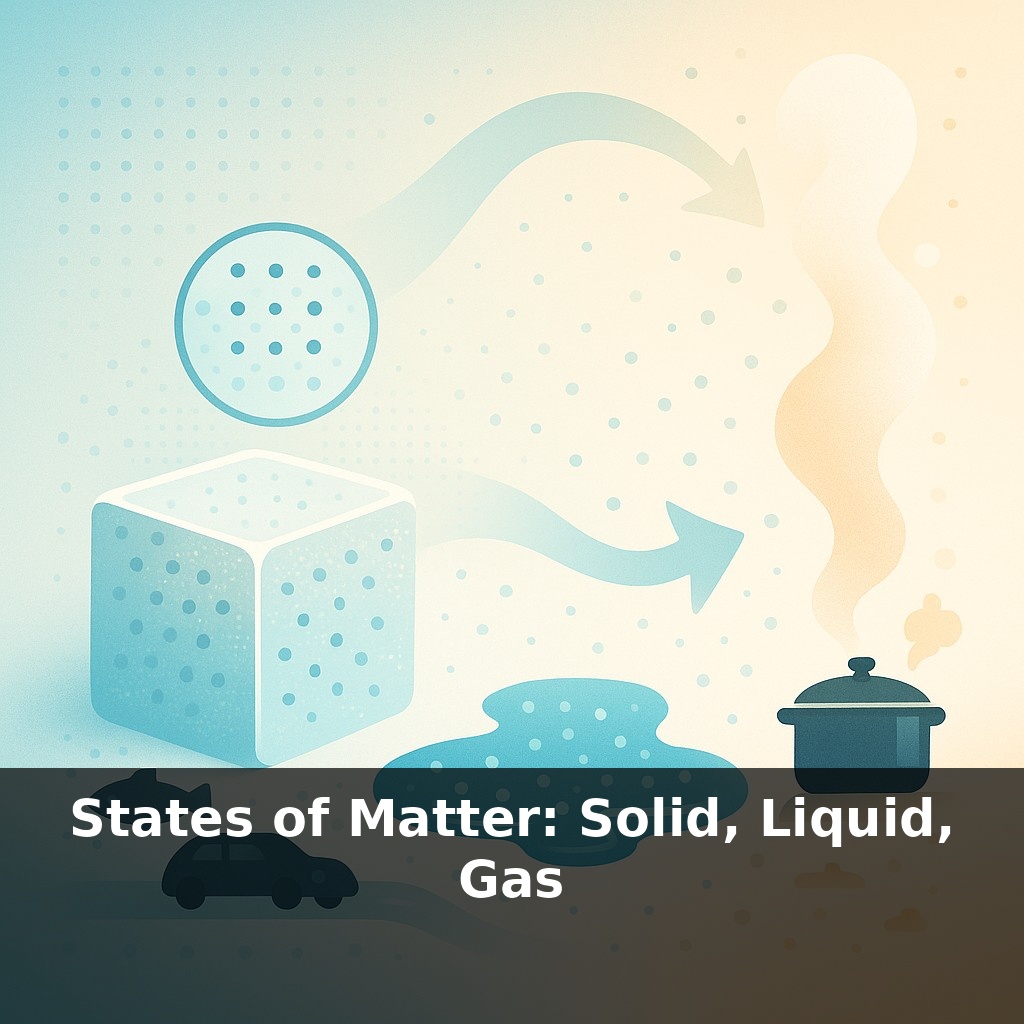
A block of ice can keep fish alive, wreck your car, and power a steam engine—all because its particles follow different “rules” at different times. In this episode, we’ll step inside solids, liquids, and gases to find out how tiny motions shape your everyday world.
Those shifting “rules” of matter quietly control some very practical parts of your day. The exact energy needed to melt, freeze, or boil a substance decides how roads ice over during a cold snap, how your pressure cooker shortens dinner time, and why a cloud can suddenly burst into rain. In industry, engineers obsess over these energy thresholds: they choose coolants for fridges, design safer steam lines in power plants, and even plan how to liquefy natural gas for shipping across oceans. Outdoors, the same physics lets alpine climbers predict how snowpacks will settle—or suddenly slide as avalanches. Indoors, it shapes something as ordinary as the hiss from a kettle and the “fog” from your hot shower. Follow these everyday clues, and you’re really watching energy negotiate when matter should stay put, flow, or fly apart.
Zoom in on your day and those hidden phase changes start to look like a quiet timetable of energy transfers. Morning: dew beads on grass because the air near the ground cooled just enough for water vapor to crowd back into droplets. Afternoon: fresh asphalt softens in the sun, not melting, but creeping toward a more fluid behavior as its molecules gain wiggle room. Step into your kitchen and a simmering pot, a frosted freezer wall, and a whistling kettle are all announcing different balances of heat, pressure, and molecular freedom—like traffic shifting between calm neighborhoods and high‑speed highways.
Think about what really “pays the bill” when a substance changes its behavior. Raising temperature generally speeds particles up, but during a phase change the thermometer can stall while energy still pours in. That energy goes into breaking or forming the attractions between particles instead of making them move faster. For water, those hidden costs are steep: melting 1 kilogram of ice soaks up 333 kJ, but turning that same kilogram of liquid into vapor devours around 2,260 kJ. That difference is why a hot, humid day feels so punishing—your sweat needs a lot of energy to evaporate, and most of it comes from you.
The atmosphere leans heavily on this “hidden” energy budget. When water vapor condenses into cloud droplets, it releases the energy that was absorbed during evaporation. That released energy warms the surrounding air, helping fuel towering storm clouds and hurricanes. Meteorologists track where condensation and evaporation are happening because those phase flips quietly shuffle enormous amounts of heat around the planet.
Conditions matter as much as temperature. Climb a mountain and the air pressure drops, dragging down water’s boiling point with it—about 1 °C for every 285 meters. Pasta that cooks in 10 minutes at sea level can take significantly longer in a high‑altitude kitchen because the water never gets as hot before it boils. In hospitals, the same pressure–boiling link shows up in sterilizers that use pressurized steam to reach higher temperatures than boiling water in an open pot.
Not all substances follow water’s script. Most solids are denser than their liquids, but ice is less dense than liquid water, so it floats. That floating layer acts like a lid on lakes and ponds, slowing further heat loss and helping fish survive winter. If ice sank, many bodies of water would freeze solid from the bottom up each year.
Even “thin air” has heft and flexibility. Because gases are compressible, you can pack about 10 cubic meters of air at surface conditions into a 50‑liter scuba tank at 200 bar. When the valve opens underwater, that stored air expands back toward its original volume, providing each breath. Engineers and divers both have to respect that the contents of a tank are not abstract “pressure,” but real mass of gas that weighs, flows, and pushes back.
Open a cookbook and you’re really looking at a catalog of phase‑change tricks. Sugar syrups, for instance, are judged by “soft ball” or “hard crack” stages because tiny differences in temperature decide how much water has escaped as vapor, and thus whether cooled candy snaps cleanly or bends. Bakers quietly rely on the way butter firms into a semi‑solid in the fridge yet softens on the counter: that shift controls how well air pockets stay trapped in pastry layers. In medicine, anesthetic gases are chosen not just for their effects, but for how readily they pass from liquid in a metal cylinder to a precisely metered vapor flowing into a patient’s lungs. Weather forecasters eye dry, cold air masses that encourage snow to stay powdery versus borderline conditions where flakes partly melt, refreeze, and turn into dangerous crust or slush. Each case is really a negotiation between structure, freedom of movement, and the energy available to rearrange both.
Factories and hospitals are quietly turning phase control into a design tool. Solid‑state batteries, for instance, swap flammable liquids for ceramic‑like conductors that behave more like tempered glass than sloshing fuel. Refrigeration researchers chase materials that shift between solid forms the way a dimmer switch slides between light levels, trimming energy waste. In dry regions, porous crystals are tuned to “sip” vapor from night air, then release liquid at sunrise—like programmable dew on demand.
So the next time a drink sweats on your table or fog wraps a streetlight, treat it like a lab note from nature. Those shifting phases sketch temperature, pressure, and hidden energy budgets in real time. Your challenge this week: follow one glass of water from tap to air, noticing every shape it takes before it “vanishes” into the room.