Atoms and Molecules: The Building Blocks
📝 Transcript
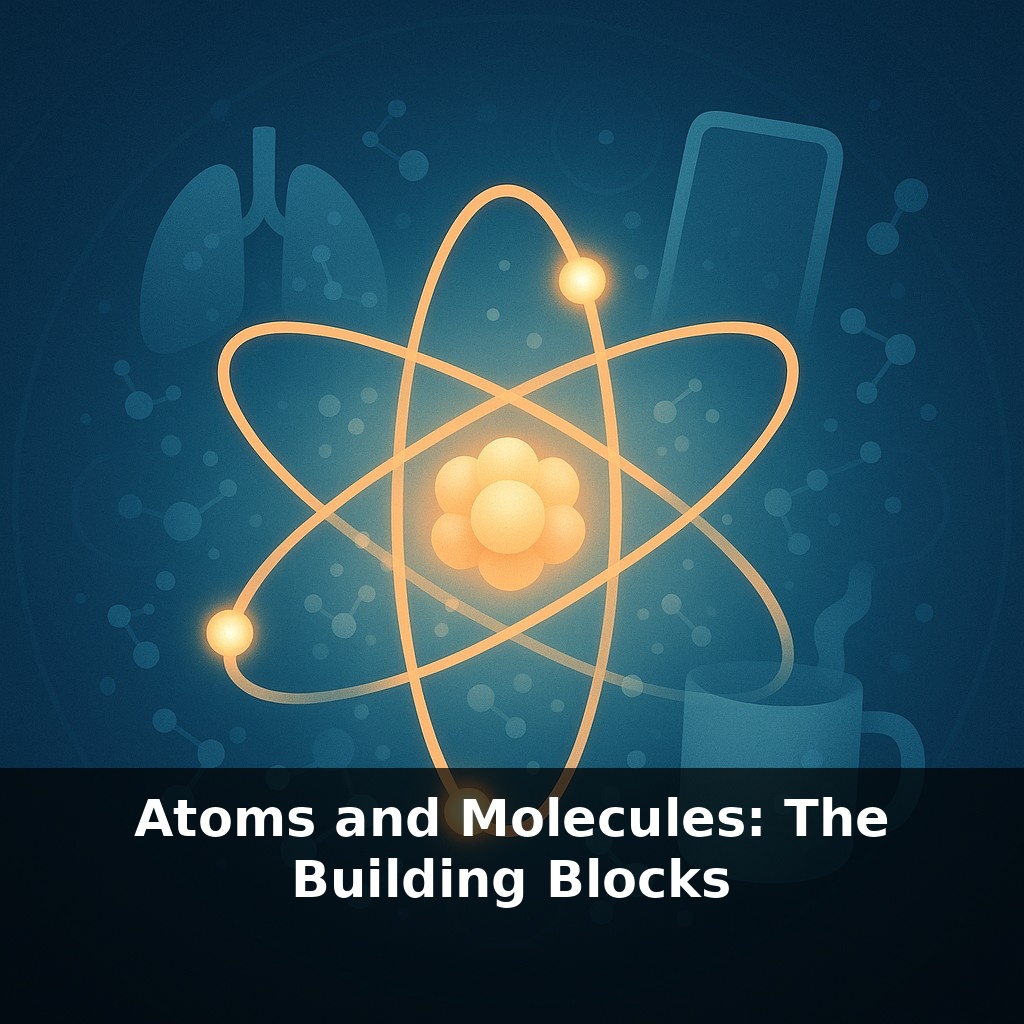
Right now, you’re breathing in a gas that makes up about one-fifth of Earth’s air—yet you can’t see, taste, or smell its tiny building blocks. In this episode, we’ll step inside that invisible world and uncover what your lungs, your phone, and your coffee mug secretly share.
That same hidden world quietly controls your everyday experience. The sharp scent of a peeled orange? Molecules of limonene hitting receptors in your nose. The rigid screen on your phone? Silicon and oxygen atoms locked into an orderly crystal. Even the heat from a cup of tea is just atoms jostling faster as they gain energy.
To work with matter—whether you’re cooking pasta, charging a battery, or designing a drug—you’re really working with the way atoms connect and move. A single drop of water contains roughly 10²¹ molecules, each with a precise shape that helps it cling to surfaces, dissolve salts, and transport nutrients in your body.
Chemistry’s power comes from numbers like these. In this episode, you’ll learn how to count the “uncountable” using moles, how molecular shape controls behavior, and how tiny mass differences shape life’s big outcomes.
Chemists zoom in even further, past what you can see or smell, to track which specific atoms show up and in what ratios. Your body, for example, is roughly 65% oxygen and 18% carbon by mass, but by *atom count* it’s dominated by lighter elements: about 63% hydrogen, 20% oxygen, 10% carbon, and 3% nitrogen. These four alone make up ~96% of the atoms in living things. Change their arrangement, and you change the substance: C₂H₆O can be drinkable ethanol or poisonous dimethyl ether, depending on how the same 9 atoms are connected in space.
To make sense of so many tiny particles, chemists needed a counting shortcut. That’s where the mole comes in. One mole is exactly 6.022×10²³ particles—about 602,200,000,000,000,000,000,000. If you had 1 mole of grains of sand, they could cover all Earth’s beaches in layers thousands of meters deep. Yet 1 mole of water is just 18 grams—less than a tablespoon.
Why 6.022×10²³? It’s chosen so that the mass of 1 mole of atoms in grams matches the average mass of a single atom in atomic mass units. Carbon‑12 is defined as exactly 12 atomic mass units (u), so 1 mole of C‑12 atoms weighs exactly 12 grams. That link lets you go from “I weighed this” to “I know how many atoms are here” in one step.
Suppose you dissolve 5.84 grams of table salt (NaCl) in water. Sodium is about 23 u, chlorine about 35.5 u, so NaCl is roughly 58.5 g per mole. Divide 5.84 g by 58.5 g/mol and you get 0.100 mol. Multiply by Avogadro’s number: 0.100 × 6.022×10²³ ≈ 6.0×10²² formula units of NaCl in the glass. Each of those consists of one Na⁺ and one Cl⁻, so there are about 6.0×10²² of each ion moving around.
Inside any solid or liquid, those particles aren’t arranged randomly. The way they’re packed—and the kind of bonding—controls properties you notice every day. In copper wire, metallic bonding allows about 10²³ electrons per cubic centimeter to drift when you apply a voltage, which is why it conducts electricity so well. In contrast, in sugar crystals each carbon‑hydrogen‑oxygen framework is covalently bound and electrically neutral; almost no freely moving charges exist, so a sugar cube doesn’t conduct.
Shape also matters. The angle between bonds, the distances between nuclei, and how electrons are distributed create polar or nonpolar regions. A polar molecule can attract ions or other polar molecules; a nonpolar one resists mixing with them. That’s why a few drops of cooking oil (made mostly of long, nonpolar hydrocarbon chains) stubbornly float on top of water instead of dispersing, even if you stir.
At the nanoscale, “empty” space between nuclei doesn’t mean weakness. Repulsive forces between overlapping electron clouds ramp up steeply when atoms are pushed too close. Press your hand on a table with 50 newtons of force, and trillions of trillions of such interactions push back to support you.
A single sip of tap water—about 10 mL—contains roughly 3×10²³ water molecules, more than the number of stars in the observable universe by a factor of about 10 million. Mixed in are dissolved ions: in moderately hard water, you might have around 2×10²⁰ Ca²⁺ and Mg²⁺ ions in that same sip, enough to leave visible scale on a kettle after repeated heating. In a 250 mL cup of coffee, about 5 grams of dissolved substances—caffeine, organic acids, minerals—correspond to on the order of 10²² individual molecules, each interacting through specific bonds and shapes to create flavor. Stainless steel cutlery owes its rust resistance to a surface layer only a few atoms thick: roughly 2–3×10⁻⁹ m of chromium‑rich oxide that self‑repairs when scratched. Like a tightly woven raincoat that blocks large drops but lets air pass, this ultrathin barrier stops further corrosion while still allowing the bulk metal to remain structurally strong.
Designing matter from atoms up lets us program behavior instead of just discovering it. By tweaking a catalyst’s atoms, chemists have cut some reactions’ energy use by 50–80%. Single‑atom catalysts—each active site just 0.1 nm—can turn CO₂ into fuels with >90% selectivity. DNA‑based nanorobots only ~20 nm across have already targeted leukemia cells in mice, shrinking tumors by ~45%. Ultra‑thin coatings 1–5 nm thick can make glass repel germs, fog, or fingerprints without changing how it looks.
Your challenge this week: spot chemistry in action 5 times a day. Note a phase change, a color shift, a smell, a fizz, or metal tarnish. Each event traces back to atoms rearranging by the quintillions. By day 7, you’ll have logged at least 35 examples—enough to see patterns and start predicting what will happen next.
From this course
Chemistry of Everyday Life: The Molecular World
7 episodesUnlock all episodes
Full access to 7 episodes and everything on OwlUp.
Subscribe — $1.99/monthLess than a coffee ☕ · Cancel anytime