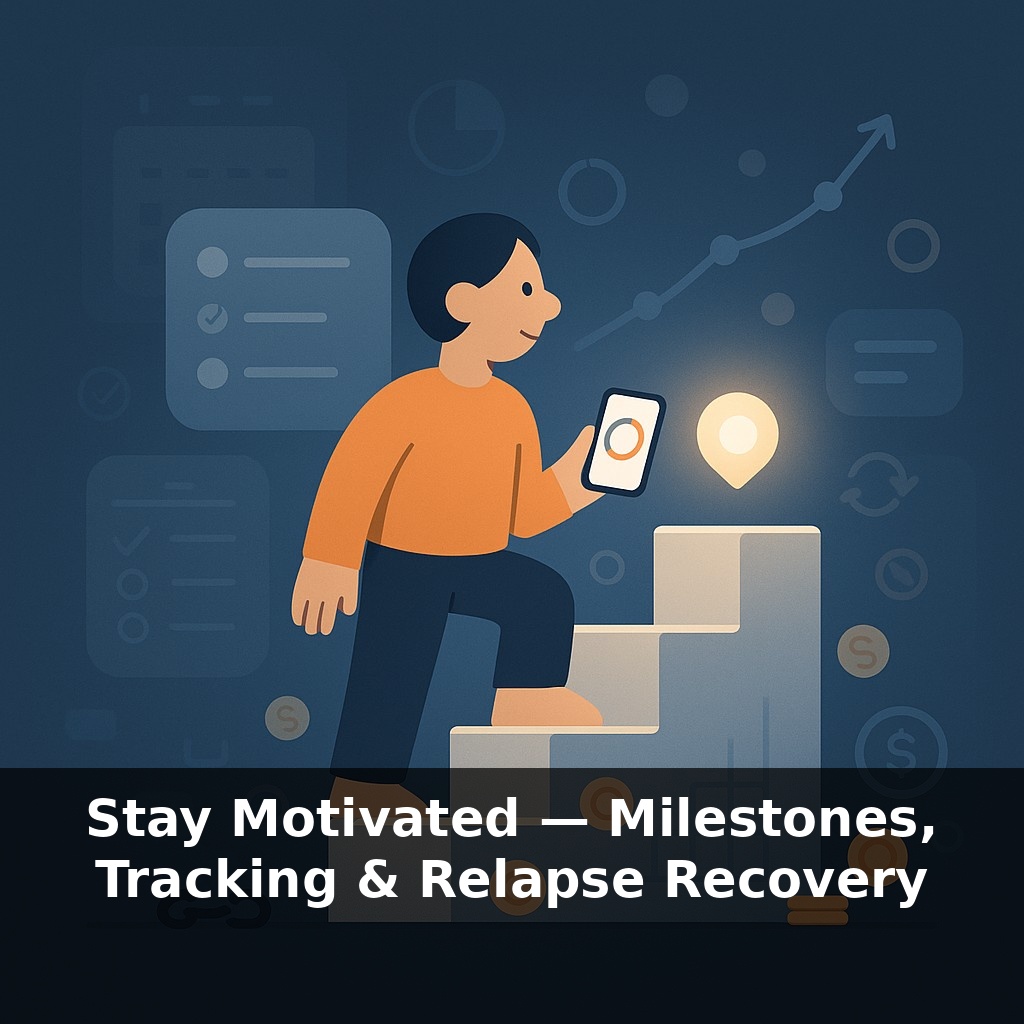
About half of people who start a debt payoff plan quit within a few months—not because the math is wrong, but because the journey feels endless. You open your banking app, see a typical balance, and think, “Why bother?” Today, we’ll flip that script so progress actually feels rewarding.
Written goals make you 42% more likely to succeed, yet most people keep their debt payoff “in their head” and then blame willpower when they stall. The research says something different: what you *see* and *measure* shapes what you do next. In a meta‑analysis of 138 studies, people who actively tracked their progress were about 20% more likely to hit their targets. Translate that to debt: if your plan says “pay off $12,000,” turning it into twelve $1,000 checkpoints with visible tracking can be the difference between burning out in month 4 and crossing the finish line in month 12. Tools help too. YNAB reports its average user wipes out about $6,000 of debt in the first year—largely because the app forces you to see every dollar’s job. Today, we’ll build a system like that for you: clear milestones, simple tracking, and a script for exactly what to do when you slip.
Most people set a payoff target and a monthly amount… then stop there. The missing layer is structure: *when* you’ll hit each step and *how* you’ll know you’re on track. Take a $9,000 balance. Instead of “$300 a month until it’s gone,” you might set nine $1,000 checkpoints over 12 months, with dates: $1,000 by April 30, $3,000 by July 31, $5,000 by October 31, and so on. That lets you see early if you’re drifting. Even a basic spreadsheet or app can flag, “You’re $150 behind this month,” which is far easier to correct now than discovering a $1,800 shortfall at year‑end.
Motivation rises when your brain can *see* progress and *expect* rewards. So let’s turn your payoff into a series of tight feedback loops: milestones that trigger hits of satisfaction, tracking that shows cause‑and‑effect, and a pre‑written “relapse protocol” that keeps a bad week from becoming a lost year.
Start by turning each checkpoint into something you can “cash in.” Say you’re tackling $9,000 with nine $1,000 chunks. For every $1,000 of principal you eliminate, pre‑assign a small, fixed celebration: a $15 treat, a solo afternoon off scrolling money apps, or a guilt‑free night watching movies at home. Cap these at maybe 1–2% of the milestone amount so they don’t slow you down: on $1,000, that’s $10–$20. The key is not the size, but the *certainty*: “When I hit X, I always get Y.” That reliability is what reinforces the habit loop.
Next, wire in frequent, low‑effort feedback. Two options that work well:
1. **Automatic app‑based tracking.** Connect accounts in an app (YNAB, Monarch, Mint’s successors, or your bank’s budgeting tool). Turn on: - Weekly email summaries - Category alerts when spending passes custom limits - Push alerts for new charges over, say, $50
Aim for a 5‑minute weekly review: “Debt total last week: $8,400; this week: $8,180. Difference: $220.” That micro‑check keeps your payoff “top of mind” without consuming your life.
2. **Manual visual tracker.** Create a 90‑square grid on paper or a tablet for that $9,000 balance; each square = $100. Every time you knock off $100 of principal, fill in one square. For a $450 payment where $320 hits principal, color 3 squares and write “+20” in the margin to remind you you’re close to another full square. Place it where you’ll see it daily.
Now, pre‑write your **Relapse Recovery Plan** so you follow a script instead of your feelings when something goes wrong. Example:
- **Trigger:** Payment was less than planned, or I added $200+ to a card. - **Step 1 (10 minutes):** Identify *exactly* what happened. “Car repair: $480; used card.” - **Step 2 (15 minutes):** Adjust the plan, not abandon it. Spread the setback over 3 months: “Increase payments by $70/month for 3 months.” - **Step 3 (5 minutes):** Add a tiny corrective action this week: sell one item, skip one takeout, or redirect $25 from nonessential spending. - **Step 4 (2 minutes):** Log it. On your tracker, mark “detour: +$480, recovery: +$70 x 3.”
This way, a relapse becomes a documented detour with a scheduled recovery, not a personal failure.
Here’s a real‑life style example that pulls the pieces together.
Say Maya owes $14,400 on three cards. She splits this into 24 checkpoints of $600 each and assigns each one a 1% celebration budget: $6 max. She prints a 24‑step ladder and writes dates next to every third rung. Now she layers in tracking: her bank’s app sends a Sunday summary, and she does a 7‑minute “money check” over coffee—no spreadsheets, just noting: “Total down $230 this week; next $600 mark in 3 weeks if I stay on pace.”
Her relapse protocol kicks in month 5 when a $720 vet bill lands on a card. She tags it “unexpected” and revises three upcoming payments: +$80, +$80, +$80, then schedules a one‑time $120 from selling a spare TV. On the ladder she draws a side arrow labeled “vet detour: +$720, recovery: 3 months.”
One analogy: treat those marks like weather radar—each dot doesn’t stop the storm, but it shows the direction it’s moving so you can steer instead of just getting soaked.
Soon, your tools will do more of the heavy lifting. AI budgeting bots could scan thousands of your transactions and automatically set “micro‑targets” like: “Send an extra $37.50 on the 18th when your rideshare payout hits.” Wearables might flag stress spikes near spending triggers and prompt a 30‑second check‑in before you tap “buy.” Employers may add $25–$50 match bonuses for each 3‑month streak you stick to your plan, turning consistency into literal extra income.
Treat this like training for a 10K: consistency matters more than perfect days. Studies show people who review their numbers weekly miss fewer payments and rebound faster. Set a simple rule: two 10‑minute check‑ins every week for the next 30 days. If you hit all eight sessions, give yourself a small $10–$15 reward—proof your new system actually runs.
Here’s your challenge this week: Pick *one* current goal and create a simple “milestone ladder” of 5 rungs you can visibly track on paper or a whiteboard today (e.g., 5 workout sessions, 5 sober days, 5 deep-work blocks). Every time you hit a rung, mark it off immediately and write the exact date and what you did to earn it. If you relapse or miss a rung, don’t erase anything—circle that day in a different color and add one short note about what triggered it and what you’ll try differently tomorrow. Your goal is to reach rung #5 by this time next week, with every step and setback clearly logged in front of you.