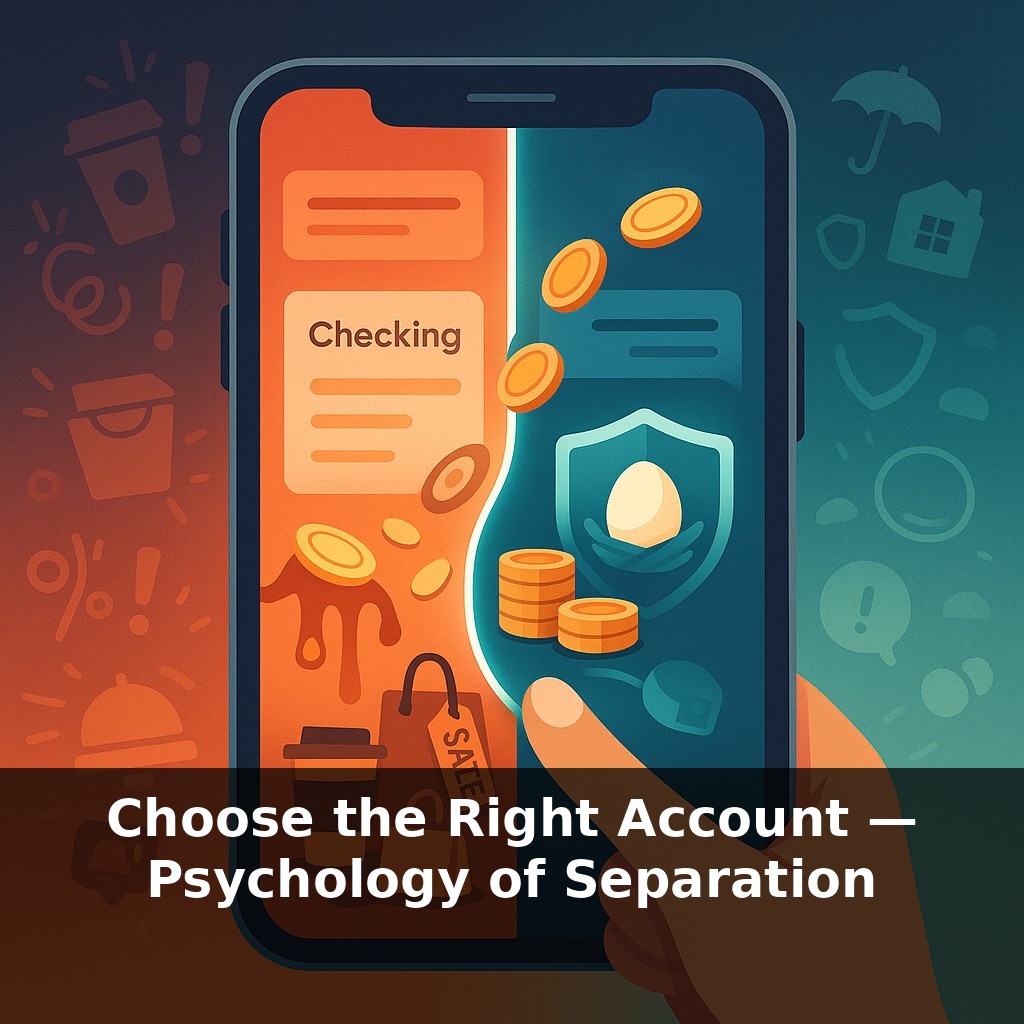
Right now, someone is proudly “saving” in a checking account—and silently leaking that money on takeout and impulse buys. Here’s the twist: the problem isn’t their willpower, it’s the *account*. In this episode, we’ll explore why *where* you park savings can make or break your emergency fund.
You’ve already sketched out how much safety you need and spotted some easy places to free up cash. Now the next trap is subtle: putting that hard-won money in the *wrong* place and watching it quietly disappear. Not because you’re reckless, but because your brain is doing exactly what it’s wired to do—treat “available” money as spendable.
Researchers call this mental accounting: we behave very differently with dollars labeled “for bills,” “for fun,” or “for later,” even when they’re identical. The structure around your money nudges your behavior more than good intentions do.
That’s why the account you choose matters as much as the amount you save. A few clicks—different bank, different label, different level of friction—can turn “extra” cash into money you instinctively protect, not casually drain when a tempting notification pops up.
So now, instead of asking “how much should I save?” the question shifts to “how do I keep this money from quietly drifting back into everyday life?” This is where small design choices do the heavy lifting. The same dollars feel very different when they sit in a bare-bones app with no debit card, no bill-pay, and no constant balance peeking at you next to your spending. Think of it like moving tools from the kitchen junk drawer into a labeled toolbox in the garage—still yours, still reachable, but no longer something you grab absentmindedly while making dinner or scrolling through your phone.
Here’s where psychology and product design quietly team up to help you win. You’ve done the hard work of deciding *how much* you need and spotting where it can come from. Now the move is to choose an account setup that makes the “right” behavior the default, not a daily act of willpower.
The research is blunt: when savings sit right next to spending money, they don’t stay savings for long. One study found that money kept in a general-purpose account was over a third more likely to vanish within a few months. That’s not about you being “bad with money”; it’s about your brain reacting to what’s visible, easy, and emotionally “up for grabs.”
So you want an account that does three things at once:
1. **Feels separate.** A different login, a different app, or even just a different bank name on the screen creates a tiny but powerful mental boundary. “This is for crises, not concerts.” That label—often literally the nickname you give the account—changes how your brain treats each dollar.
2. **Stays boring day-to-day.** No debit card dangling from your keychain. No option to pay at checkout. No rewards nudging you to “use” it. Boring is a feature: if you can’t casually tap it at the grocery store, you’re less likely to blur the line between “true emergency” and “I’m tired of cooking.”
3. **Rewards patience.** A high-yield online savings account quietly pays you for *not* touching the balance. When the national average rate is tiny but some FDIC- or NCUA-insured online banks pay close to 5%, that gap compounds—especially when you’re holding several months of expenses.
The “online-only” part often scares people, but as long as the bank is properly insured and you stay under coverage limits for each institution, the risk you’re really managing is *behavioral*, not technological. The danger isn’t that your emergency fund evaporates in a bank failure; it’s that it evaporates in $40 chunks of “I’ll replace it later.”
Another subtle upgrade: automation. Setting transfers to leave your main account on payday means the decision happens *once*, not every month when you’re tired and scrolling past sales. People who automate this way consistently end up with larger cushions than those who rely on “leftovers.”
You’re not just choosing a place to park cash; you’re choosing the path your future stressed-out self will follow. A little extra friction now becomes a safety rail later, when you’re one bad week away from dipping into whatever looks easiest to spend.
Mia, a freelance designer, opens a separate high-yield account at a credit union she *doesn’t* use for anything else. She nicknames it “Six Months of Rent” and turns off almost every notification. The balance lives in the background, not on her daily money dashboard. When a client pays late, she can move money back in one transfer—but the extra step makes her pause long enough to ask, “Is this truly urgent, or can I juggle invoices first?”
Contrast that with Jordan, who keeps everything in one place. A festival ticket, a flash sale on flights, a “limited-time” gadget—each feels justified because the total balance still looks healthy. Three months later, the number is lower, but there’s no clear moment when “savings” turned into “spending”; it just bled across an invisible line.
One useful experiment: create *two* distinct savings goals at that separate bank—“Oh-No Fund” and “Next-Year Goals.” Watching them grow side by side trains you to distinguish “now” problems from “later” dreams instead of lumping all non-bill money into one blurry pile.
Open banking could soon let your money “breathe” overnight—surplus cash drifting from everyday use into safer corners until you actually need it. Fintechs are already testing rules-based sweeps, like a thermostat that nudges the temperature up or down without asking every hour. Layer in climate shocks, gig-work droughts, or AI job shifts, and this quiet infrastructure starts to look less like a convenience and more like plumbing: invisible, but essential when stress hits.
Over time, that quiet separation reshapes your habits: you start treating “extra” cash as seedlings to plant, not confetti to toss. As balances grow, choices feel less like juggling bills and more like steering a ship with a sturdier hull. Next episode, we’ll zoom in on *how* to feed this system—without feeling like you’ve put your life on financial lockdown.
Start with this tiny habit: When you move money into your checking account, say out loud which “job” that money has (like “this $20 is for groceries” or “this $15 is fun money”). Then, open your banking app and drag just $1 into a separate “fun” or “future you” bucket so your brain sees that account as different. Each time you spend from that fun bucket, pause for two seconds and remind yourself, “I’m spending only from my fun account, not my bill money.” Do this every time you move or spend money today, even if it's just a few dollars.