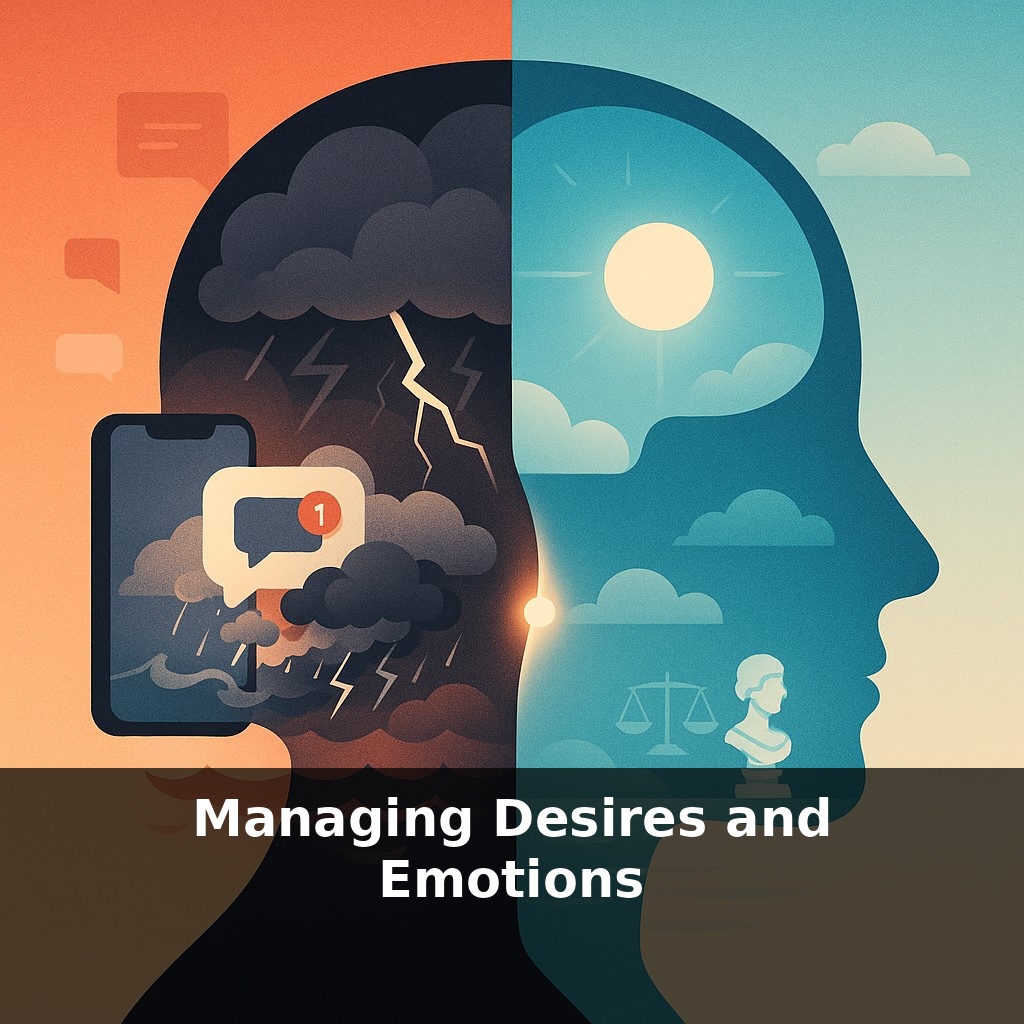
“‘It’s not things that disturb us, but our opinions about them.’ A man survives years as a prisoner of war with that one line from an ancient handbook. Another person checks their phone and spirals after a single text. Same world, same events—completely different inner weather.”
Most of us treat emotions like pop-up ads: they appear, we either click impulsively or scramble to close them, and then feel guilty about both. Desire feels similar—one notification from the world, and suddenly we’re “supposed” to want a promotion, a reply, a perfect body, a calmer mind. But Stoics would say the real issue isn’t feeling pulled; it’s silently agreeing that every pull is a command.
Here’s the twist: Stoicism doesn’t ask you to become a stone. It assumes you’ll feel the rush of anger when a colleague undercuts you, the stab of envy scrolling social media, the heat of craving when stress meets sugar or shopping. The project isn’t to delete those reactions; it’s to insert a moment of inspection between signal and response.
In this episode, we’ll treat your emotional life less like a courtroom delivering verdicts—and more like a lab, running experiments on what truly needs your consent.
Think of this as upgrading your mind’s operating system rather than installing a mood-blocker. Epictetus breaks your inner resources into four “settings”: what you think about something, what you chase, what you avoid, and what you hope for. Those levers stay in your hands, even when circumstances don’t. Modern psychology quietly agrees: change the frame, and the feeling often follows. So in this episode, we’ll run small, live tests on one question: “What happens if I move just one inner lever, instead of trying to rewrite the whole world?”
Here’s the first surprise: the early Stoics didn’t say “don’t want anything.” They drew a sharp line between three layers:
1. **Raw impressions** – the flash of “this seems good/bad.” 2. **Assent** – the quiet “yes, that’s true” you give it. 3. **Action** – what you actually do next.
Layer 1 is automatic. Layers 2 and 3 are where your freedom lives.
When a message pops up—your boss’s name, your ex’s initials—that instant jolt isn’t a failure. The Stoic question kicks in a half‑second later: “Do I sign off on the story that just auto-loaded?” A raised voice can trigger the inner script, “I’m being disrespected.” A friend’s success can trigger, “I’m falling behind.” The feeling spikes *because* that script was green‑lit without review.
This is why they trained not to feel less, but to **slow down assent**. Instead of “I’m angry, therefore I’ve been wronged,” they’d insert a micro‑audit: “I feel anger; what claim is it trying to make, and is that claim solid?” That move won’t erase the heartbeat in your ears, yet it changes the *job* of the feeling—from commander to consultant.
Modern research on cognitive appraisal maps neatly onto this. In anxiety experiments, two people can show the same physiological arousal, but if one labels it “my body preparing to help me focus,” their distress stays lower and performance improves. The bodily surge is similar; the story about it is different.
So how do you practice this without turning into a robot analyzing every breath?
Stoic writers suggest shrinking the time horizon and the scale. Instead of vowing to overhaul your entire temperament, you pick **one domain and one kind of trigger**: criticism at work, silence after you send a message, delays and queues. Then you treat each episode as a drill in contesting the first story.
You’re not pretending the trigger is pleasant. You’re testing alternative readings:
- “Is there any other way to interpret this?” - “If my friend were in this situation, what would I say it means?” - “Will this matter in a week? A year?”
Bit by bit, you’re building a habit of **curating your inner headlines** rather than letting the loudest one run front page.
You can see this most clearly in tiny, ordinary frictions. You open your banking app and notice an unexpected charge. The first surge is there. The training begins with the *second* move: instead of auto‑narrating “I’m doomed” or “these people are thieves,” you pause long enough to ask, “What are three neutral explanations?” Maybe it’s a subscription you forgot, a delayed posting, or fraud that can be fixed with one call.
Same with a delayed reply. You send a risky message; minutes stretch into hours. One storyline says, “I’ve been rejected.” Another says, “They’re in a meeting,” or “They’re drafting a thoughtful answer.” You’re not forced to pick the comforting story—you’re invited to see that there *is* a choice among several.
Think of it a bit like debugging code. The app crashing is the symptom; the hidden assumption in the script is the bug. The more fluently you spot those assumptions, the fewer emotional crashes you’ll suffer, even while running the same demanding “programs” of work, family, and ambition.
As biometric tools get cheaper, they’ll quietly mirror what your journal already reveals: patterns in spikes, slumps, and recovery. A watch might flag, “Your heart rate jumps in Monday meetings,” then an app could prompt: “Name the story you’re running right now—and write a truer one.” Schools and workplaces could bake in five‑minute “cognitive cool‑downs,” like a mental version of washing your hands, until checking your judgments feels as normal as checking your phone.
Treat this less like self‑defense and more like learning a new instrument: clumsy at first, then almost musical. Each time you spot a story mid‑flight and tweak it, you’re tuning a string. Over months, patterns emerge—recurring notes of pride, fear, habit. That’s where deeper work begins: not deleting stories, but authoring better ones.
Here’s your challenge this week: Once a day, when a strong desire or emotion shows up (like scrolling your phone, snacking, or snapping at someone), set a 5‑minute timer and do nothing but sit with it—no acting on it, no distracting yourself. Silently name what’s happening (“This is craving,” “This is anger in my chest,” “This is anxiety in my stomach”) and notice how it changes over the 5 minutes. After the timer ends, choose either to follow the desire or not, but only after you’ve given it that full 5‑minute “cooling-off” window. Do this with at least one desire or emotion every day for 7 days and see how your relationship to urges shifts.