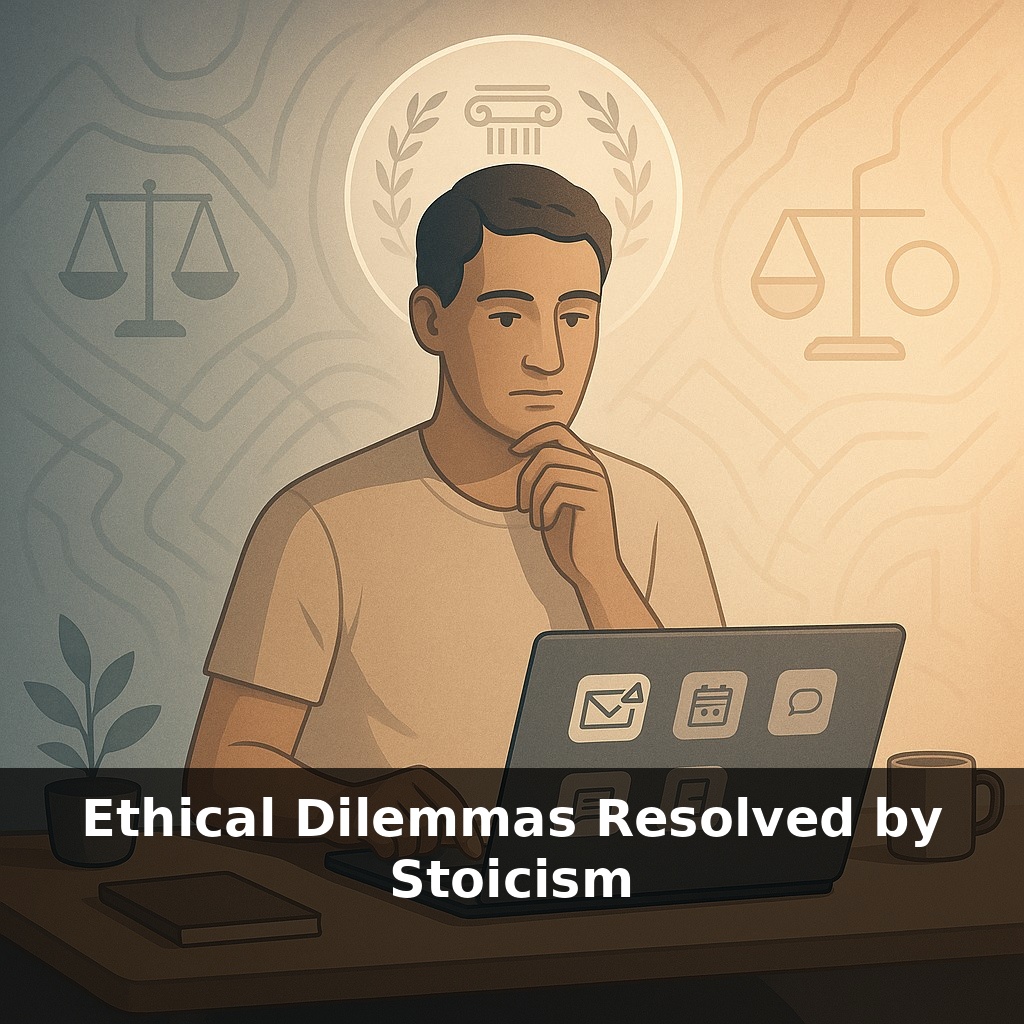
More than twenty thousand people have tried a “Stoic Week” experiment—and most reported feeling noticeably happier. Now zoom in on one person: a worker staring at a risky email, a programmer tempted to leak data, a manager weighing the climate cost of profit. What would a Stoic do?
Ethical dilemmas rarely arrive with villain music. They show up as calendar invites, quiet emails, and “can we talk?” messages. A colleague hints at fraud but begs you not to report it. Your team ships a feature that quietly collects more user data than anyone expected. Your company’s green policy turns out to be mostly marketing. None of these choices are simple—and the usual advice (“follow your heart,” “do what feels right”) tends to dissolve the moment careers, friendships, or money are on the line.
Here’s where an older, sterner voice enters the room. Instead of asking, “What outcome do I want?” the Stoic asks, “What kind of person am I choosing to be in this moment?” That shift sounds small but it rearranges the whole problem: from juggling consequences to examining your own character under pressure.
Instead of handing you a rigid rulebook, this older voice offers a toolkit. At the center are four demanding questions: What is the wise thing here? What would courage look like? What is genuinely just to all involved? And where does temperance—restraint, balance—ask you to stop? Each question aims at something you can actually govern: your judgment, your speech, your next move. Rather than gaming outcomes, you start adjusting your inner “settings,” like tuning the privacy, security, and power options on your own moral operating system before you click send on any decision.
Begin with the oldest Stoic move: strip the problem down to what’s really up to you. Not “Will I win this case?” or “Will the board back me?” but “What will I say? What evidence will I check? Whom will I refuse to mislead?” Outcomes move to the background; specific next steps move to the front.
Now the four virtues become a set of filters, not abstract ideals.
Wisdom asks: “What am I missing?” In a whistle‑blowing case, that might mean quietly verifying facts, learning the policy, asking precise questions instead of launching into accusations. Wisdom is allergic to lazy certainty; it forces you to slow down when adrenaline wants speed.
Courage asks: “What am I afraid of—and is that fear running the show?” Losing a job, angering a supervisor, being disliked online—Stoics don’t pretend these risks vanish. They just refuse to let them decide. Courage isn’t the absence of fear; it’s the decision to act for the sake of the good while afraid.
Justice shifts the lens outward: “Who else is affected, and what do they reasonably deserve?” In data‑privacy conflicts, this might mean centering users’ right not to be treated as raw material. In environmental calls, justice widens even further: future colleagues, communities, and ecosystems count, even if they’re not in the meeting.
Temperance, finally, trims both excess and cowardice. You neither dramatize (“I alone must save the world”) nor minimize (“It’s nothing; everyone does it”). You take the smallest honest step that moves the situation toward integrity—documenting concerns, refusing to ship a deceptive feature, insisting on accurate reporting.
Underneath this, Stoics treat intention as the ethical core. You might expose wrongdoing and still be ignored—or even punished. By their lights, the act is no less ethical if it was sincerely guided by wisdom, courage, justice, and temperance. Just as a well‑built app can crash on a bad device, a well‑chosen action can “fail” in an unjust environment without losing its inner quality.
This doesn’t guarantee comfort. It does something quieter: it lets you know, in detail, why you chose as you did—so you can look back on the moment without flinching.
A product manager spots a slide in the deck: the “optional” data toggle will be on by default, buried three clicks deep. She can’t rewrite company policy today, but she can insist the toggle be surfaced clearly on the main screen, and ask for a short, plain‑language explanation of what’s collected. Not heroic, not dramatic—but a concrete nudge toward treating users as ends, not means.
A junior engineer on an AI team is asked to scrape public profiles that were never meant for training data. He starts by logging his concerns in an email to his lead, citing the platform’s own terms of service. If nothing changes, he quietly documents dates, requests, and responses, creating a clear trail before deciding whether to escalate externally.
In environmental choices, a facilities director at a logistics firm can’t halt global shipping, but she can refuse the cheapest vendor who falsifies emissions reports, and pilot a smaller, cleaner route—testing integrity in one corridor before scaling up.
As AI systems triage patients, price insurance, or flag “suspicious” behavior, a Stoic lens could become a quiet safety feature. Instead of grand codes few people read, teams might use short, virtue‑based checklists before shipping models—like a last pre‑flight walk‑around. Over time, regulators, hospitals, even school boards could borrow these tools, not to freeze innovation, but to slow it just enough for conscience to catch up with code.
Instead of hunting for perfect rules, you’re tuning a daily habit: pausing before you click send, sign, deploy, or stay silent. Over time, that pause becomes a kind of ethical muscle memory. Small, repeated choices—what you log, question, or refuse—add up like compound interest, gradually shaping a life you’d be willing to reread in full.
Try this experiment: For the next 24 hours, treat yourself as a “Stoic judge” whenever you hit an ethical snag—big or small. The moment you feel torn (e.g., whether to speak up when a coworker is being unfairly blamed, whether to keep quiet about a small mistake, or whether to share gossip), pause and silently ask three questions: “Is this just?”, “Is this courageous?”, and “Is this in line with my role as a human being among other humans?” Then deliberately choose the option that best fits those three Stoic virtues, even if it’s slightly uncomfortable, and note how your sense of regret or peace feels that evening compared to a normal day.