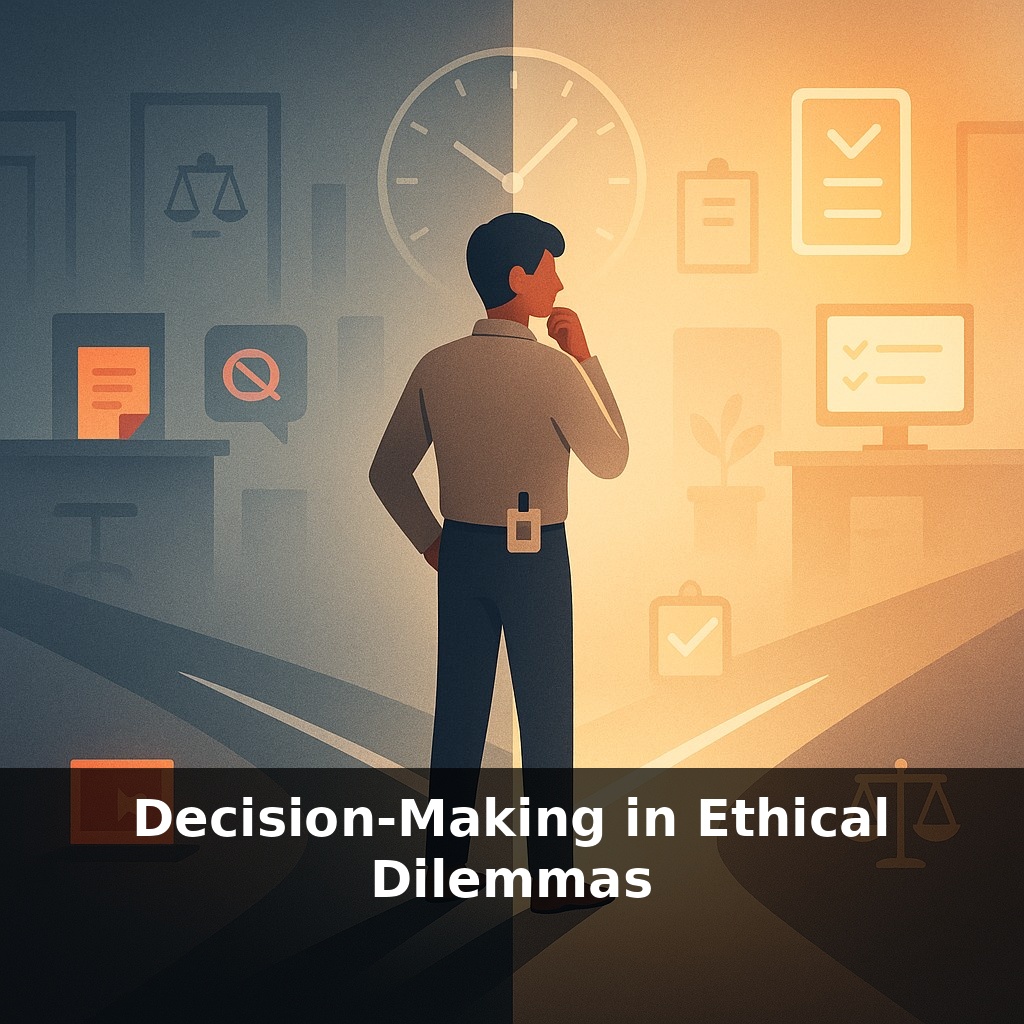
About half of employees see misconduct at work—and many stay silent. A nurse watches a colleague skip a safety check. A manager’s asked to “adjust” the numbers. A designer’s told to copy a rival’s layout. Each has minutes to choose: protect a job, or protect their integrity.
62 % of U.S. employees say they’ve seen something wrong at work, yet almost half stayed quiet. That silence doesn’t come from not caring; it often comes from feeling rushed, isolated, or unsure what “the right thing” actually looks like when paychecks, pressure, and people you like are involved.
In real life, ethical choices rarely appear as neat “right vs wrong” labels. They feel more like standing at a crowded intersection: loyalty pulling one way, fairness another, self‑preservation a third. Under deadlines and cognitive overload, we default to habit or hierarchy instead of our values—Harvard researchers found our accuracy in ethical judgment can drop by half when our mental bandwidth is strained.
This episode explores how to slow that moment down, bring your best thinking online, and build a repeatable way to choose you can stand behind later.
Most of us were never really taught how to decide in hard moments—we just picked up fragments: “follow your gut,” “follow the rules,” “do what helps the most people.” In practice, those signals can clash. You might feel one pull from personal loyalty, another from professional standards, and a third from your own future goals. Philosophers, psychologists, and compliance experts have each built tools for that exact tension. This episode connects them: clear principles, step‑by‑step checklists, and insights about how emotion and reason interact when you’re under pressure. The goal isn’t perfection; it’s a method you can trust when the stakes are high.
Ethical philosophers start from different questions, and each question becomes a lens for tough decisions. Utilitarianism asks, “Which option produces the best overall balance of benefit over harm?” Deontology asks, “What duties, rights, or rules must not be broken, even for a good outcome?” Virtue ethics shifts focus: “Who am I becoming if I choose this, and would a person of character do it?”
None of these gives a magic answer every time, but together they prevent you from being trapped in a single story—like only checking cost and never checking quality. When you face a dilemma, you can quickly run all three: - If I only maximised overall benefit, what would I do? - If I only followed duties and rights, what would I do? - If I only cared about the kind of person I’m shaping, what would I do?
Where they agree, you usually have a strong option. Where they conflict, you’ve located the real crux of the problem.
Structured models turn those lenses into steps you can walk through under pressure. Rest’s Four-Component Model says ethical action depends on four things: noticing there’s a moral issue at all, figuring out what’s right, prioritising that over competing motives, and then following through. Kidder’s checkpoints add prompts: clarify what’s at stake, sort out whether it’s a “right vs wrong” or “right vs right,” test options against principles, and seek a third way when two values collide. The Potter Box walks you through: define the facts, identify your values, consider relevant principles, and then weigh your loyalties.
Moral psychology adds one more piece: the timing of emotion and reasoning. Feelings often fire first; justification arrives later. Instead of treating emotion as the enemy, you can treat it as an early‑warning system that needs a second pass. The move is: feel, then name, then check. “I’m angry / afraid / protective—what value might that be flagging?” Then run the frameworks, and invite at least one outside perspective, especially from someone affected by the outcome.
Over time, the combination of lenses, steps, and emotional awareness becomes less like a script and more like a practiced skill—deliberate, but natural enough to use when the clock is ticking.
A product lead is told to launch an app feature despite known privacy flaws. Using the three lenses, they sketch options on a whiteboard: ship now and patch later, delay and fix fully, or restrict the rollout. Then they run a quick test: which choice would they defend in a press interview, to a regulator, and to a close friend who uses the app daily? That triangulation often reveals which “clever compromise” is really just avoidance.
In hospitals that train clinicians on the Potter Box, staff practice in short simulations: a family wants “everything done” for a patient who previously refused aggressive treatment. Teams pause, map the facts, list values (autonomy, compassion, professional standards), and explore a third path, such as time‑limited trials of treatment.
In team settings, one person can play the “utilitarian,” another the “duty advocate,” another the “character coach.” Rotating roles surfaces blind spots and prevents any single moral habit from dominating decisions.
Future implications stretch beyond personal choices. Boards now treat ethics like cybersecurity: not optional, and failure can crash the whole system. As AI, biotech, and climate tools scale, “good intentions” won’t be enough—regulators will expect visible decision trails, just as auditors track money. The next skill gap won’t be coding vs. humanities, but people who can fluently translate between algorithms, human values, and public accountability.
When the next dilemma hits, treat it as a live-fire drill for your values, not just a threat to survive. Pause long enough to map whose lives are touched, what rules and long-term habits you’re reinforcing, and how you’ll explain your choice to someone you respect. Over time, those small, traceable decisions quietly redesign the culture you move through.
Here’s your challenge this week: Before Friday, pick one real ethical dilemma you’re currently facing (or have recently faced) at work and run it through the exact three-lens process from the episode: outcome-focused (who’s helped/harmed), principle-focused (which values or policies are at stake), and character-focused (who you become by doing this). Then, schedule a 15-minute conversation with one “ethical ally” (a colleague you trust, as described in the podcast) and walk them through your reasoning using those three lenses, asking where they’d push back. Finally, before you act, write a one-sentence “future headline” about your decision that you’d be comfortable seeing shared with your team, and use that as your final test before you move forward.