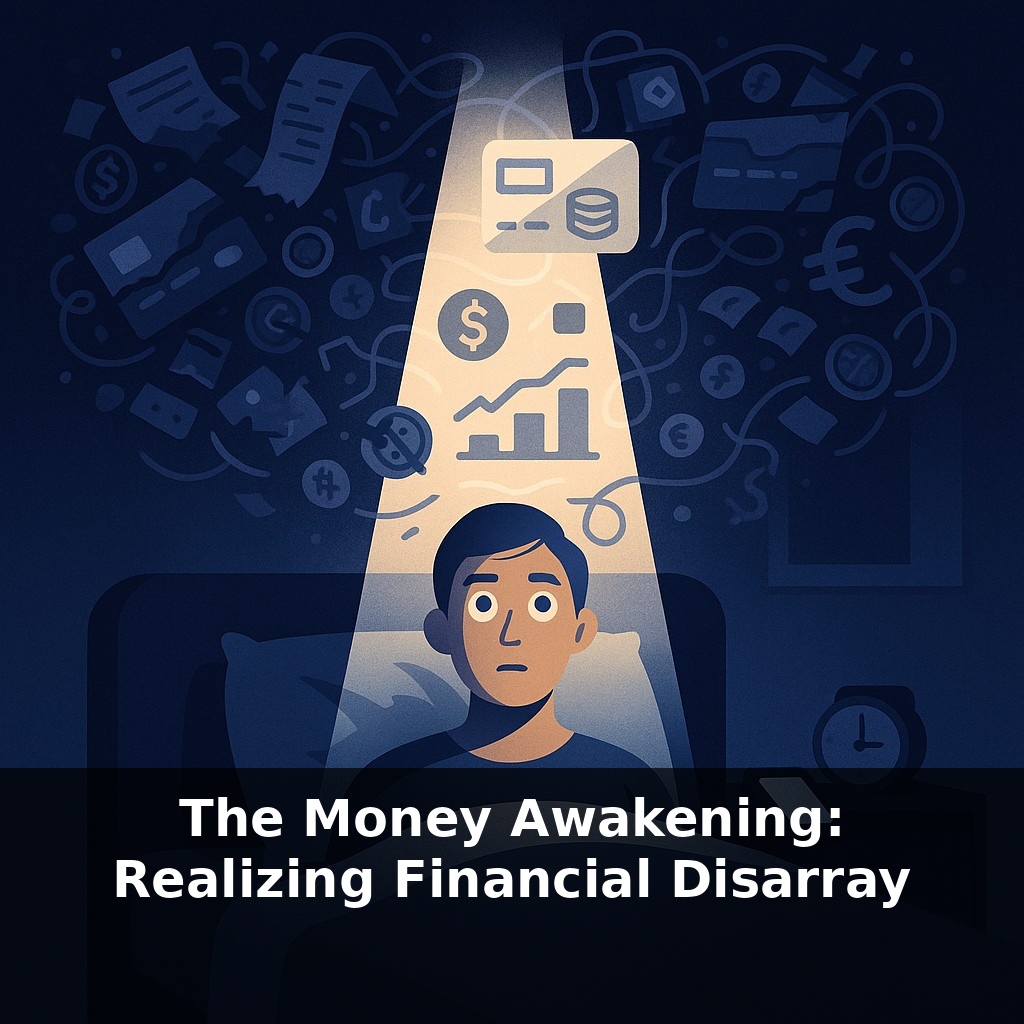
The Money Awakening: Realizing Financial Disarray
📝 Transcript
A strange money truth: people with high financial stress are more than twice as likely to lose sleep—yet many can’t say, out loud, how much they owe. You’re paying for chaos with your rest. Why do smart, capable adults feel so lost the moment the topic is their own bank account?
You’re not “bad with money” because you lack willpower; you’re operating in a system wired to exploit confusion. Apps nudge you to “buy now, pay later,” cards reward you for spending more, and subscriptions quietly stack in the background. Meanwhile, no one hands you a clear playbook for income, bills, debt, and savings working together on purpose. That gap—between complex money tools and almost no training—is where financial disarray thrives.
Here’s the twist: disorganization isn’t just messy, it’s measurable. Scattered accounts, revolving balances, and missing savings are data points, not character flaws. When you start treating your money life like a buggy software program—diagnosing glitches instead of blaming the user—you unlock a calmer, more objective mindset. This episode is about spotting those glitches, without shame, so you can finally see where your system is breaking down.
Think about what “normal” has started to mean: juggling four different banking apps, a handful of credit cards, and a dozen subscriptions you barely remember approving. On paper, your income might look fine; in practice, money keeps vanishing between paychecks. That gap between what you *earn* and what you can actually *see* is where quiet chaos hides. The signs are subtle at first—an overdue notice here, a declined card there—until they stack into a background hum of dread. This isn’t about perfection; it’s about turning that hum into a clear signal you can finally respond to.
The starting point is brutally simple: either your money has a job on purpose, or it’s drifting. Disarray lives in that drift. It shows up as income arriving, swirling through accounts, and disappearing without you being able to say, “Here’s where it went, here’s what it did for me.”
One way to see this is to follow the “money trail” of a single paycheck. It lands in checking, a few card payments hit, random taps from food delivery and rideshares go through, a streaming service renews, a gym membership you’re not using auto-charges, and by the time you look again, the balance is thin. Nothing catastrophic happened, but nothing was intentional either.
Notice what’s missing in that story: a clear order of operations. There’s no moment where essentials, savings, and debt reduction get first claim. Instead, spending wins by default because it’s easiest and most emotionally rewarding in the moment. This is where cognitive biases quietly run the show—present-you is louder than future-you, and “I’ll sort it out later” becomes a standing policy.
The math underneath this drift is not neutral. That $5,000 sitting on a 22% card isn’t just a number; it’s a daily meter running in the background. Roughly six dollars a day leaks out of your future choices to pay for past ones. Over a year, that’s more than some people keep in their entire emergency fund. When there’s no structure, interest becomes the only “plan” in place—and it’s working for the bank, not for you.
Another red flag: silence. Unopened bills, unread statements, and app notifications you swipe away are all forms of opting out of feedback. The less you look, the scarier it feels to look, and the more likely you are to miss the moment when a manageable balance becomes a problem balance.
Think of the architecture of a building: if pipes, wiring, and exits are mapped, you can fix issues quickly. If they’re haphazard, every leak becomes an emergency. Financial awakening isn’t about perfection; it’s about finally sketching a floor plan of your money so problems stop ambushing you.
Your challenge this week: pick one paycheck and trace it, transaction by transaction, from the moment it arrives until it’s gone. No judgment, no editing—just observe where it actually flows. At the end of the week, circle every dollar that surprised you. Those surprises are your first, concrete proof of where chaos lives.
A practical way to spot money drift is to zoom in on tiny, “harmless” choices. Say you grab takeout for $18 instead of using groceries you already bought. Once? No big deal. But if that happens three times a week, you’ve quietly reassigned about $200 a month—money that could have knocked real chunks off a card balance or padded a thin buffer. Another example: subscriptions. A $12 app here, $9 service there, a “free trial” you forgot to cancel. Individually they feel invisible; together they might match a car payment. This is where awareness beats guilt: you’re not banning takeout or canceling joy, you’re noticing patterns that never got a conscious “yes.” One more angle: track how often you “patch” shortfalls by shifting between accounts or cards. Each transfer is like taping over a crack in the wall—evidence of stress in the structure, not failure in you. Once you see these recurring moves, you’re closer to redesigning the system so it needs fewer patches in the first place.
As tools get smarter, disarray becomes harder to hide. A future dashboard might flag, “Your weekend spending just cut next month’s travel fund by 18%,” the way a GPS reroutes after a wrong turn. That level of feedback can feel intrusive, but it also shifts money from foggy guesswork to visible tradeoffs. The open question: will you let these systems coach you, or treat them like warning lights on a car you keep driving until something actually breaks?
You don’t have to fix everything at once; noticing is the first lever. Like finally turning on the lights in a cluttered room, you see both the mess and the open space. As you keep watching where money actually goes, patterns turn into choices, and choices turn into small experiments. Over time, those experiments become a system that quietly has your back.
To go deeper, try one of these specific experiments: 1) Open a free account with a tracking tool like Monarch Money or You Need A Budget (YNAB) and import the last 90 days of transactions so you can actually see the “financial fog” the episode talks about in black and white. 2) Grab *The Psychology of Money* by Morgan Housel (a favorite among people doing a “money awakening”) and read just Chapter 1 today, then jot one behavior you recognize in yourself directly into the notes app on your phone. 3) Watch Ramit Sethi’s 20-minute “Conscious Spending Plan” video on YouTube and use his downloadable worksheet to map a first-pass version of your own “aligned spending” – especially around the 1–2 areas where you feel the most shame or chaos, like debt or impulsive purchases.
From this course
From Financial Chaos to Peace
5 episodesUnlock all episodes
Full access to 5 episodes and everything on OwlUp.
Subscribe — $1.99/monthLess than a coffee ☕ · Cancel anytime