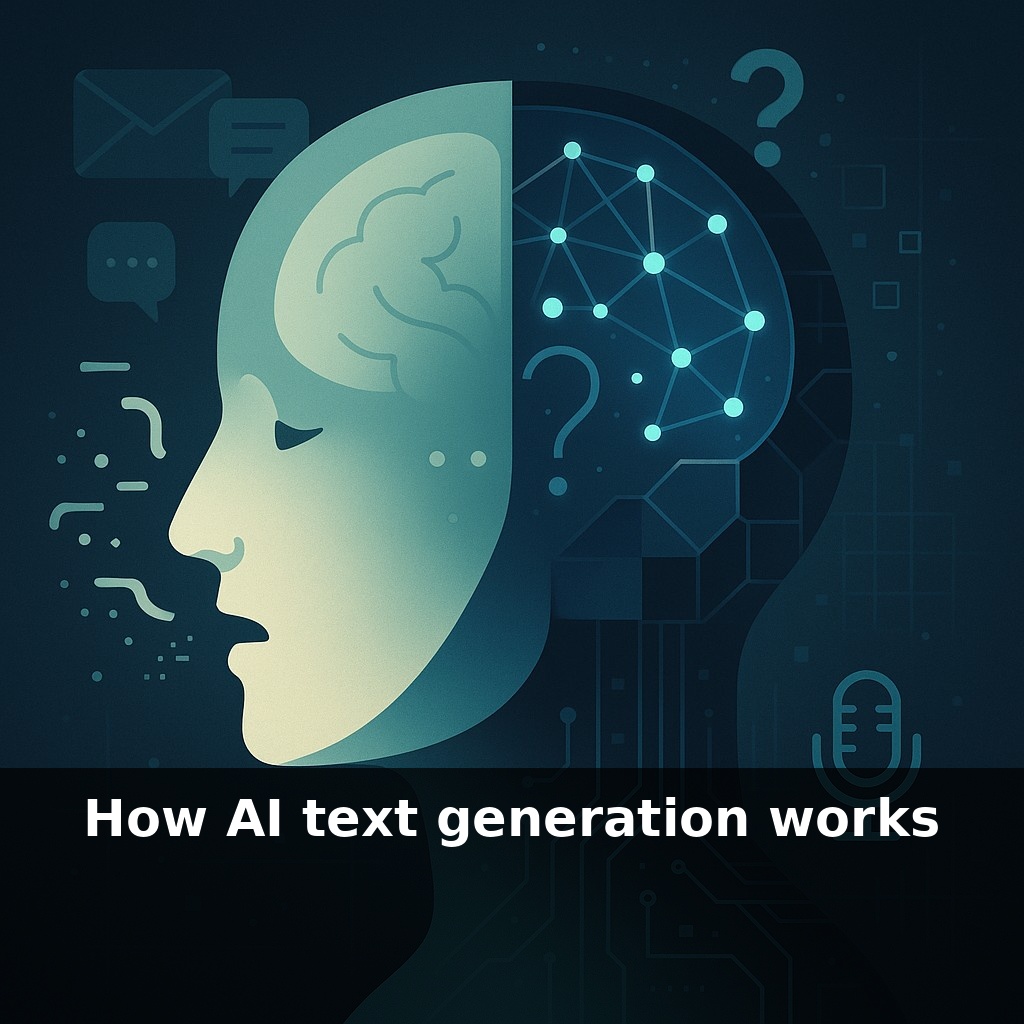
Emails flood your inbox daily, seamlessly blending human and AI-generated content. Yet, what if the machine behind those sentences never 'understood' a single word? Yet that machine has never “understood” a single word. In this episode, we’ll step inside that contradiction and trace how lifeless math starts sounding unmistakably human.
So if the AI never truly “understands,” what *is* it doing under the hood? Modern systems lean on something called a large language model, or LLM. Think of it as a vast internal map of how words, phrases, and structures tend to follow one another across billions of examples. Instead of storing facts like an encyclopedia, it stores tendencies: this word often follows that one; this style usually goes with that topic.
Today’s most advanced LLMs are built with a design called a Transformer, introduced in 2017 by Vaswani and colleagues. This design lets the model look at every part of your input at once, weighing which pieces matter most before choosing each next word. When you type a prompt, it’s sliced into tokens (numerical IDs), pushed through layers of this mechanism, and then—step by step—the model proposes the next likely token, over and over, until your reply appears.
During training, this mapping of word patterns grows to an almost absurd scale. GPT‑3, for example, tuned 175 billion internal “knobs” using tens of terabytes of text drawn from books, web pages, code, and more. Each training step slightly adjusts those knobs to make the model’s next-word guess a bit less wrong. Repeat that billions of times, across countless topics and styles, and the system develops a flexible sense of how people *tend* to write everything from legal briefs to love letters, without storing any one document line by line.
When that training is over and you finally ask the model something, a very different game begins. Now it isn’t *learning* from text; it’s *leaning* on what it has already learned to navigate a space of possibilities in real time.
The core move is surprisingly simple: at each step, the system builds a giant probability list over its whole vocabulary. For your current partial sentence, it estimates how likely every possible next token is—maybe “cat” gets 0.21, “dog” 0.07, “quantum” 0.000003, and so on. Then it doesn’t just grab the top option and march forward mechanically; most modern systems add a controlled dose of randomness.
Two dials matter here: temperature and sampling strategy. Temperature nudges the model to be cautious or adventurous. Turn it down and the model hugs the safest, most predictable continuations. Turn it up and it’s more willing to take risks, occasionally leaping to an unusual but still plausible turn of phrase. On top of that, sampling schemes like “top‑k” or “top‑p” deliberately ignore the long tail of ultra‑unlikely words, forcing choices among only the most credible candidates.
This is where style, creativity, and even mistakes come from. The same prompt with a low temperature might yield a dry bullet list; with a higher one, you could see vivid storytelling or quirky phrasing. The underlying training hasn’t changed at all—only the way we walk through the probability landscape does.
Scale amplifies these effects. GPT‑3’s 175 billion parameters let it extend patterns over long stretches of text: keeping code syntax consistent, preserving character traits in a story, or maintaining a legal argument’s structure across pages. That’s also why specialized deployments matter. GitHub Copilot, for example, steers the model heavily toward code completions, while Duolingo’s roleplay feature constrains prompts and responses toward language practice and gentle feedback rather than open‑ended chatting.
All of this output is then filtered and guarded. Providers layer on safety rules, content filters, and sometimes extra models that watch the text as it’s produced, nudging it away from harmful or off‑policy directions in real time.
Think about how this plays out in tools you might already use. GitHub Copilot, for instance, doesn’t just “finish your code.” It tends to mirror your habits: if you favor verbose variable names and generous comments, its suggestions drift that way; if you’re terse and compact, it usually follows suit. The underlying probabilities get bent by your recent edits, the file’s style, even the surrounding project.
In Duolingo’s Roleplay, something similar happens with tone. The same learner prompt can yield very different replies depending on your level and past mistakes: more hints, slower phrasing, or extra encouragement if you’ve been struggling. Instead of a single generic voice, the system’s sampling choices are quietly steered by the app’s goals—keep you practicing, not just “answer the question.”
A bit like a jazz group adjusting mid‑performance to the room’s energy, these systems constantly nudge their next notes to stay in sync with *you* and the task at hand.
Turing warned that “machines take me by surprise with great frequency.” As text systems expand into multimodal tools that can also watch, listen, and speak, that surprise cuts both ways. They’ll draft laws, debug circuits, even storyboard films. Your future feed might blend human and synthetic voices so seamlessly that provenance matters as much as content—like checking a food label, but for ideas. Expect norms, audits, and watermarks to become part of everyday digital hygiene.
Soon, spotting AI text may feel less like catching a typo and more like tasting a hint of spice in a familiar dish—subtle, but there. You’ll weigh tone, context, and stakes: is this closer to a calculator, a coauthor, or a counterfeit? As tools blend into search, docs, and chat, your real power becomes choosing when synthetic words are welcome.
Before next week, ask yourself: 1) “If I watched a ‘token-by-token’ playback of my own writing, where do I tend to ramble or repeat myself the way a poorly-tuned language model does—and how could I tighten one real email or document I wrote today using that awareness?” 2) “Looking at a concrete task I do often (like drafting reports, lesson plans, or marketing copy), where could I safely let an AI handle the ‘prediction-heavy’ first draft while I stay firmly in charge of the facts, tone, and final judgment?” 3) “If I treated AI like a ‘probability engine’ instead of a magic brain, what’s one risky use case I’m considering (e.g., medical, legal, hiring) that I should explicitly *not* automate—and how will I draw that boundary in my work this week?”