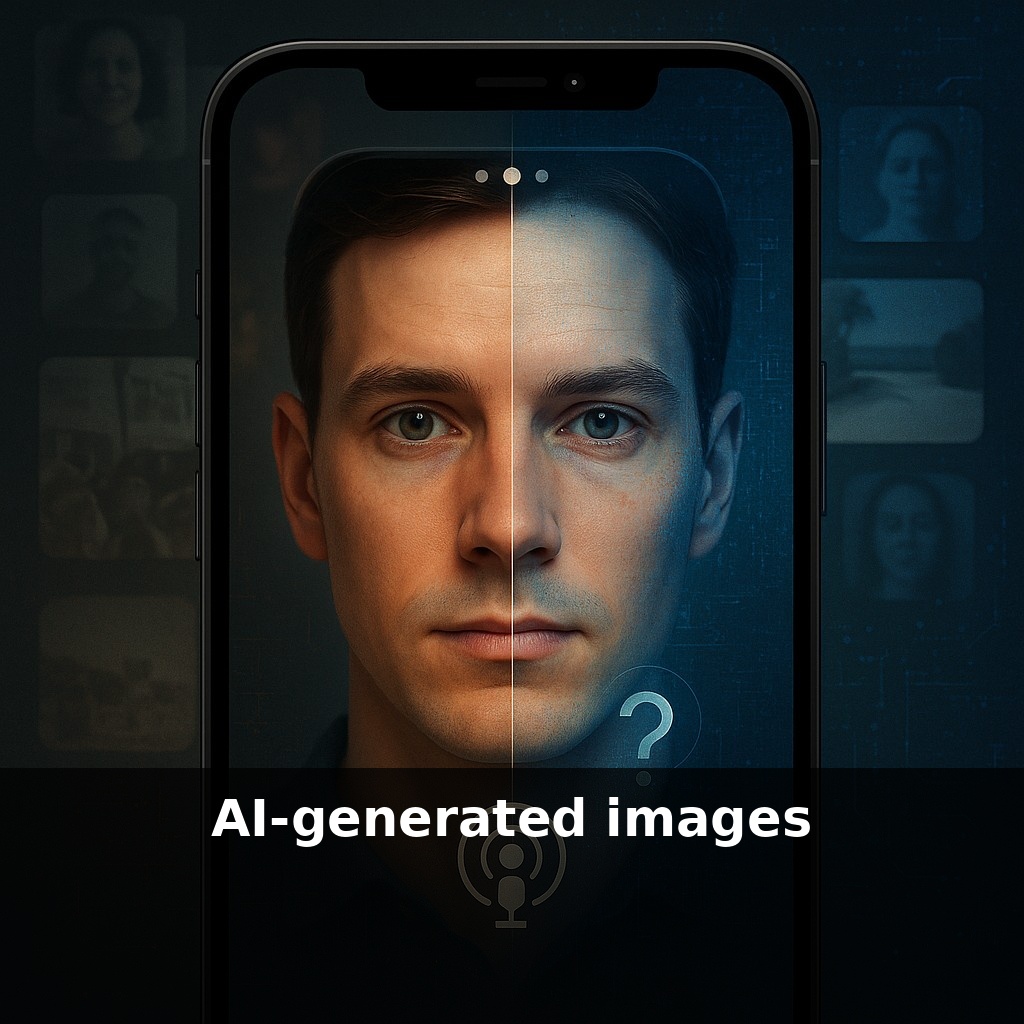
About half of people now struggle to tell an AI‑generated face from a real one. You’re scrolling late at night, you see a tearful selfie, a shocking protest photo, a too‑perfect vacation shot. One is fake, one is real, one is edited. You have three seconds. What tips you off?
About 61% of the time, people guess wrong when they try to spot an AI‑made face. That’s barely better than flipping a coin, and it gets harder as generators improve. The tricky part: most fakes don’t scream “fake.” They quietly slip past your instincts, especially in fast, emotional contexts—breaking news, charity appeals, viral celebrity “leaks.”
Today we’ll zoom out from single images and look at the bigger ecosystem they live in: how AI systems are trained on billions of pictures and captions, how that scale shapes the kinds of mistakes they make, and why those mistakes are getting rarer. Think of it like learning to hear a new instrument in a crowded song: at first it’s noise, then patterns start to emerge. We’ll also touch on why platforms built around these tools—like massive prompt‑sharing communities—are accelerating both creativity and confusion.
That scale has a flip side: the same statistical quirks that let models invent convincing scenes also leave faint seams to tug on. Think odd reflections in sunglasses, jewelry that warps into the skin, shadows that don’t agree on a light source, or crowds where every “unique” face feels like a remix of the last. Meanwhile, tools to detect these quirks are racing to keep up, from forensic filters that scan for pixel‑level fingerprints to browser plug‑ins that flag suspect visuals. The result isn’t a clear win for humans or machines, but an arms race most of us are dropped into mid‑stream.
Some of the clearest clues that an image is synthetic don’t live in single pixels, but in how meaning, physics, and context line up—or don’t.
Start with *stories inside the frame*. Generators are superb at surface detail, but they’re still shaky on cause-and-effect. Look at whether the scene tells a coherent mini‑story: Does the way someone grips an object match what they’re supposedly doing? Are facial expressions synced with body language, or is everyone “smiling with their teeth” while their eyes stay oddly blank? Are props actually usable—a microphone with no cable or pickup, a “security badge” with nonsense text, medical gear that looks vaguely right but couldn’t function?
Next, check *consistency across copies*. AI systems often struggle to keep distinctive symbols stable when they reappear. In a sequence of images of the “same” person or event, does the logo on a jacket morph between frames? Does a tattoo hop from arm to arm, or change design slightly? In genuine photo sets, errors happen, but they tend to be in focus or angle, not in the underlying identity of objects.
Then there’s *style bleed*. Models like Stable Diffusion and Midjourney absorb millions of visual styles at once. When they remix them, you sometimes see anachronistic mashups: “old” street scenes lit like a glossy fashion ad, or “war zone” photos with cinematic color grading that feels more movie poster than journalism. That doesn’t prove anything by itself, but when the emotional temperature of the scene is high and the image looks suspiciously well‑composed, treat it as a yellow light.
Outside the frame, *metadata and provenance* matter. Many AI tools strip or alter EXIF data, leaving images with no camera model, impossible timestamps, or compression artifacts that don’t match how social networks usually process uploads. Newer standards like C2PA aim to embed tamper‑evident logs of where and how a visual was created. When they’re present, they can confirm a chain of trust; when they’re conspicuously absent on something that claims to be official, that’s another soft flag.
Think of it like listening for a cover song that almost—but not quite—nails the original: the melody is there, but tiny timing slips and odd emphases give it away. With practice, you’re not hunting for one “tell,” but noticing a cluster of small dissonances between what the image shows, what the world allows, and what the surrounding context supports.
Think of an AI image claim like a travel story from a stranger at a bar. You don’t verify every sentence; you listen for little mismatches. “I took this on my phone from inside the plane *during takeoff*” – but the shot is perfectly framed outside the cockpit, with no window reflection. Or “this was a quick news snapshot” – yet every person stands in perfect thirds, with cinematic backlighting, as if they posed for a magazine spread.
Concrete examples help. When a “breaking news” disaster image circulates, zoom into the edges: do power lines connect to anything, or fade into nowhere? Do license plates follow a real format for that region? In AI sports photos, watch the gear: basketball rims that are slightly oval, goalposts merging with the crowd, or jerseys that almost spell a famous brand but not quite.
You can also cross‑check time and place. A “live” snowstorm shot paired with weather reports showing clear skies, or palm trees in a city that doesn’t have them, should nudge you to pause before sharing.
Misinformation isn’t the only consequence of synthetic images; expect quieter, everyday shifts too. Visual trust may move from “do I believe this?” to “who vouches for this?”, nudging us toward news outlets, friends, or tools that act like photo sommelier—curating what’s likely authentic. At home, families might routinely tag “AI‑assisted” albums, the way we once labeled film rolls, turning personal archives into layered timelines of both memories and machine imagination.
Treat this as learning a new city at night: the more you walk it, the better you sense which streets feel “off.” AI images will only grow sharper, but so will your intuition if you keep testing it—checking sources, pausing on viral claims, comparing angles like you’d verify a surprising rumor. Curiosity, not paranoia, is your best long‑term filter.
Before next week, ask yourself: Where in my current work or hobbies (like presentations, social posts, product mockups, or lesson materials) could AI-generated images immediately save me time or unlock visuals I currently can’t create? When you next open a tool like Midjourney, DALL·E, or Stable Diffusion, what’s one oddly specific image you’d love to experiment with (e.g., “a 3D isometric city at sunset in vaporwave colors” or “a friendly robot explaining budgeting to teenagers”)? As you play with prompts and variations, how will you decide what feels ethically and creatively “right” for you—such as being transparent about AI use, avoiding style-mimicking of living artists, or setting personal rules for what you will and won’t generate?