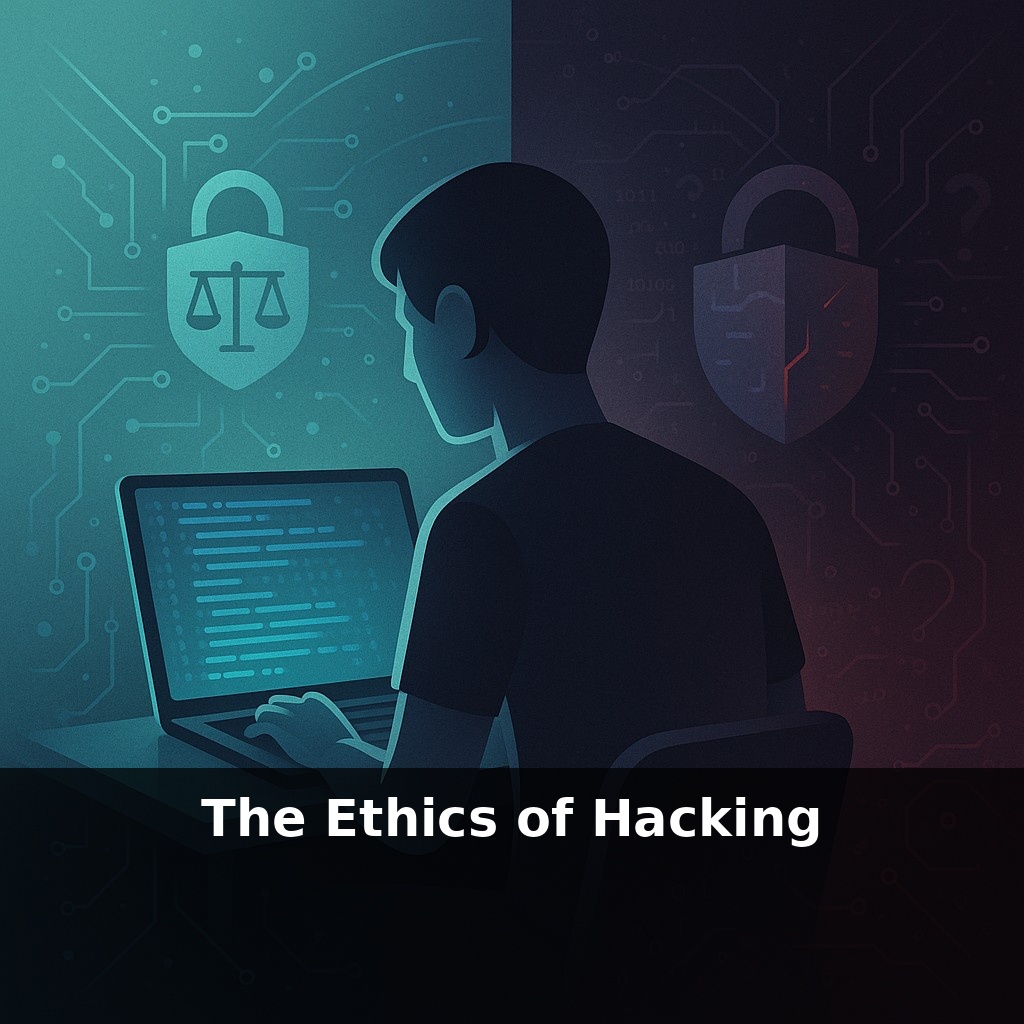
The Ethics of Hacking
📝 Transcript
Meet Ethan, a hacker who changed his life by earning a bounty for breaching a company’s system—with their explicit permission. But here's the twist: what could be a crime in one context becomes a job description in another. So, when does hacking transform from a public service to digital crime?
In this episode, we’re stepping into the gray zone where curiosity, law, and responsibility collide. Not every exploit is launched by a villain in a hoodie; sometimes it starts with a bored student, a misconfigured server, and a conscience that has to decide what happens next. Ethical frameworks are what turn raw technical power into something society can live with. They answer questions like: Who gave you permission? What will you do with what you find? Who gets hurt if you’re careless—or if you stay silent? Professional codes, certification pledges, and disclosure timelines might sound dry, but they quietly shape whether a clever discovery becomes a security fix, a public scandal, or a criminal case.
Think of today’s networks as crowded cities stitched together by fragile bridges: cloud platforms, medical records, smart homes, industrial controls, even voting infrastructure. When one of those bridges fails, the traffic it carries isn’t just data—it’s salaries, hospital charts, power grids, and private conversations. That’s why intent and permission aren’t abstract philosophy; they decide whether probing a weakness quietly protects millions or quietly endangers them. As more organizations invite outsiders to test their defenses, the puzzle becomes how to encourage curiosity without normalizing recklessness.
When professionals talk about “ethical hacking,” they’re really talking about three moving parts: consent, scope, and consequence.
Consent is more than “the company kinda knows I’m testing them.” It usually means a written agreement, a clearly published Vulnerability Disclosure Policy, or a bug‑bounty program with rules. Those rules spell out what’s in bounds and what’s absolutely off‑limits—like production payment processors or live medical systems. Cross that line, and the law tends to care more about what you touched than how noble your intentions were.
Scope is where a lot of people with good motives still get burned. Maybe a signup form is in scope, but the marketing database behind it is not. Maybe you’re allowed to test the web app, but not flood the servers or touch user data. Ethical hackers learn to squeeze maximum signal from minimal intrusion: low‑impact payloads, throttled scans, careful proof‑of‑concepts that show risk without creating new damage.
Consequence is the part ethics frameworks can’t fully script. Suppose you stumble on credentials that open far more than you were authorized to test. Do you stop at the edge of the agreement, or go further to assess the real blast radius? Do you quietly report, or also warn affected users if the company drags its feet? That’s where “legal” and “ethical” can start to diverge.
On the other side are people who weaponize the same skills for extortion, sabotage, or ideological spectacle. Their targets aren’t just giant corporations—it might be a local school district or clinic that can’t afford downtime. The technical steps may look nearly identical to what a penetration tester does, but the absence of consent and the disregard for collateral damage flips the moral calculus.
Ethical hackers also argue among themselves. Some see any testing without explicit permission as a red line. Others defend limited, good‑faith probing of critical public infrastructure when no formal channels exist, especially if the alternative is leaving obvious flaws for criminals to find first.
The messy truth is that our laws were largely written for a world of locked rooms and broken windows, not shared APIs and misconfigured S3 buckets. Until those laws catch up, practitioners have to navigate a patchwork of contracts, norms, and personal red lines—deciding not just what they can do with their skills, but what they’re willing to live with afterward.
A famous case: a teenage researcher quietly probed a public transit card website, discovered he could reload cards for free, and privately alerted the operator. They fixed it, thanked him—and later hired him as a consultant. Same pattern, different choices: another teen found a flaw in a school grading portal, changed a few scores “as a joke,” and ended up with felony charges. The technical leap from reading‑only access to tampering was small; the ethical leap was huge.
Think of two hikers who notice a loose plank on a popular cliffside trail. One flags the park rangers, takes photos, and steps back. The other kicks at the plank to “see what happens,” sending it tumbling onto the path below. Both were curious; only one treated other people’s safety as part of the experiment.
In practice, companies signal how they want these “hikers” to behave. Clear “hack us if you can” pages, safe‑harbor language, and public thanks on a Hall of Fame wall tell researchers: we’re ready to listen. Silence, vague warnings, or legal threats tell them: even well‑meant discoveries may backfire.
Building on the understanding of how ethical hacking intersects with legality, we see it drifting from subculture to civic duty. As smart homes, cars, and hospitals become tightly wired, flaws in one device can ripple like a power outage across a city. Law, policy, and engineering are slowly converging: treaties that treat zero‑days like hazardous exports, audits that ask “who’s allowed to hack you, and how?”, and teams where a red‑teamer sits beside the AI engineer, arguing not just about what’s possible, but what’s acceptable.
As more everyday objects quietly join the internet, deciding how we use offensive skills becomes less niche craft and more civic question. Do we reward people who surface ugly truths, or push them into the shadows? Your challenge this week: notice one device you rely on, and ask who’s allowed to break it on purpose—and who should be.
From this course
Introduction to Ethical Hacking Techniques
6 episodesUnlock all episodes
Full access to 6 episodes and everything on OwlUp.
Subscribe — $1.99/monthLess than a coffee ☕ · Cancel anytime

