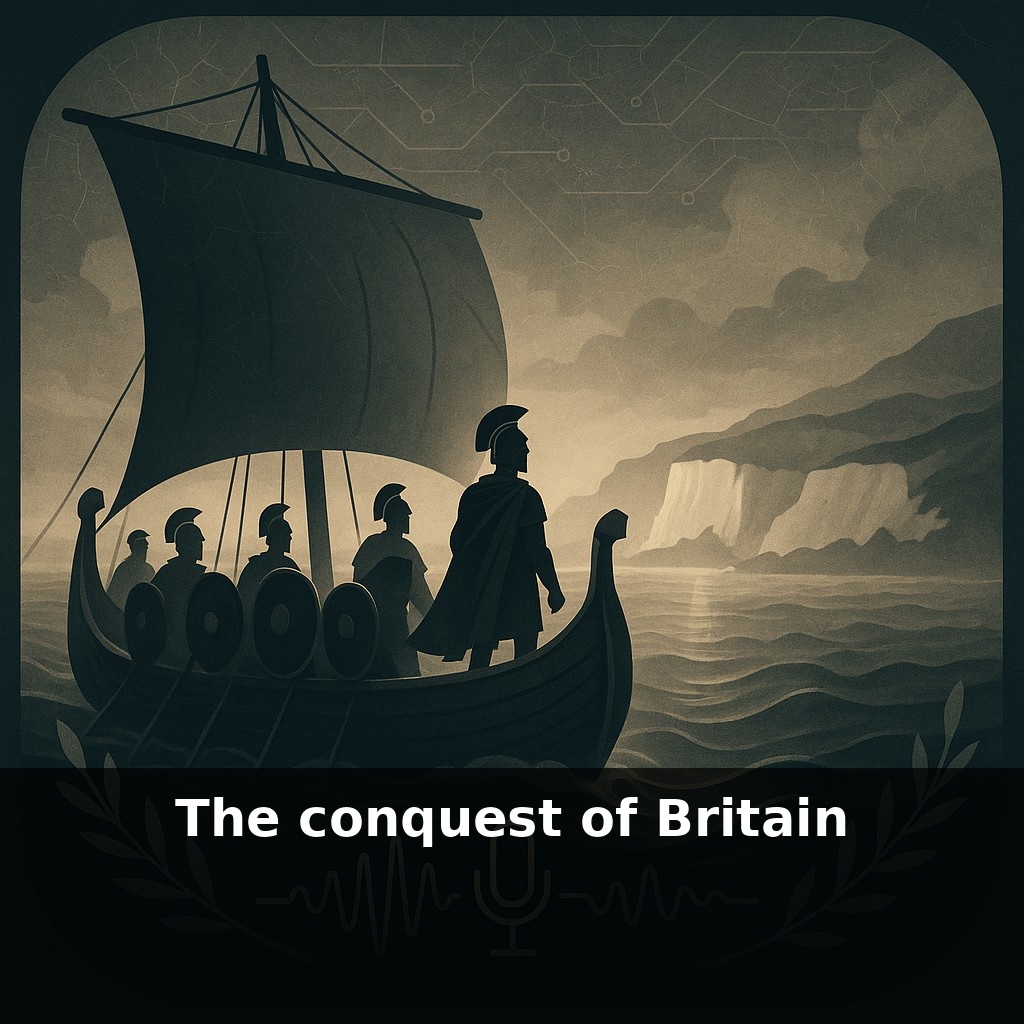
Roman soldiers once sailed toward a misty shoreline they could barely describe, chasing an island they weren’t even sure was real. In this episode, we dive into why Caesar risked his career to touch a land his own advisors treated as half‑myth, half‑military gamble.
Caesar reached Britain at a moment when the Roman Republic felt both unstoppable and strangely fragile. Power was expanding outward, but politics at home were cracking like ice under too much weight. So when he looked across the Channel, he wasn’t just seeing distant hills; he was seeing leverage. Britain had tin, slaves, exotic goods, and a reputation as a supplier of warriors to Gaul. Controlling the source meant tugging on a whole web of influence that stretched back onto the continent and, ultimately, into the Roman Senate.
For many Britons, the Channel was less a border and more a busy highway of trade and alliances. Raiding, hostage‑taking, and political deals hopped back and forth with the tides. Caesar’s decision to cross didn’t invent this traffic—it tried to hijack it. To understand his expeditions, we have to see Britain not as a lonely island, but as a noisy intersection in Iron Age Europe.
Caesar also knew he wasn’t the first outsider to matter in Britain—just the loudest so far. Local kings were already competing like rival band leaders, each trying to control key ports, river crossings, and sacred sites that drew trade and tribute. Some had family ties in Gaul, some hired continental mercenaries, and several were quietly betting that a Roman connection could tip the balance at home. Britain, from Caesar’s perspective, wasn’t a blank map; it was a crowded scoreboard where he planned to rewrite who counted as a “local” power.
The first time Caesar actually pointed his prows toward Britain, nearly everything about the operation screamed “improvised.” He sailed late in the campaigning season with too few ships, no secure harbor, and only sketchy reports about tides and weather. The result was a kind of controlled embarrassment: his infantry managed to scramble ashore under missile fire, but his cavalry—crucial for pursuit and scouting—was blown back to Gaul by storms. Once he was on the beach, he found that the real enemy wasn’t just British resistance; it was logistics.
Supplies had to cross a narrow but treacherous sea. Tides chewed at anchors, storms ripped moorings, and any ship that broke meant less grain, fewer horses, fewer options. Caesar learned quickly that conquering a shoreline on a sunny afternoon and sustaining an army beyond it for months were two very different problems. He could win set‑piece clashes yet still be forced to bargain if his food, cavalry, or ships were threatened.
The second expedition looked very different. When he returned, it was with a massive armada and a clearer picture of who mattered politically inland. He marched beyond the coastal belt and started targeting the power networks behind the warriors. That meant pressing leading tribes, demanding hostages, and backing rivals when it suited him. Submission, in this context, was less about planting flags and more about bending key families just enough that they’d send tribute and promises back across the Channel.
On British side, the technology of resistance had its own character. War chariots still rattled across the fields—something Romans hadn’t faced at scale for generations. They combined mobility, missile fire, and shock, darting in to harass, then racing away before heavy infantry could fix them. To legionaries drilled for tight formations, these swirling attacks added a layer of psychological pressure as well as tactical complication.
All the while, Caesar was writing. De Bello Gallico turned messy, weather‑wrecked campaigns into a narrative of steady dominance. Defeats became “difficulties,” withdrawals became “strategic decisions,” and brief, fragile agreements were framed as far‑reaching submissions. Britain, on the page, became less a frustrating coastline and more a stage on which Caesar could display adaptability, daring, and command over a reluctant edge of the known world.
Caesar’s British campaigns are easiest to grasp if you zoom in on three kinds of “technology”: ships, roads, and information. His first crossing exposed how fragile his sea‑bridge was; the second showed how quickly Rome could turn that weakness into a repeatable system. Engineers adjusted hull designs and loading methods, pilots refined timing with tides, and scribes quietly standardized sailing data into something like a field manual for the Channel.
Once ashore, the lack of Roman‑style roads meant movement ran on local knowledge. Caesar had to “borrow” Britain’s mental maps—learning which tracks avoided marshland, which fords were seasonal, which hilltops could signal across distance. Every guide, hostage, and political guest doubled as a potential data source, filling in the blank spaces of Roman charts with lived detail.
The paradox is that Britain changed Rome’s mental geography long before Rome changed Britain’s landscape. Routes, wind patterns, and tribal chains of command all became part of a planning toolkit that future emperors could pull from as casually as later generals consulted rail timetables.
Future work will likely treat Caesar’s Channel forays less as isolated stunts and more as the starting point of a long, data‑driven experiment in empire. As coastal zones shift and new surveys peel back soil like layers of old paint, patterns of camp placement, supply routes, and local collaboration may emerge. Your challenge this week: pick any modern border region and ask how today’s patrols, ports, and pipelines echo those first cautious Roman probes.
In the end, Caesar left more questions than milestones in Britain. His raids functioned less like a finished story and more like a sketchbook margin, where someone has scribbled half‑formed plans. Later emperors would color them in—sometimes following his lines, sometimes ignoring them. The Channel remained a hinge, quietly teaching Rome how far its reach could stretch.
Before next week, ask yourself: 1) “If I were a Briton watching Claudius’ legions land and march on Camulodunum, what would I actually fear losing the most—my land, my gods, or my way of life—and what does that reveal about what I cling to now?” 2) “The Romans built roads, forts, and towns like Londinium to lock in their control; what ‘roads and forts’ (habits, systems, routines) have I allowed into my life that quietly shape my decisions the way Roman infrastructure reshaped Britain?” 3) “Thinking of Boudica’s revolt—when she decided that living under Roman rule was worse than the risk of rebellion—where in my own life am I tolerating a ‘Roman occupation’ of my time, values, or attention that I might finally be ready to challenge?”