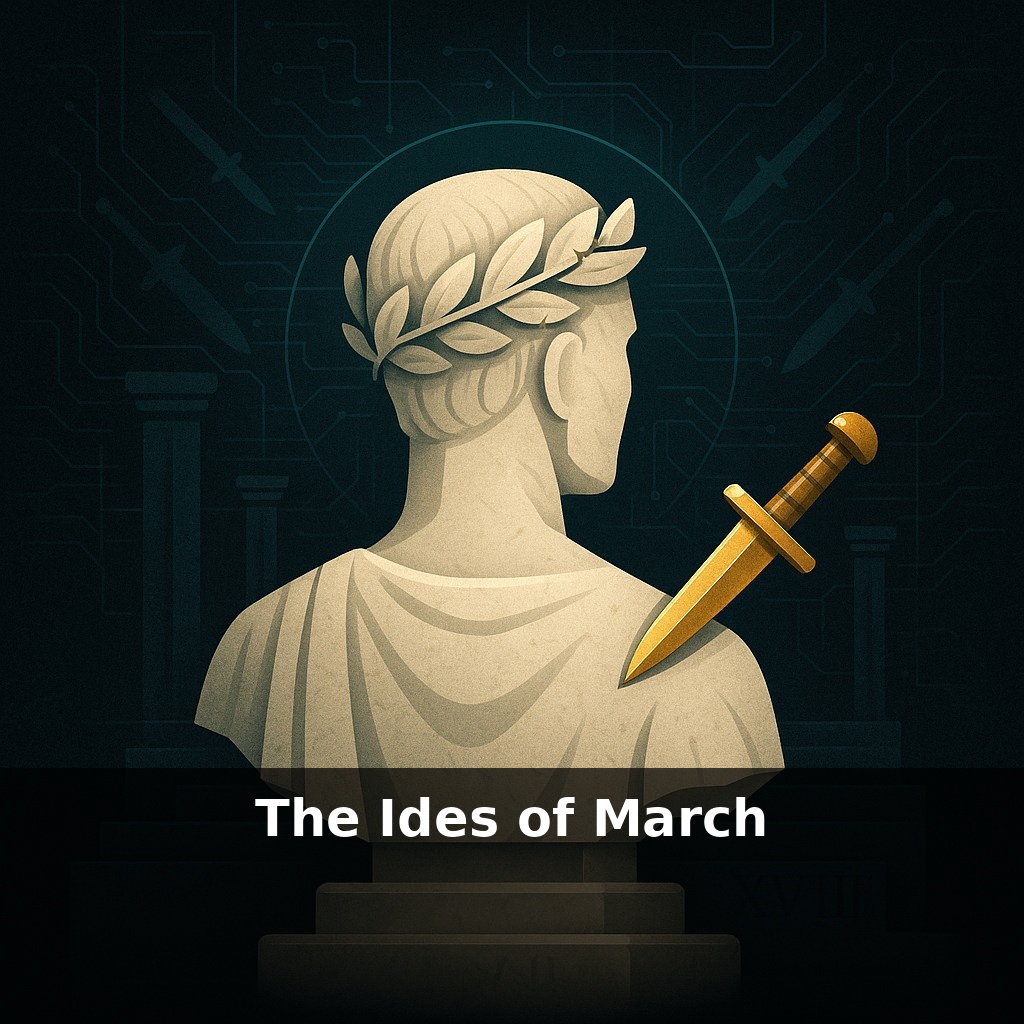
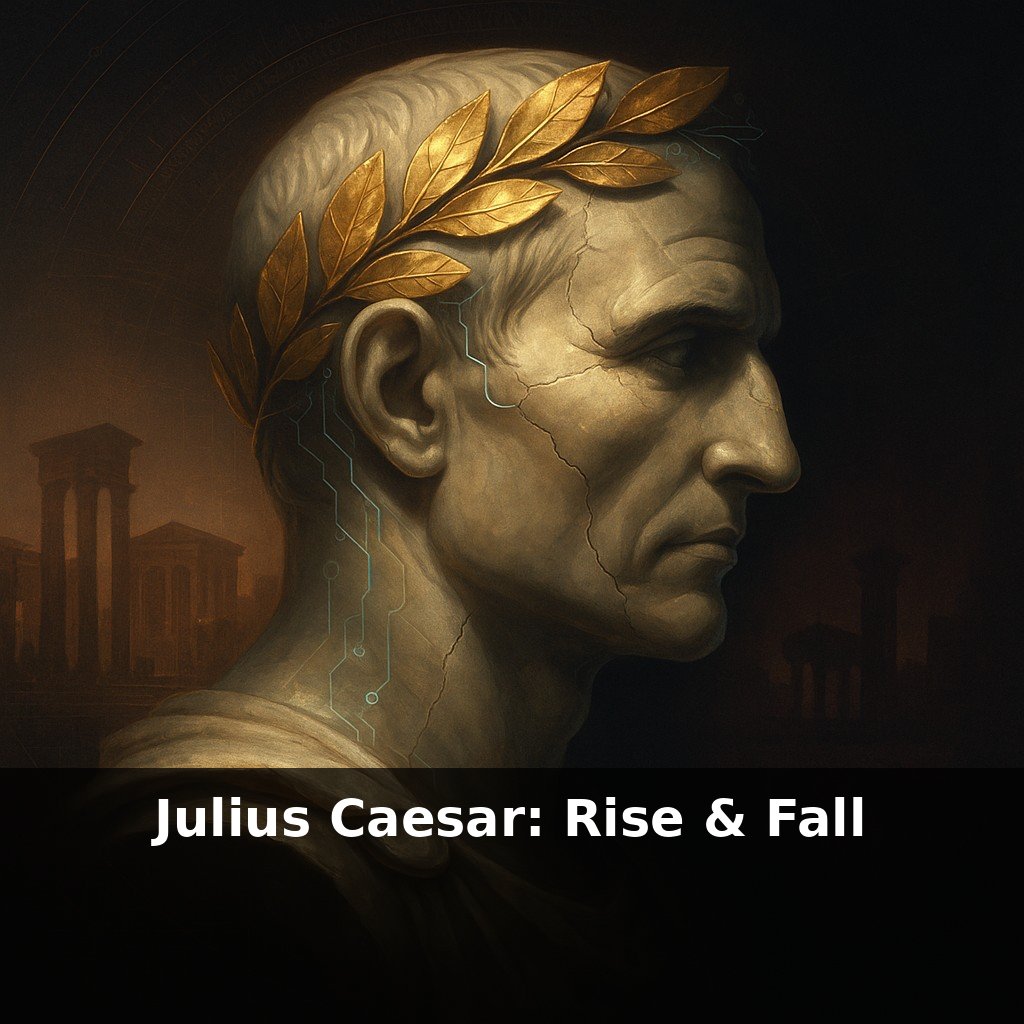
Julius Caesar walked into a Senate meeting and never walked out—killed not in the Forum, but in a theatre built by his rival. Senators thought they were saving the Republic. Instead, they may have killed it. How does one murder reshape the fate of millions who never held a sword?
Fifteen March 44 BCE is famous, but its details are strangely off from the movie version most of us carry around. Caesar didn’t fall beneath a marble dome in the Forum; he climbed the steps of the Curia in Pompey’s theatre complex, a space built by a man he’d once defeated. The regular Senate House was still a construction site after a fire, so this temporary venue became the stage for Rome’s most consequential ambush. Around sixty senators had woven themselves into a single plot: some nursing old grudges, others chasing lost prestige, a few genuinely terrified of one-man rule. Think of it less as a single dagger strike and more as a messy group project where everyone brings their own motive—and the deadline is lethal.
Caesar arrived that morning already warned by bad omens, sleepless and hesitant, coaxed out of his house only after allies assured him the city needed to see him in motion. The atmosphere in Rome felt off: festivals on the calendar, but tension in the streets, like an orchestra tuning slightly out of key. Inside the meeting space, the seating plan itself was a silent weapon—conspirators positioned close, loyalists scattered. Communications were primitive but effective: whispered promises, nods, and carefully staggered arrivals functioned like an encrypted group chat, syncing dozens of nervous men for a few decisive seconds of violence.
When Caesar finally took his seat, the choreography snapped into motion. One man, Tillius Cimber, stepped forward with a petition to recall his exiled brother. This wasn’t random begging; it was the pre‑agreed signal. As Cimber tugged at Caesar’s toga to hold him in place—a breach of etiquette that would have shocked the room—others closed in, forming a human wall that blocked both his bodyguards and any senators who might have intervened.
The first blow, from Casca, was clumsy. Ancient accounts say he struck near Caesar’s neck and chest but failed to kill him. For a heartbeat, this looked less like a clean coup and more like a botched mugging. Caesar reportedly grabbed Casca’s arm and cried out for help, and in that instant the plan tottered: if nearby senators had rallied to him, the conspirators might have gone from king‑slayers to failed assassins in front of hundreds of witnesses.
Instead, hesitation flipped to frenzy. Daggers flashed from beneath togas; men who had promised to “only” support the plan now had to choose in real time whether to stain their hands or risk being named as traitors to both sides. Several wounds may have been accidental, as conspirators hit each other in the crush. The famous number—twenty‑three—comes from the autopsy, but it’s really a measure of panic. Most blows were shallow. Only one, likely to the chest, was judged truly lethal by the attending physician, Antistius.
All this happened in seconds. No manifestos were read, no formal declaration made. The conspirators had obsessed over how to strike, but not over what came five minutes later. There was no emergency council prepared, no detailed security plan for the city, no roadmap for calming the legions scattered across the provinces who had sworn loyalty to Caesar personally.
In medical terms, they had diagnosed a real disease—concentrated power—but chose surgery without anesthesia, sterilization, or any post‑op care. As Caesar’s body lay on the floor, the conspirators tried to present themselves as liberators, even waving bloody knives and shouting slogans. The response was not the eruption of gratitude they expected, but confusion and fear. Rome had seen strongmen die before; it had not often seen the center of government turn itself into a crime scene in full daylight.
Many conspirators framed their act as a clean, principled reset—“we’ll remove one man, everything else stays the same.” But power in Rome was already wired differently. Caesar had stacked key offices with loyalists, blurred lines between military command and civic rule, and turned his own name into a political brand; killing the person didn’t erase the system that had grown around him. The legions in Spain, Gaul, and the East weren’t loyal to a constitutional ideal; they were loyal to the memory on his coins, the land grants he’d promised, and the paymaster who never missed a donative. Urban crowds, too, had learned to expect grain, games, and cash from a single towering figure, not slow, faceless committees. In that environment, removing Caesar without a replacement plan was less like cutting off the head of a snake and more like yanking the conductor from an orchestra mid‑performance: the music doesn’t stop, it collapses into competing rhythms, each section trying to seize the beat.
Markets, not just mobs, felt the shock. Credit networks froze as lenders wondered which IOUs died with Caesar’s seal and which might be honored by rivals. Foreign courts watched like investors eyeing a volatile stock, delaying treaties and trade until a clear successor emerged. Your challenge this week: follow one modern leadership crisis and track how uncertainty spreads—from headlines to currency moves to corporate hiring freezes. Notice how many systems depend on one name.
The Ides of March lingers because it exposes a system built on names, not safeguards. Once Caesar was gone, titles and temples proved as flimsy as scenery after the lead actor exits. Power rushed to fill the gap like water through a cracked dam, carving a new channel that no one had designed—and that Rome would spend generations trying to map.
Before next week, ask yourself: 1) “Where in my life am I ‘ignoring the omens’ the way Caesar ignored the soothsayer—what concrete warning signs (missed deadlines, tense conversations, financial red flags, health symptoms) have I been brushing off, and what’s one specific step I can take today to face them head-on?” 2) “If my current ‘inner circle’ were a Roman senate, who might secretly benefit from me staying exactly as I am—overstretched, distracted, or people-pleasing—and what honest boundary or conversation could I initiate this week to rebalance that power?” 3) “If I declared this month my personal ‘Ides of March,’ what bold decision or overdue ending (a commitment to cancel, a project to kill, a habit to stop) would actually protect my future self, and what’s the very first concrete move I’m willing to make before the week is over?”