“Uber’s AI platform handles tens of thousands of predictions every second—yet teams can spin up a new model in under an hour. In one company, the same hardware drains budgets; in another, it prints value. How does the same tech become a bottleneck in one place and a superpower in another?”
A 175‑billion‑parameter model can cost millions just to train—yet many teams still treat their AI stack like a one‑off science project. They celebrate a big benchmark win, then quietly bleed money on idle GPUs, manual handoffs, and fragile scripts that only one engineer understands. The pattern isn’t “we need more power,” it’s “we can’t reliably turn power into progress.”
This episode is about making that conversion reliable.
Two shifts matter most: infrastructure that grows and shrinks as effortlessly as a zoom call, and workflows that turn today’s clever notebook into tomorrow’s standard pipeline. When those click, you stop arguing over who gets the last GPU and start asking better questions: Which experiment should become a service? How quickly can we ship the tenth version, not just the first?
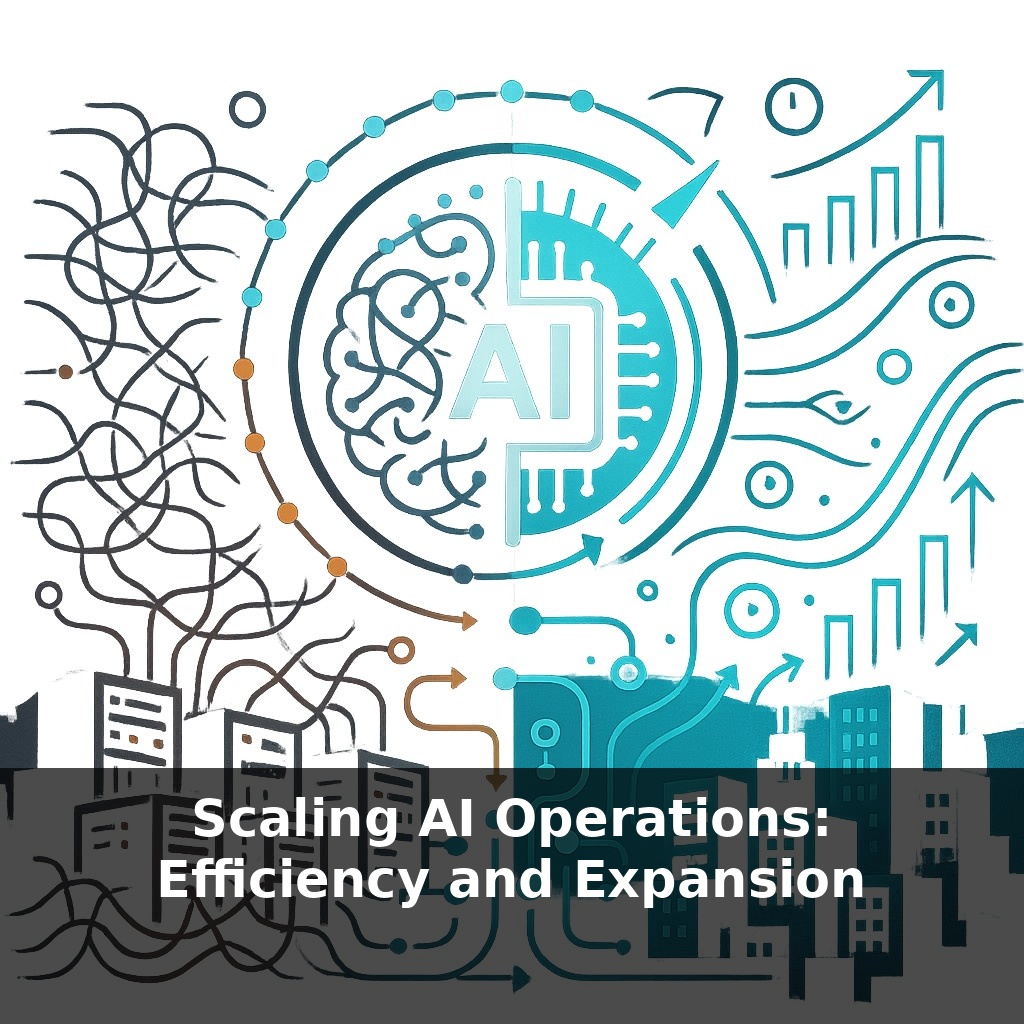
Scaling AI isn’t just “more models, bigger clusters.” It’s shifting from heroic launches to repeatable, almost boring reliability. The gap between scrappy prototype and dependable system usually hides in two places: how you allocate compute when demand spikes or drops, and how you turn one‑off successes into shared, upgradeable assets. Think less about pushing a single breakthrough and more about composing a portfolio—small, focused services that can be versioned, swapped, or retired without drama, like rearranging musicians in a well‑rehearsed orchestra.
NVIDIA estimates a single idle GPU can quietly burn around 50 watts. Stretch that across a cluster and a year, and you’re staring at six‑figure waste—before you’ve shipped a single new feature. The paradox: teams obsess over squeezing 2% more accuracy from a model while ignoring 20–30% swings in utilization.
Scaling with discipline starts by separating two very different motions:
1) **Elastic capacity for spiky work.** Training, batch scoring, and backfills are bursty. One week you’re hammering GPUs, the next they’re cold. This is where cloud‑native primitives shine: autoscaling pools, spot/preemptible instances, and job queues. The pattern is: define jobs declaratively, submit to a scheduler, let the cluster grow and shrink around the queue. Your objective isn’t “keep GPUs busy at all costs,” it’s “minimize cost *per useful experiment or job*.”
2) **Stable lanes for always‑on services.** Inference for core products is the opposite: predictable, latency‑sensitive, often tied to strict SLOs. Here you want reserved capacity, canary rollouts, and clear concurrency limits. Think: small, single‑purpose services, each with its own autoscaling rules, dashboards, and on‑call ownership. When load doubles, you scale *instances* of a known pattern, not spin up bespoke infrastructure.
Where teams stumble is treating everything like one or the other. Burst workloads pinned to fixed clusters create waste. User‑facing APIs running on bargain‑bin spot nodes create outages.
On top of this, you need a **pipeline for change**. Not just CI/CD for code, but:
- Versioned datasets and features, so you can recreate last month’s “win” and understand why it changed. - Reproducible training runs, so scaling from a single node to dozens is a config change, not a rewrite. - Promotion criteria that link technical metrics to business ones, so you don’t scale models nobody needs.
Organizationally, the leverage comes from a platform mindset: one small team owns the shared rails, many product teams ride on top. The art is deciding what becomes a common building block and what stays a local experiment—too little standardization and you drown in bespoke stacks; too much and innovation routes around your platform.
A useful way to test your setup is to zoom in on **what actually scales cleanly** when things go well. At one fintech, the breakthrough wasn’t a new architecture; it was standardizing a single “model service template.” Any team could drop in a trained artifact and a config file, and the platform wired up logging, autoscaling, and rollbacks by default. Shipping the *second* model went from weeks to a day.
At another company, growth stalled because every new project demanded its own bespoke feature store. They turned it around by carving out a small, central “data contracts” group. Their job: define a handful of shared feature sets (e.g., customer activity, risk scores) with SLAs. Suddenly, model reuse emerged “for free”—fraud and marketing models pulled from the same, trusted foundations.
Your systems are on the right track when adding a model feels less like founding a startup and more like hanging a new painting on an already solid wall.
As capacity becomes elastic and pipelines standard, strategy shifts from “Can we run this?” to “What’s worth running?” Teams start treating experiments like a portfolio: some low‑risk “index funds” that refine proven use cases, some bold “options” that might unlock new products entirely. Like a coach managing minutes across a season, you’ll decide which bets deserve prime GPU time, which can wait, and which should be cut before they drain focus. Over time, this discipline quietly compounds into an edge competitors can’t easily copy.
As you grow, the questions shift: not “can we scale this?” but “what deserves to scale next?” The most durable AI orgs treat infra like fertile soil and MLOps like careful pruning—letting the healthiest ideas take root while cutting back waste. Over time, your portfolio of models starts to look less like scattered experiments and more like a deliberately tended forest.
Before next week, ask yourself: 1) “If our ticket volume doubled tomorrow, which parts of our current AI ops stack (model retraining, monitoring dashboards, human-in-the-loop review, or incident playbooks) would break first—and what’s one concrete safeguard I can put in place today to relieve that single bottleneck?” 2) “Looking at our current prompts and workflows, where am I still relying on ad‑hoc fixes (like manual overrides or Slack pings to engineers) instead of systematized guardrails or automation, and how could I turn one of those recurring ‘fire drills’ into a repeatable, documented flow?” 3) “What’s one measurable, business-relevant metric (e.g., average resolution time, cost per assisted ticket, or model error rate in a high-risk queue) I can start tracking this week so I can prove whether scaling our AI operations is actually improving outcomes rather than just adding more complexity?”