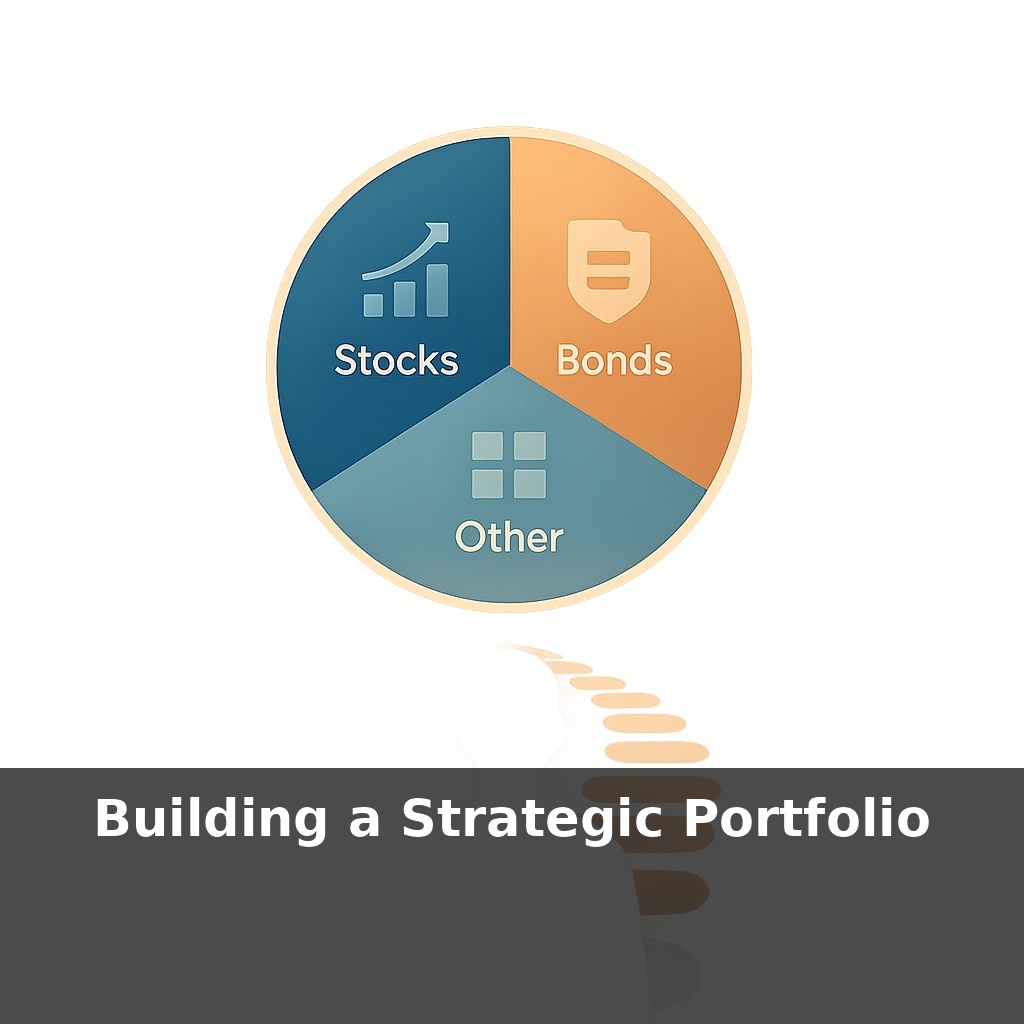
Most of your long‑term returns come from one quiet decision you rarely revisit: how you split your money between stocks, bonds, and everything else. A few clicks today can outweigh years of stock picking. So let’s step into your future and listen to what that portfolio is trying to tell you.
That quiet split between stocks, bonds, and other assets becomes strategic only when it’s tied to your real life: your income, time horizon, and how much loss you can tolerate without panicking. A 30‑year‑old saving for retirement can usually ride out a 40–50% stock drawdown; a 63‑year‑old three years from retirement usually can’t. Institutions know this. The Yale Endowment didn’t just chase higher returns when it moved from 15% to over 60% in alternatives; it matched its allocation to a century‑long time horizon and steady inflows. You can apply the same mindset in simpler form. Instead of guessing, you can use data: the classic 60/40 U.S. portfolio has returned about 9.1% annually since 1926, while narrower mixes often swing more. The key shift now is moving from “what might perform best” to “what mix I can actually stick with through a full market cycle.”
Brinson, Hood & Beebower showed that over 90% of portfolio return variation comes from your overall mix, not your stock picks—so now the question shifts from “what to buy” to “how to structure everything you own. ” That structure has three practical dimensions: what you own (stocks, bonds, cash, alternatives), where you own it (U.S. vs. international, developed vs. emerging), and how you own it (index, active, factor). For example, a US$100,000 portfolio split 70/20/10 across global stocks, bonds, and REITs will behave very differently from one that’s 50/40/10 U.S. only, even if both hit similar average returns.
Now you turn that high‑level structure into numbers you can actually implement. Start by deciding how many “building blocks” you want. Most individuals do well with 4–8 core holdings instead of 30 overlapping funds. For instance, with US$50,000 you might choose five low‑cost index funds: U.S. stocks, international stocks, investment‑grade bonds, cash/short‑term bonds, and one diversifier like real estate.
Next, translate percentages into dollars. Suppose you land on:
- 55% global stocks (35% U.S., 20% international) - 35% high‑quality bonds - 5% real estate - 5% cash
On US$50,000, that’s: - US$17,500 U.S. stock index - US$10,000 international stock index - US$17,500 bond index - US$2,500 REIT fund - US$2,500 cash or short‑term Treasury ETF
Now decide where each piece lives. Tax‑inefficient assets (bond funds, REITs) often fit better in tax‑advantaged accounts if you have them, while broad stock indexes are usually fine in taxable accounts due to lower turnover. For example, in a US$30,000 401(k) and US$20,000 brokerage, you might put almost all bonds and REITs in the 401(k) and hold more stock index funds in taxable.
Then set rebalancing rules before markets test you. Research suggests simple bands work: if any major slice drifts more than ±5 percentage points from target, you trade back. A 55% stock target that grows to 63% would trigger selling down to 55% and adding to bonds or cash. You can also set a calendar check—say, once or twice a year—and apply the bands at that time rather than watching daily moves.
Finally, plan how you’ll incorporate new savings. Direct fresh contributions to the underweight parts instead of always buying what just went up. If stocks fall and drop to 50% when your target is 55%, channel new money into stock funds until the gap closes. Over a year in which you add US$12,000, simply steering most of that toward the lagging slice often avoids any need to sell winners at all.
Think of this like designing a simple app architecture instead of hard‑coding every screen. You choose core modules and define how they talk to each other, then let the system run. Say you’re mid‑career with US$80,000 invested and adding US$1,500 per month. You might decide any single holding can’t exceed 25% of your total. If a hot sector ETF grows from 15% (US$12,000) to 27% (US$25,000) while your portfolio rises to US$92,000, you’d cap it back near US$23,000 and redirect the extra US$2,000 into something underweight—maybe international stocks sitting at 14% when your cap is 20%.
You can also stress‑test behavior. Ask: “If stocks dropped 30% next year, what would my actual dollar loss be?” On US$80,000 with 70% in stocks, that’s about US$16,800. Writing that number down often changes how aggressively you set those caps and targets, and how many moving parts you’re genuinely willing to manage.
Your future portfolio decisions will likely be more customized and automated. Direct indexing may let a US$250,000 taxable account mirror an index while harvesting, say, US$8,000 in losses during a bad year. Tokenized real estate could let you add a US$2,000 slice of global property with daily liquidity. AI tools may flag that you historically sell after a 15% drop and nudge you to pre‑commit rules—like automatic rebalancing instead of panic trades.
Now test this in real numbers: decide what you’ll do with the next US$1,000 you invest, before it hits your account. For example, you might pre‑commit: “If stocks fall 20%, I’ll direct the full US$1,000 there; otherwise I’ll split US$700 to bonds, US$300 to stocks.” Writing that rule once can guide hundreds of future decisions.
Try this experiment: Pick two very different “bets” for your strategic portfolio—a low-risk, cash-generating project you’re already doing (e.g., optimizing your current offer or doubling down on your best channel) and a high-uncertainty, high-upside experiment (e.g., testing a new product tier, bundling, or niche). For the next 7 days, spend exactly 70% of your available “strategy time” on the safe bet and 30% on the bold bet, and track two numbers only: revenue (or leads) from the safe bet and learning milestones from the bold bet (e.g., number of conversations, test results, or signups). At the end of the week, compare how each bet performed and decide whether to (a) double down, (b) modify, or (c) kill the bold bet—then deliberately replace anything you kill with a new, clearly different experiment so your “portfolio” always has at least one risky, future-facing slot.