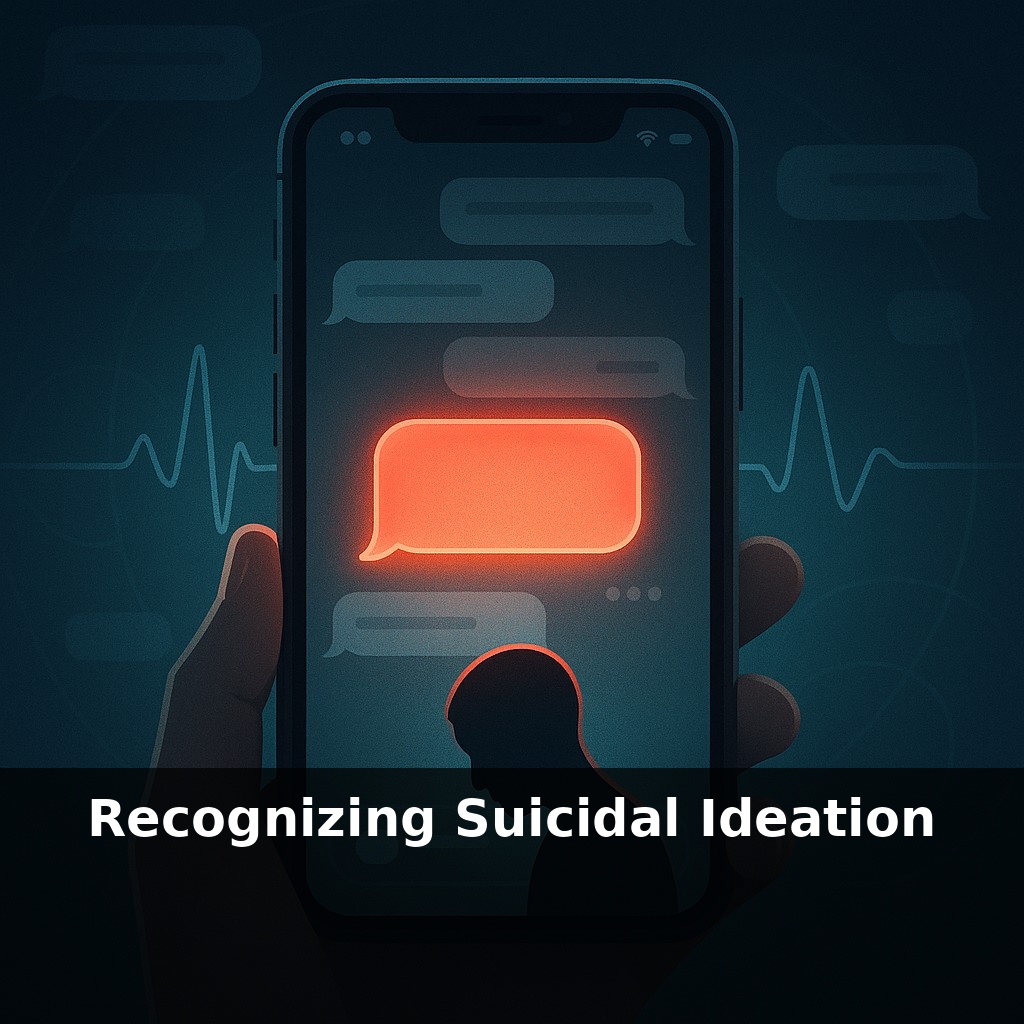
Recognizing Suicidal Ideation
📝 Transcript
“Every forty seconds, somewhere in the world, someone dies by suicide—yet most told someone they were struggling before it happened. You’re in a group chat, or on a late-night call, and a friend says, ‘I’m done.’ Is it drama—or a warning light you can’t afford to ignore?”
Sometimes suicidal thoughts are loud—“I wish I were dead.” More often, they hide in plain sight: “I’m so tired of this,” “It wouldn’t matter if I disappeared,” “I just want everything to stop.” In texts, DMs, or voice notes, the difference between venting and real danger can be subtle, especially when you’re scrolling fast, half-distracted. Technology makes it easier than ever to broadcast pain—and just as easy for everyone else to miss it. A friend might start posting late-night “jokes” about not wanting to be here, change their profile bio to something bleak, or suddenly send you a playlist that feels like a goodbye letter set to music. In this series, we’ll break down how to notice those digital breadcrumbs, how to respond without panicking—or ghosting—and how to loop in real help when it’s needed.
Online, distress rarely appears as a tidy “I need help” message. It leaks out sideways: a gamer who suddenly rage-quits every match and vanishes from Discord, a classmate who goes from daily memes to total silence, a coworker posting only at 3 a.m. about being “done with everything,” then deleting it by morning. Think of your feeds less like entertainment and more like a live weather map of people’s moods: abrupt storms, long droughts, strange temperature swings. We’ll focus on patterns over one-off posts—because risk usually shows up as a cluster of small shifts, not a single dramatic moment.
Some of the clearest digital clues show up in *language*. Not just the dramatic lines, but the quieter drift of how someone talks about themselves and the future. Watch for shifts toward absolute, closed-door words: “always,” “never,” “no point,” “everyone would be better off.” When posts or messages move from “today sucked” to “nothing will *ever* get better,” that move from specific frustration to global, permanent hopelessness matters.
Pay attention, too, to how people talk about their own value. Self-hate can be casual online—“I’m trash,” “I’m the worst”—but there’s a difference between dark humor and a steady theme of worthlessness. If a friend keeps circling back to “I ruin everything,” “I’m a burden,” or “I shouldn’t be here,” especially across platforms (IG, Discord, private chats), that repetition is a red flag, not just an edgy aesthetic.
Another layer: loss of connection to things that used to anchor them. Someone who loved streaming with friends or debating tech in group chats starts saying, “I just don’t care anymore,” or “I’m done trying.” Posts shift from sharing interests to deleting old content, abandoning projects, or talking about “cleaning up” their digital life. It can look like they’re quietly stepping back from the stage.
Concrete plans sometimes leak through technology in surprisingly practical ways. A friend might ask detailed questions about medications, heights, bridges, or how long someone can be unconscious without being found. Or they suddenly join forums that focus on extreme methods rather than support. Curiosity exists, but repeated, targeted research around lethal options is different from a one-off Google spiral.
Secrecy is another pattern: moving conversations to encrypted apps “so nobody sees,” locking down accounts after posting something bleak, or sending you a message and begging you not to tell anyone. That “don’t tell” is important data in itself; it often means they’re wrestling with thoughts they don’t feel safe sharing widely.
Think of these cues like instruments in a band: one discordant note might just be noise, but when the rhythm of hopeless language, self-erasure, method-seeking, and secrecy all start playing together, it’s time to pause and listen closely.
Think of a friend whose posts once bounced between memes, music, and random life updates. Over a few weeks, the range narrows: fewer selfies, fewer inside jokes, more late-night posts that hint at being “done trying,” plus a quiet purge of old photos. On its own, each change is easy to shrug off; together, it’s like a playlist shifting from mixed genres into a single, heavy loop. You’re not diagnosing them—you’re noticing the setlist has changed.
Concrete example: someone in a coding Discord starts saying they can’t focus, then gives away a prized repo, then drops, “You guys won’t have to put up with my bugs much longer.” Or a classmate keeps posting “I don’t deserve you all,” paired with sending valuables to friends “just because.” These aren’t proofs, but they’re invitations to check in.
Your role isn’t to solve their life. It’s to notice when the pattern feels off, name what you’re seeing (“you’ve been posting really differently lately”), and open a door for a deeper, safer conversation.
Every 40 seconds, someone dies by suicide—yet most never posted a dramatic “goodbye.” Future tools may quietly scan group chats or gaming servers for risky patterns and nudge a trusted friend: “Something seems off—here’s how to check in.” If done with consent and strong privacy rules, it could feel less like surveillance and more like a safety net, the way a smartwatch flags an irregular heartbeat before you notice anything is wrong. The challenge will be balancing digital alerts with real, human follow‑through.
Staying curious is your best tool. You won’t always read things perfectly, and that’s okay. Treat each odd post like a quietly out-of-tune note in a familiar song: not proof of crisis, but a reason to lean in and really listen. Your challenge this week: notice one small change in someone’s online tone—and gently ask how they’re *really* doing.
From this course
Mental Health First Aid: Recognizing Crisis
7 episodesUnlock all episodes
Full access to 7 episodes and everything on OwlUp.
Subscribe — $1.99/monthLess than a coffee ☕ · Cancel anytime

