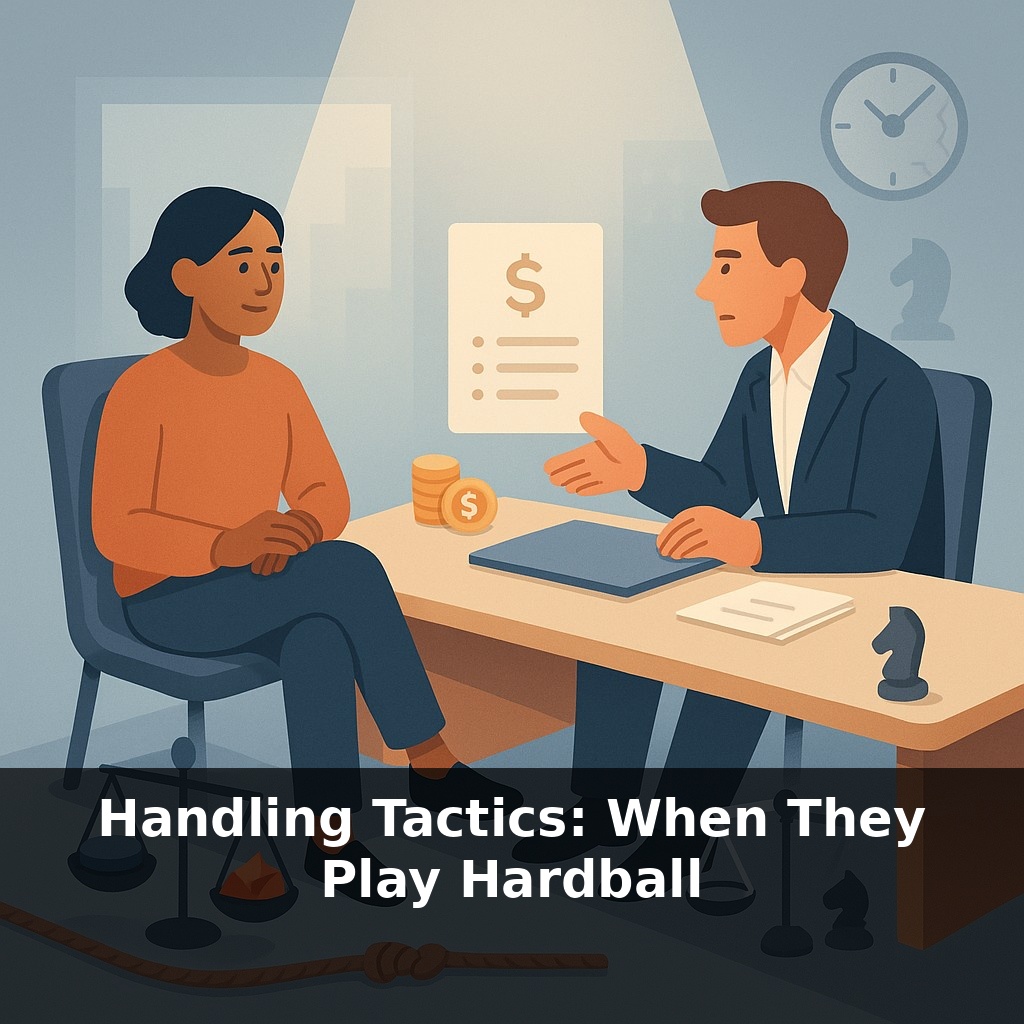
The person who cares least about the deal often gets the best terms. In one study, negotiators who calmly called out pushy tactics on the spot gained a clear edge. Now you’re in a salary talk, and the manager says, “We have a strict cap, take it or leave it.” What do you do next?
Only 11% of professional negotiators think hardball tactics create long‑term value—yet you’ll still run into “take it or leave it,” fake deadlines, and last‑second demands. This isn’t just about ego or aggression; research shows these moves usually show up when people see the deal as purely win‑lose and are scared of leaving money on the table. That mindset makes them grab for power plays instead of solutions.
In earlier episodes, you built a strong foundation: preparation, smart openings, and creating value. Now you’re facing the test of all that work—what you do when the other side stops playing nice. Think of this as moving from normal driving to hitting black ice: the rules change, but panic makes everything worse. In this episode, you’ll learn how to spot hardball tactics fast, pause without freezing, and quietly shift the game back to interests, options, and real leverage.
Most people either freeze or fight when talks turn rough. But research suggests a better move: treat the moment like turbulence on a flight—uncomfortable, yes, but navigable if you know what the instruments are telling you. In this phase of the series, you’ll learn how to read those “instruments”: subtle shifts in tone, sudden “rules,” or surprise ultimatums that signal the other side is tightening the screws. Instead of reacting on instinct, you’ll experiment with slowing the tempo, surfacing what’s really driving them, and quietly testing how firm their wall actually is.
When the other side turns up the heat, your first job isn’t to “win” the moment—it’s to slow it down so you can see it clearly. Most hardball moves fall into a few families: pressure (fake deadlines, “take it or leave it”), deception (invented constraints, exaggerated alternatives), and aggression (personal attacks, threats, deliberate stonewalling). You don’t need an exhaustive catalog; you need a simple filter:
1) Does this move shrink my sense of choice? 2) Does it make me feel rushed, confused, or defensive? 3) Does it come with very little explanation or data?
If two of three are “yes,” treat it as a possible hardball tactic and shift gears.
The research-backed sequence is: notice → pause → reframe. Notice means you silently label what’s happening (“That was a sudden ultimatum”). Pause means you buy time for your brain to catch up: “Let me think about that for a minute,” or “Can we take five? I want to consider this properly.” Reframe means you gently move from the dramatic move back to something you can reason about.
This is where naming the tactic—carefully—matters. The Harvard PON work isn’t about shaming people; it’s about dragging the move into the daylight:
- “That sounds like a very firm deadline. Help me understand what makes that date non‑negotiable.” - “When you say ‘take it or leave it,’ are you saying there’s absolutely no flexibility anywhere in the package?”
You’re not accusing; you’re testing. Often, the “deadline” softens or the “cap” suddenly has exceptions.
Next, bring in something neutral to lean on: objective criteria. Market data, industry benchmarks, internal precedents, even their own earlier statements. Objective standards let you counter a tough line without a personal clash: “Compared with similar contracts we’ve both done, this term is an outlier. Can we look at why?”
At the same time, your BATNA is your quiet backbone. The stronger it is, the easier it is to say, “If those are truly the only terms, I may need to pursue other options.” You’re not threatening—you’re describing reality. Paradoxically, that calm clarity often softens rigid behavior more than any counter‑threat.
Finally, be curious about the pressure itself. Instead of pushing back head‑on, ask: “What’s making this so tight on your side?” Many “walls” are actually curtains hiding fears, constraints, or incentives you can work with once they’re out in the open.
In a supplier meeting, you’re told, “Price is non‑negotiable; all our clients accept this.” Instead of arguing, you treat it like a sudden spike in a stock chart. First, you zoom out: “Interesting. Compared to last quarter’s proposal, this is a 12% jump. What changed on your side?” You’re not contesting yet—you’re collecting data.
Next, you test the story: “If every client accepts this, would you be open to anonymized examples of similar volumes at this rate?” If they dodge, that “every client” claim starts to look less like fact and more like leverage. You’ve gently separated their narrative from reality without a fight.
Or think of travel bookings. The site flashes “Only 1 room left at this price!” Instead of clicking in panic, you open a second tab, check other dates, other sites, maybe even the hotel directly. That tiny pause plus a broader view often reveals more availability or better terms. In negotiations, the same move—creating a second “tab” of questions and comparisons—turns their drama into just one data point, not your only choice.
As AI tools enter negotiations, the “fastballs” may come faster and quieter—algorithmic pricing squeezes, opaque recommendation systems nudging you toward worse terms. Your edge will be transparency: asking how numbers were generated, which assumptions drive the model, who benefits if they’re wrong. Like reading a mutual fund prospectus instead of just the glossy ad, you’ll need to decode risk, incentives, and time horizons before you swing at any offer.
Treat these moments like spotting a sudden detour sign on a road trip: you don’t slam the gas—you slow down, scan for side roads, and choose your route. Over time, you’ll notice a pattern: the more calmly you explore constraints, the more people shift from pressure to problem‑solving. That shift is where real deals—and reputations—are built.
Before next week, ask yourself: 1) “The last time someone used a hardball tactic on me (like artificial deadlines, last‑minute demands, or ‘take‑it‑or‑leave‑it’ offers), what exactly happened—and where did I feel myself getting defensive instead of curious?” 2) “If that same situation happened tomorrow, what’s one specific question I could calmly ask to surface their real interests (for example, ‘Help me understand what’s driving this deadline’ or ‘What problem are you most worried about if we don’t agree today’)?” 3) “Looking at a current negotiation or tough conversation on my plate, what’s one boundary I want to be ready to state clearly (e.g., ‘I don’t agree to exploding offers’ or ‘I need 24 hours to review any major change’), and how will I phrase it so it sounds firm but respectful?”