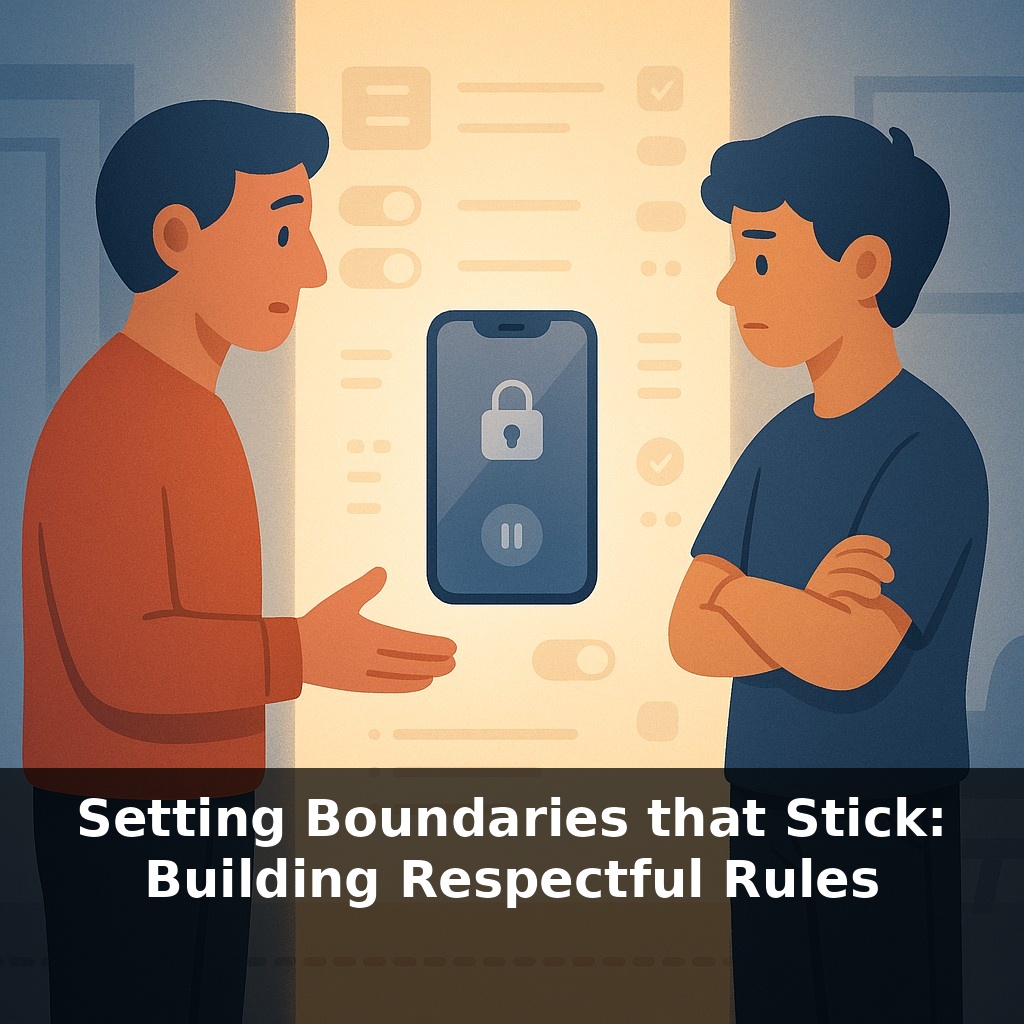
About half of teens say their parents’ rules feel random or unfair—yet those same parents swear they’re “clear.” Your daughter slams her door after you take her phone. Your son shrugs off curfew… again. You’re enforcing rules, but somehow respect keeps slipping through your fingers.
Here’s the twist: most parents *think* they’re setting strong boundaries, but teens often experience those limits as moving targets. In one large survey, 60% of teens said the “rules” at home change depending on their parent’s mood. That inconsistency quietly trains them to test, argue, or wait you out. In this episode, we’re going to turn those shaky rules into boundaries that actually stick—especially around technology, where conflicts flare fastest. We’ll look at how to move from “Because I said so” to clear, shared agreements your teen can predict and explain, even when they don’t like them. You’ll learn what to say *before* you introduce a new limit, how to respond when it’s broken, and how to adjust without caving. By the end, you’ll have a simple script and checklist to pressure-test any family rule.
Research on thousands of families shows that *how* you set limits matters as much as *what* the limit is. Teens are far more likely to follow rules when three pieces line up: the rule is crystal clear (“no phones after 10 p.m.”), enforced the same way every time, and your teen understands *why* it exists and has had some voice in shaping it. This is the core of authoritative parenting—high warmth plus firm structure. It’s linked with 20–30% lower rates of substance use and better grades than both “my way or the highway” and “do whatever you want” approaches. In this episode, we’ll apply that model directly to tech use at home.
Let’s turn the research into something you can actually use—especially around tech.
Think of three layers you can stack for any technology rule: **the rule**, **the reason**, and **the routine**.
1. **The Rule: Specific enough to be checkable**
Vague: “Don’t be on your phone all night.” Checkable: “Wi‑Fi turns off at 10:00 p.m. on school nights. Phones stay in the kitchen charger from 10:15 p.m. to 6:30 a.m.”
A good test: could a neutral stranger tell if the rule was followed just by looking? If the answer is no, tighten it. Replace “too long,” “late,” or “excessive” with numbers: minutes, times, locations.
Examples: - “You can game from 4:00–5:30 p.m., after homework is checked, in the living room.” - “You can post on social media, but accounts must stay private and we know the usernames.” - “No devices at the table from when food is served until everyone is done.”
2. **The Reason: Short, honest, teen-level**
You don’t need a TED Talk—two sentences is plenty. Developmental studies show teens comply more when they hear a concrete “why,” not a lecture.
Try this format: - “The rule is __, because __, so that __.”
For example: - “The rule is no phones in bedrooms overnight, because blue light and alerts keep your brain wired, so that you actually feel rested for practice.”
Avoid fake reasons; they will fact‑check you in 0.3 seconds. If part of the reason is *your* stress, say that: “I sleep better when I know everyone’s offline.”
3. **The Routine: Make it automatic, not a nightly showdown**
Every extra negotiation is a chance for conflict. Instead: - Tie tech rules to **triggers** (specific times or events). - Use **systems** instead of willpower.
Examples with numbers: - Router schedules: Wi‑Fi for personal devices off 10:00 p.m.–6:00 a.m. on school nights. - Visible docks: 1 charging station in the kitchen for all phones; devices plugged in by 10:15 p.m. - Screens-for-chores swap: 30 minutes of leisure screen time after each completed chunk of homework (e.g., 45 minutes).
Teens push least when expectations are posted and predictable. A one‑page “family tech plan” on the fridge, with 5–7 concrete rules, beats a 30‑minute argument at 9:59 p.m.
When you stack **rule + reason + routine**, you shift from debating every boundary to calmly enforcing a shared structure—exactly the kind of predictability their still‑developing prefrontal cortex leans on.
Here’s where boundaries either quietly hold…or slowly unravel. Teens watch what you *do* far more than what you say, so your own habits are part of the rule. If you’re asking for phones out of bedrooms, but you’re scrolling at 11:45 p.m. under the covers, expect pushback. Two concrete tweaks:
1. **Align your behavior with the rule by at least 80%.** If the dock time is 10:15 p.m., aim to hit it 6 nights out of 7. When you can’t, name it: “I’m on call tonight, so my phone stays with me. Tomorrow we’re back to normal.”
2. **Pre‑decide consequences and write them down.** Instead of inventing penalties in anger, link one specific outcome to each tech rule: - Miss the 10:15 p.m. dock once: next day’s leisure screen time ends 30 minutes earlier. - Miss it twice in 7 days: lose gaming for 24 hours. - Go 14 days with no misses: earn a 30‑minute extension on Friday or Saturday only.
A single, consistent consequence used 5 times calmly beats 15 different threats you never follow through on.
Teens who help shape rules are more likely to follow them—and to carry those skills into college, work, and relationships. Treat each new tech rule like a mini “civics lesson”: invite a proposal, debate, revision, and a trial period (e.g., 14 days). Track results with 2–3 simple metrics, like on‑time sleep, morning mood (1–5), and homework completion rates. After the trial, review the data together and adjust. You’re not just reducing conflict; you’re training a future adult in self‑governance.
Use this week to stress‑test one tech rule in real life. Pick a single change—like no phones after 9:30 p.m.—and run it for 7 days. Track 3 numbers daily: bedtime, total sleep hours, and morning mood (1–5). If at least 4 of 7 mornings score higher than your “old normal,” keep the rule and add a small, teen‑chosen reward.
To go deeper, here are 3 next steps: (1) Grab Nedra Glover Tawwab’s book *Set Boundaries, Find Peace* and complete the “Boundary Scripts” exercises specifically for the relationship you were thinking about during the episode, then pick one script you’ll actually use in your next real-life interaction. (2) Install and set up the “Clear Fear” or “Insight Timer” app, and save one 5–10 minute grounding or anxiety-calming practice you’ll use right before (not after) you state a new boundary, so your nervous system is on your side. (3) Download a free “boundary phrases” list—like the ones in therapist account @nedratawwab’s Instagram highlights—and copy three exact sentences that match your non‑negotiables (e.g., “I’m not available for calls after 9 p.m.”); put them in your phone’s Notes app as a ready-made script you can literally read from the next time that boundary is tested.