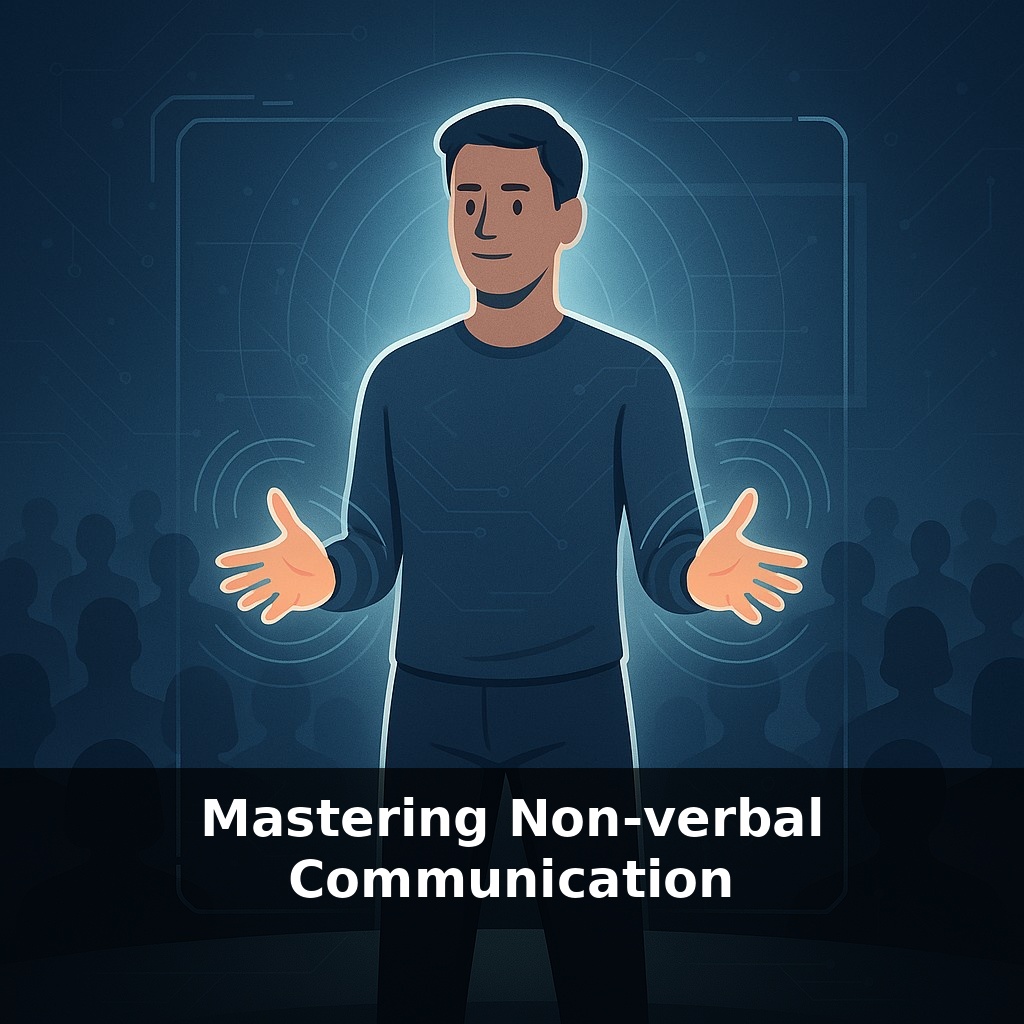
Within a few heartbeats, your audience has decided how confident, honest, and prepared you are—before you’ve finished your first sentence. A nervous shuffle, a tight half-smile, eyes glued to your slides… each tiny move is quietly voting for or against your credibility.
In tech talks, we obsess over the slide deck and almost ignore the “interface” our audience stares at the most: our body. Research on public speaking shows that as much as 60–80 % of what people feel about your confidence and emotional state comes from non-verbal cues—gestures, posture, facial expression, eye contact—not your neatly crafted bullet points. And it’s not just about looking polished. When your hands, face, and voice underline the same idea, listeners remember more: up to 65 % when words are paired with congruent images or gestures, versus about 10 % for words alone. That means your explanations of complex systems, trade-offs, or roadmaps can either evaporate after the meeting, or stick. Think of a clear architectural diagram: the structure makes the details easier to follow. Intentional non-verbal choices do the same for your spoken content, guiding your audience’s attention and making your message physically “click.”
In technical settings, your body often “speaks” before your title slide loads. But this isn’t about acting or faking charisma; it’s closer to refactoring legacy code. You already have habits—where your hands go when you’re thinking, how you stand when challenged, what your face does when a demo breaks. Most of this runs on autopilot, shaped by culture, past managers, even office layouts. The shift is to treat these patterns as debuggable signals. Rather than chasing some generic “confident speaker” template, you’ll learn to map your natural style to specific choices that support clarity, trust, and real technical influence.
Start by zooming out from “good” or “bad” body language and think in layers: baseline, emphasis, and recovery.
**1. Baseline: how you “idle” when nothing special is happening**
Most tech speakers only think about what to do during a big point. But audiences are constantly sampling what you do between those moments: while a slide loads, a question is forming, or you’re transitioning. That’s where distracting tics creep in—rocking, swaying, spinning pens, tapping clickers.
Treat this as a systems problem: you want a stable default state that doesn’t consume attention. For most people, that means:
- Feet about hip-width apart, both planted, weight evenly distributed. - Hands relaxed at your sides or lightly joined at your midsection. - Gaze broadly toward the audience, not drilling into one person or fleeing to the floor.
Test your baseline in low stakes: stand like this while waiting for a build or test run to complete. If it feels unbearably still, you’ve found how much your nervous system is used to fidgeting.
**2. Emphasis: when and how to move on purpose**
The goal isn’t more movement; it’s *information-carrying* movement. Research on top TED speakers shows they gesture a lot, but those gestures are tied to structure: comparisons, sequences, contrasts.
Three reliable patterns:
- **Numbers and lists** – show “two things” with your fingers; step slightly to a new spot for item 1, then 2. - **Before vs. after** – gesture to your left for “today’s system,” to your right for “where we’re going,” and keep reusing those locations. - **Scale and risk** – widen your hands for “large impact,” narrow them for constraints or edge cases.
This is where the one analogy comes in: treat your movements like bolding in a document—used sparingly to mark what matters, not sprinkled everywhere.
**3. Recovery: what you do right after something goes wrong**
Glitches are inevitable: a broken demo, a tough question, a mental blank. Many speakers visibly crumple here—collapsing their stance, shrinking their gestures, or freezing.
Instead, script a default recovery sequence:
1. Exhale once, slowly. 2. Reclaim your baseline stance. 3. Lift your gaze before you speak again. 4. Use one clear gesture that signals direction: palm up (“here’s what we’ll do”), or a small forward motion (“let’s continue”).
Practise this on purpose: run a friendly mock talk and ask someone to interrupt you with “hard mode” moments. Your goal isn’t to avoid the jolt; it’s to shorten the time between surprise and visible reset.
Over time, these three layers—baseline, emphasis, and recovery—turn non-verbal habits from background noise into part of your technical toolkit.
Think of a high-stakes design review: one engineer leans back, swivels, and talks to the ceiling while defending their proposal; another stands still, then walks closer to the whiteboard when trade-offs heat up, tracing paths through the diagram while glancing back at the room. Same content, but the second person feels like they’re *in* the discussion with you rather than broadcasting at you.
Now that we understand the impact of non-verbal cues, let's consider two quick applications:
- During Q&A, try “triangling”: when someone asks a question, look at them *first*, then shift your gaze briefly to a few others while answering. You’re signaling, “This is for all of us,” not a private sidebar.
- In hybrid meetings, treat the camera like an extra stakeholder. When summarizing a decision, turn slightly toward it and hold for one sentence. Remote folks experience that as inclusion, not as an afterthought.
Over time, notice where your feet “live.” Do you always retreat behind a podium, or glue yourself to one spot? Each default placement quietly redraws the map of who feels invited into your message.
In the next decade, speaking may feel less like a slide deck and more like live debugging *with* your environment. VR spaces could mirror your movements as data flows around you, while haptic cues nudge you to slow down or turn toward a quieter cluster of avatars. Think of it like stepping onto a smart tennis court: lines light up where you should move next, but your timing, choices, and adaptability still decide whether the “rally” with your audience actually lands.
Treat this as an ongoing R&D project on yourself: record a few talks, mute the audio, and watch how your timing shifts when a joke lands, a graph appears, or a tough question comes. Patterns you spot there are levers you can tune. Your challenge this week: ship one tiny “patch” to how you stand, move, or pause—and observe what changes.