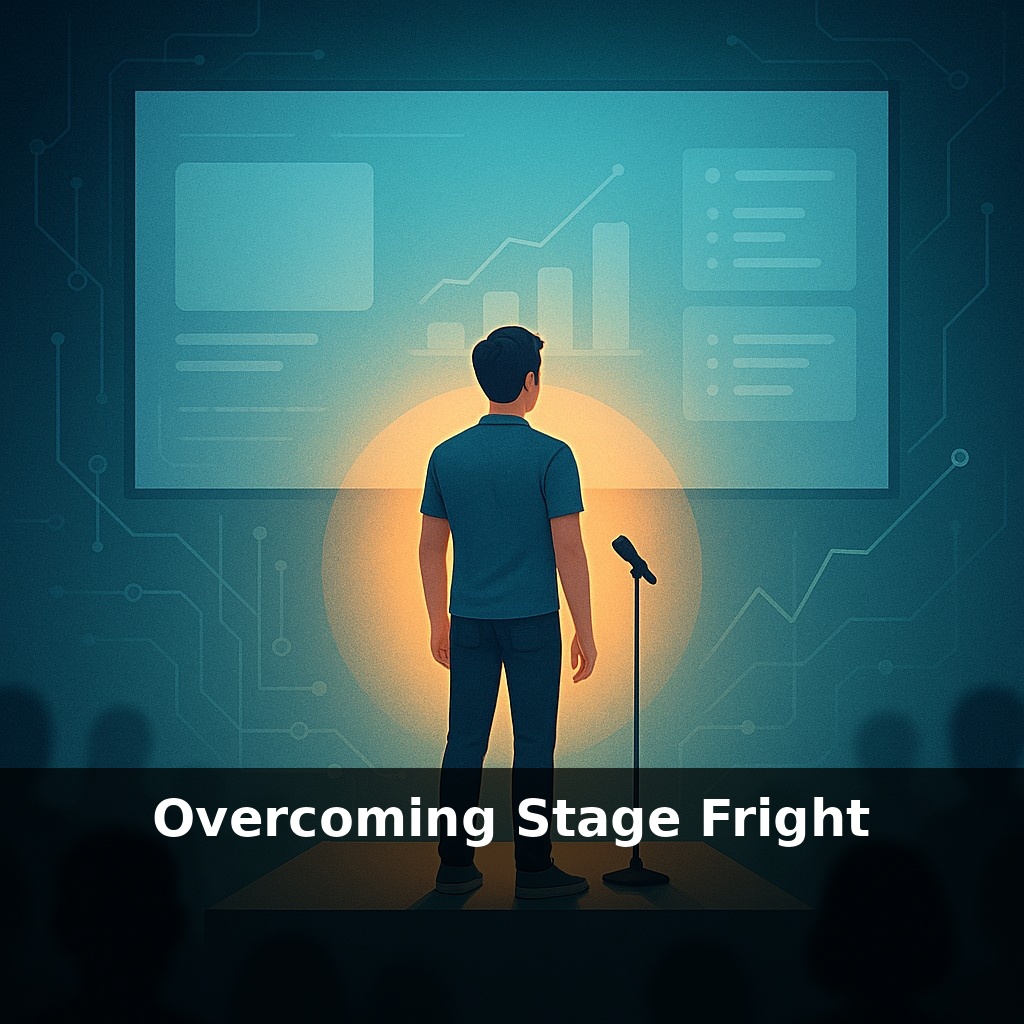
About seven in ten adults say speaking in public scares them—yet many of those same people lead teams, pitch products, and teach others every day. So why does standing up at the front of the room feel so different from speaking up inside it? Let's pull that apart.
About 72% of adults feel that spike of dread before stepping up—and if you work in tech, that spike often hits right when the stakes are highest: funding on the line, launches in motion, careers watching. What’s strange is that your body reacts as if you’re facing a charging predator, not a roomful of humans checking their email between slides. The same heart-pounding rush that helps you debug under pressure can suddenly feel like sabotage when every eye turns toward you. This isn’t a character flaw; it’s a misfire in an otherwise useful system. In this episode, we’ll treat your nerves like a complex system to be profiled, tuned, and iterated on. You’ll see how to intercept the body’s alarm signals, refactor the thoughts that amplify them, and gradually ship a new “public speaking response” that runs calmer, cleaner, and far more reliably under load.
That “system” doesn’t live only in your head; it’s distributed across hardware and software: muscles, hormones, posture, memories, habits. Under pressure, tiny things—how long you slept, the angle of your shoulders, the way someone in the front row raises an eyebrow—can tilt the whole network toward panic or poise. Instead of fighting that, we’ll start mapping it. Think of this as debugging a flaky integration test: sometimes it fails only on CI at 2 a.m. under heavy load. By watching closely when and how your response spikes, you’ll discover levers you can actually control—and begin to redirect that intensity into focus, clarity, and connection.
When that internal alarm goes off, it doesn’t just “make you nervous.” It flips three separate subsystems into a tight feedback loop: body, attention, and interpretation.
First, the body. Those sweaty palms and shaky hands are byproducts of a generic “go faster” signal. You can’t stop that signal from firing altogether, but you can quickly change its expression. A few slow, deep diaphragmatic breaths, held briefly at the top and exhaled longer than you inhale, start to shift your physiology toward steadier ground. Add posture: feet planted, spine neutral, shoulders relaxed. You’re not trying to look confident for the audience yet; you’re trying to give your nervous system fewer reasons to escalate.
Second, attention. Under stress, your focus collapses inward: How am I doing? What do they think? This self-monitoring amplifies every tiny wobble. Redirecting attention outward—toward the material, the problem you’re solving, or one engaged face—breaks that loop. You’re not performing “you”; you’re walking the room through an idea that matters.
Third, interpretation. The same quickened heartbeat can be labeled “I’m about to fail” or “my system is spinning up for something important.” CBT treats those labels as hypotheses, not truth. Instead of “They’ll see I’m incompetent,” you practice alternatives like “Some people may be critical; my job is to be clear, not perfect.” Over time, swapping catastrophic predictions for realistic ones reduces the intensity of the alarm before it even fires.
What ties these together is exposure, but not the “throw you on stage and hope” kind. Graduated exposure means you design a series of safe, controlled challenges: presenting a slide to one colleague, then three, then a larger internal group, each time pairing the stress with the new skills—breath, posture, focus, reframing. Your brain updates its model only when it repeatedly survives slightly uncomfortable situations and sees that the outcome is fine.
Tools can accelerate this learning. VR rehearsal lets you practice with avatars staring back at you; biofeedback apps show your heart-rate patterns in real time as you calm yourself. They turn “just relax” into something you can see, tweak, and progressively master.
Think of someone whose talks you admire in tech—a staff engineer calmly whiteboarding a gnarly architecture, or a founder handling tough investor questions. You’re seeing the end of a long training arc, not an inborn “no‑nerves” trait. Early on, many of those people quietly did “reps” in low‑visibility environments: lunch‑and‑learns, internal demos, even recording themselves walking through a design doc. They treated each repetition like a micro‑experiment: tweak one variable (opening sentence, first pause, where they look) and note what changes in their internal readout.
Here’s where the “surf wave” of adrenaline becomes useful. Instead of trying to flatten it, they time their first key point for that initial surge, knowing their energy will naturally crest and then stabilize. A designer might schedule a small prototype share‑out the week before a big launch review, purely to rehearse feeling that swell and riding it. Over time, the brain tags these episodes not as “threats,” but as demanding, high‑focus tasks it now knows how to handle.
72% of adults feel that lurch in their stomach before speaking, yet most will never treat it as a skill gap they can actually train. As tools mature, stage fright might shift from a fixed “personality trait” into something you tune like audio levels: a little intensity for presence, less noise in your thoughts. Think of a future where rehearsing a keynote feels more like loading a game level—adjusting difficulty, replaying tricky moments, and saving each tiny win as new muscle memory.
Your reactions on stage are more like untrained sensor data than a verdict on your talent. With practice, you’re not erasing those signals, you’re calibrating them—like tuning an instrument until feedback becomes tone. Your challenge this week: pick one tiny “edge” setting—a stand‑up, a status update—and run an experiment with just one new variable.