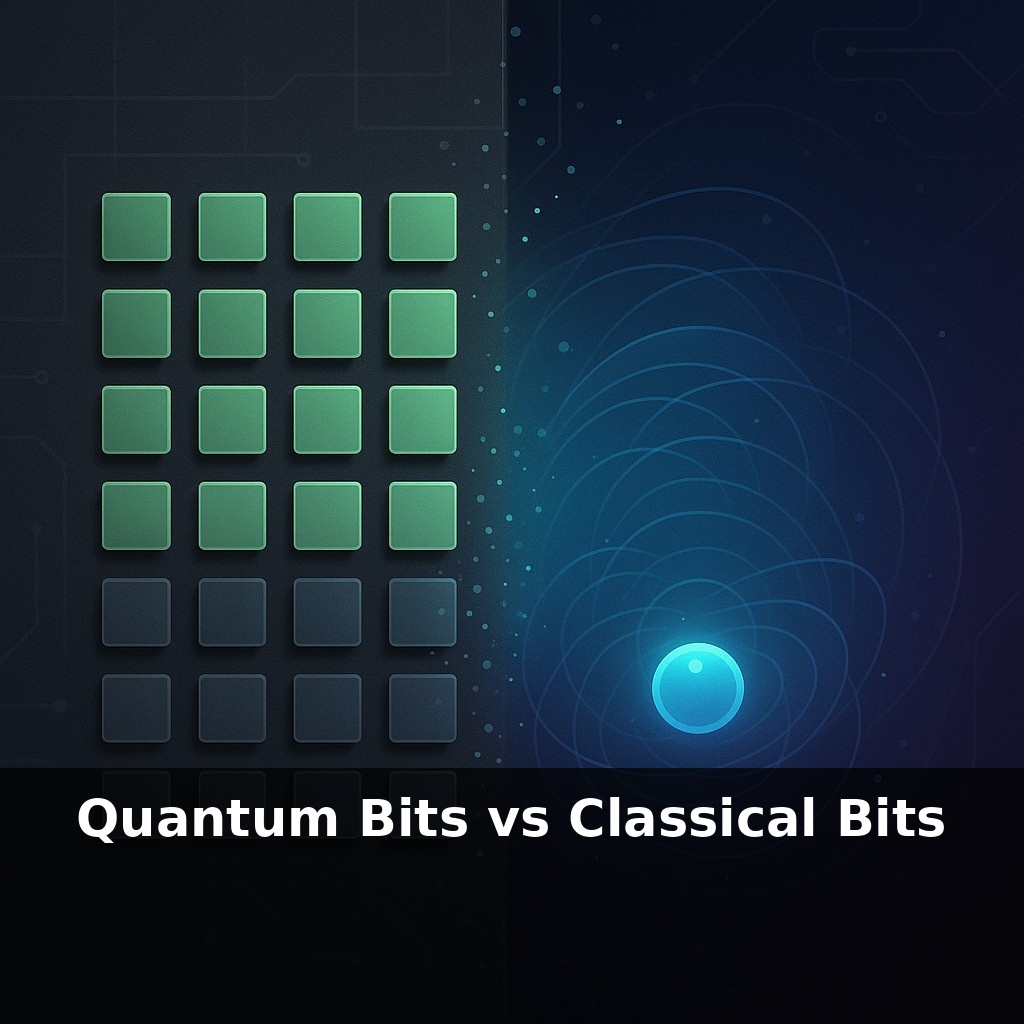
A single atom can carry more “maybes” than billions of classical bits locked into yes-or-no. In this episode, you’re in the lab: one screen shows rock‑solid zeros and ones, the other a swirling cloud of possibilities. Which one would you bet your next breakthrough on?
That swirling screen isn’t magic—it’s bookkeeping at a scale that breaks your classical intuition. On the left, your zeros and ones keep score like a basic scoreboard: each light either on or off. On the right, those maybes are tracked as complex amplitudes, with phases and probabilities that have to stay exquisitely synchronized. Mismanage that, and your fragile quantum “spreadsheet” corrupts itself before you can read it.
Here’s the twist: to protect a single high‑quality qubit today, you might need around a thousand noisy physical qubits working together, constantly detecting and correcting errors. That overhead sounds insane…until you realize what coordinated, well‑protected qubits can do: represent patterns so vast that even a planetary‑scale data center couldn’t store them explicitly. That’s where quantum stops being physics trivia and starts becoming an innovation tool.
In classical computing, you scale impact by throwing more of the same ingredient at the problem: more cores, more memory, more nodes in the cluster. Each upgrade is incremental, predictable, budgetable. Quantum scales in a weirder direction: add one well‑behaved unit, and the abstract space you can work in doubles. That doesn’t mean your application gets twice as fast—noise, compilation, and algorithm design all get in the way—but it does mean the design space for new strategies explodes, especially where structure and patterns are hard to spot classically.
main_explanation: When you hear “2^n amplitudes,” it’s tempting to assume automatic, across‑the‑board speedups. That’s not what’s on offer. The real opportunity is more surgical: learning how to *steer* those amplitudes so that the patterns you care about add up, while the irrelevant ones cancel out. Quantum algorithms are not about trying every answer in parallel; they’re about reshaping a gigantic landscape so that the right answers become statistically hard to miss.
For innovators, this matters because it changes *where* you look for advantage. You don’t ask, “Can a quantum machine run my current workload faster?” You ask, “Do I have problems where structure is hidden in a vast search space, or where simulating nature itself is the bottleneck?”
Three concrete fronts:
1. **Optimization and routing.** Think portfolio construction with thousands of constraints, supply chains with cascading disruptions, or dynamic pricing over massive product catalogs. Quantum‑inspired formulations already help companies like Volkswagen and JPMorgan explore variants of these problems; fault‑tolerant devices could push much deeper into configuration spaces that crumble classical heuristics.
2. **Chemistry and materials.** Here, classical simulation hits a wall quickly: interacting electrons grow combinatorially ugly. Quantum hardware is natively good at mimicking these systems. That’s why pharma (e.g., Roche, Boehringer Ingelheim) and materials players (e.g., BASF) are piloting quantum workflows for catalysts, batteries, and protein‑level interactions.
3. **Machine learning and data analysis.** You’ll see fewer “drop‑in” replacements for today’s neural nets and more niche tools: accelerated subroutines for kernel methods, clustering, or sampling. Think of them as specialized co‑processors that can sharpen parts of an ML pipeline rather than overturn it.
Architecturally, this shifts how you think about stacks. A scalable system will look more like a heterogeneous datacenter: classical CPUs and GPUs orchestrating workloads, with a quantum processor acting as a remote accelerator invoked only when the math justifies the overhead. The strategic question isn’t “Quantum *or* classical?” It’s “Where, inside my most valuable workflows, would a probabilistic, interference‑driven subroutine bend the curve enough to matter?”
In practice, this “interference‑driven” advantage shows up in oddly specific places. A logistics firm might use a quantum routine not to plan entire global routes, but to repeatedly refine just the nastiest bottleneck segments where classical heuristics stall. A bank won’t rebuild its trading engine; it will offload only the most combinatorial risk‑aggregation steps that dominate overnight runs. A pharma team may leave their existing simulation stack intact and swap in quantum subroutines solely for a few electron‑correlated fragments of a candidate molecule.
Think of it like upgrading the lens, not the entire camera: most of your existing hardware stays, but the parts that truly determine resolution change. The art for innovators is to map their workflows, pinpoint the subproblems with brutal scaling, and ask, “If this one piece got a non‑classical boost, would the whole system’s economics shift?”
Scaling from prototypes to fault‑tolerant machines won’t feel like dropping in a faster chip; it will resemble rewiring a factory. Entire security standards, simulation pipelines, and optimization tools may be rebuilt around quantum‑safe defaults and “interference‑aware” subroutines. For innovators, the frontier isn’t just performance—it’s governance: who gets access, how results are verified, and which industries become dependent on a resource only a few players can operate at scale.
Your next move isn’t to “go quantum” overnight, but to map where today’s methods visibly strain—overnight risk runs, week‑long simulations, brittle routing rules. Those fracture lines are early indicators of quantum relevance. As hardware matures, the leaders won’t be the ones with the most qubits, but the clearest questions ready to aim at them.
Start with this tiny habit: When you unlock your phone, glance at the time and say out loud, “Right now my phone is 0 or 1, but a qubit could be both.” Then, tap any app icon and pause for just one second to imagine that tap as choosing a measurement that “collapses” possibilities into a single outcome. Do this once a day, just with your first phone unlock, to start wiring your brain to see the difference between classical bits and quantum bits in everyday actions.