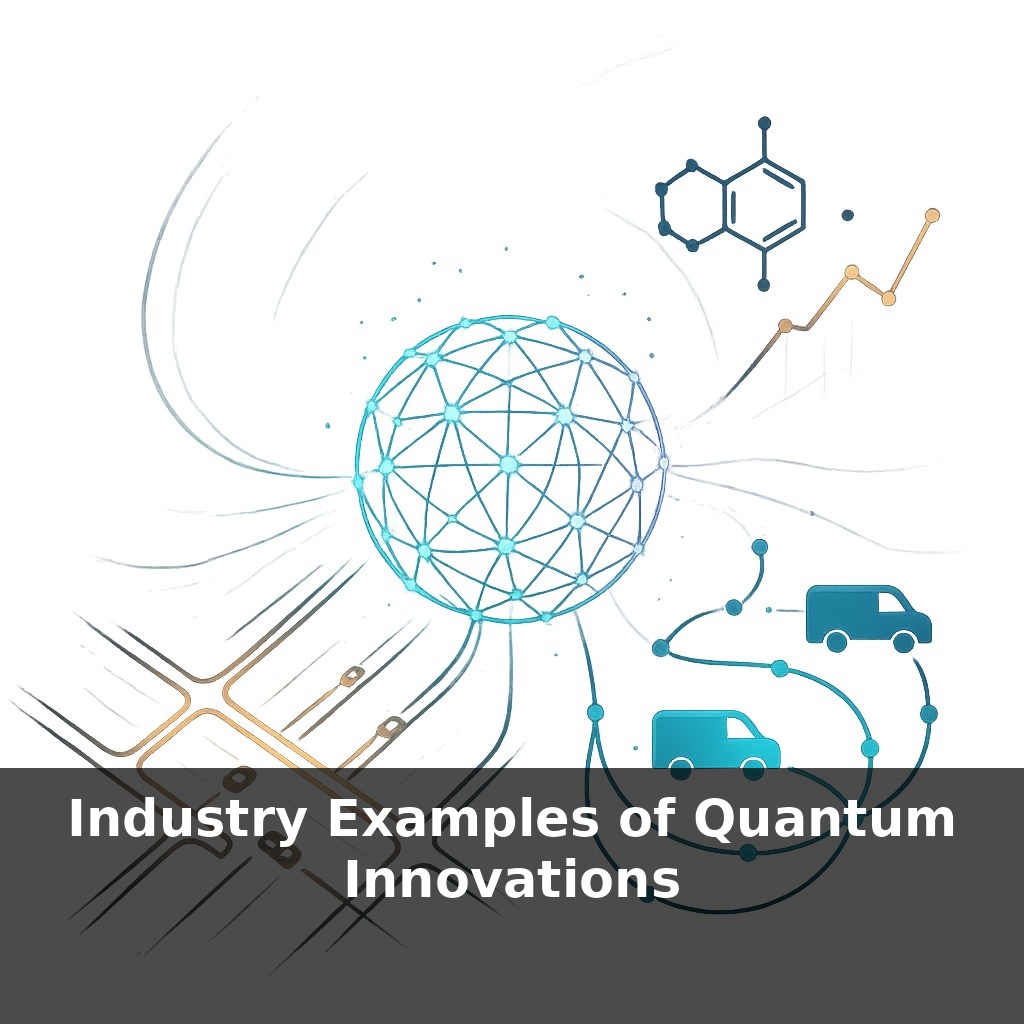
Traffic in Beijing dropped measurably because a quantum computer redesigned signal timing. A drug company is shrinking years of lab work into months using quantum chemistry. In this episode, we’ll explore how these early, imperfect machines are already shaping real industries.
Volkswagen is not alone. A global carmaker has already tested quantum tools to reshuffle delivery routes overnight, squeezing more drops into the same number of vans. A bank is probing quantum algorithms to rebalance portfolios in near–real time as markets lurch. A logistics giant is quietly experimenting with warehouse layouts that shift digitally thousands of times before anyone moves a single pallet.
In this episode, we’ll move past the lab and boardroom slides to look at where code is actually running on today’s noisy devices. You’ll see why so many pilots focus on optimisation, where shaving a few percentage points off cost or time becomes a board-level win. And you’ll notice a pattern: the most effective teams treat quantum not as magic, but as a specialised co-worker that handles a narrow, brutally hard part of the job.
Some of the most interesting quantum projects never appear in press releases. A pharma team uses today’s devices to narrow a million possible molecules down to a few hundred that are actually worth synthesising. A freight operator quietly tests layouts that cut empty truck space on cross-border routes. A cybersecurity group pilots quantum-safe key exchange before regulators demand it. In each case, quantum isn’t replacing existing systems; it’s quietly slotting into narrow, high-friction steps where even a small edge compounds into defensible advantage.
Volkswagen’s traffic pilot and BASF’s chemistry ambitions hint at a broader pattern: the first valuable quantum wins are narrow, quantifiable, and plugged into existing workflows rather than replacing them.
In pharmaceuticals, several top-10 firms now run hybrid pipelines where classical systems generate huge candidate sets and small quantum subroutines help rank or cluster them. One European company, for instance, uses a quantum routine to flag which molecular fragments are most promising for a given target, then hands that shortlist back to classical simulations and wet labs. The impact isn’t a “magic new drug,” but fewer dead ends and faster “no” decisions—crucial when a failed phase can cost hundreds of millions.
In finance, early adopters focus on rebalancing and risk, not exotic products. A large asset manager has tested quantum-assisted portfolio construction on a limited slice of assets—say, a few hundred stocks instead of thousands—to explore risk–return trade-offs under stress scenarios. The outputs still go through traditional risk committees and compliance filters, but quantum helps scan more combinations within the same overnight window. Crucially, they benchmark every run against high-end classical solvers; if the quantum path doesn’t beat or at least match them, it doesn’t ship.
Automotive and logistics players are attacking different layers of the same stack. One OEM uses a quantum annealer to prototype assembly line sequences that minimise tool changes and robot idle time. A parcel carrier applies a gate-based system to refine last-mile route clusters before a conventional optimiser assigns specific stops. Think of it like a sports team using advanced analytics only for set plays: they pick very specific, repeatable situations where better decisions compound over thousands of games.
Even in materials and chemicals, leaders are careful about scope. BASF’s projected 50 % cut in catalyst design cycles depends on tightly integrating quantum chemistry modules into lab automation, data lakes, and legacy simulation tools. The value comes less from a single breakthrough run and more from running smaller, smarter experiments week after week.
Your challenge this week: pick one process in your domain where you already track a hard metric—cost per unit, on-time delivery, energy use, or similar. Map just the one or two steps that consistently feel “computationally ugly” (too many combinations, too many scenarios). Then, without worrying about technical feasibility yet, describe the ideal black-box service that could explore those combinations for you and return a ranked shortlist. That description is often your most honest first quantum use case.
A retailer offers a more down-to-earth example. One global fashion brand is experimenting with quantum services to decide which mix of sizes and colours to send to each store before a season starts. They already know roughly what sells, but subtle interactions—rainy weeks, local festivals, payday timing—create messy patterns. A small quantum routine is used to explore many “what-if” allocations overnight, with planners still making the final calls.
In heavy industry, a turbine manufacturer is testing quantum-assisted scheduling for maintenance windows. Shutting down a unit at the wrong time ripples through energy markets and penalty clauses. Their prototype feeds in grid forecasts, contract terms, and crew availability, then uses a quantum backend to surface a handful of high-value schedules for human review.
Analogy: like an architect using a generative design tool to suggest thousands of viable building layouts, then manually curating the few that balance aesthetics, cost, and safety, these teams treat quantum outputs as ambitious drafts, not gospel.
Volkswagen’s traffic trial and BASF’s lab ambitions are early hints, not endpoints. As hardware scales, expect quantum to quietly slip into planning tools, risk engines, and R&D platforms you already use—more like a “turbo mode” than a new system. Boards will start asking why certain bottlenecks remain manual. Teams that prepare now—by cleaning data, clarifying constraints, and training “bilingual” domain–quantum talent—will be ready to plug in these upgrades instead of scrambling to catch up.
Quantum won’t land as a single “big bang” product; it will seep in like better gears in a familiar machine—first in narrow pilots, then in default settings you barely notice. As you scan your roadmap, look for spots where a 2–3 % edge would still change the story. Those are the quiet footholds where tomorrow’s quantum advantage is most likely to appear.
Start with this tiny habit: When you open your email in the morning, type one sentence to yourself answering, “Where could a quantum-style advantage help in my work today—speed, security, or optimization?” Then, still in that same email draft, add just one concrete example tied to the episode, like “Could a quantum-inspired optimization help us route deliveries more efficiently?” or “Would quantum-safe encryption matter for how we store customer data?” Hit save as a draft and let it sit—no need to act on it yet, just build the reflex of spotting one real-world quantum opportunity each day.