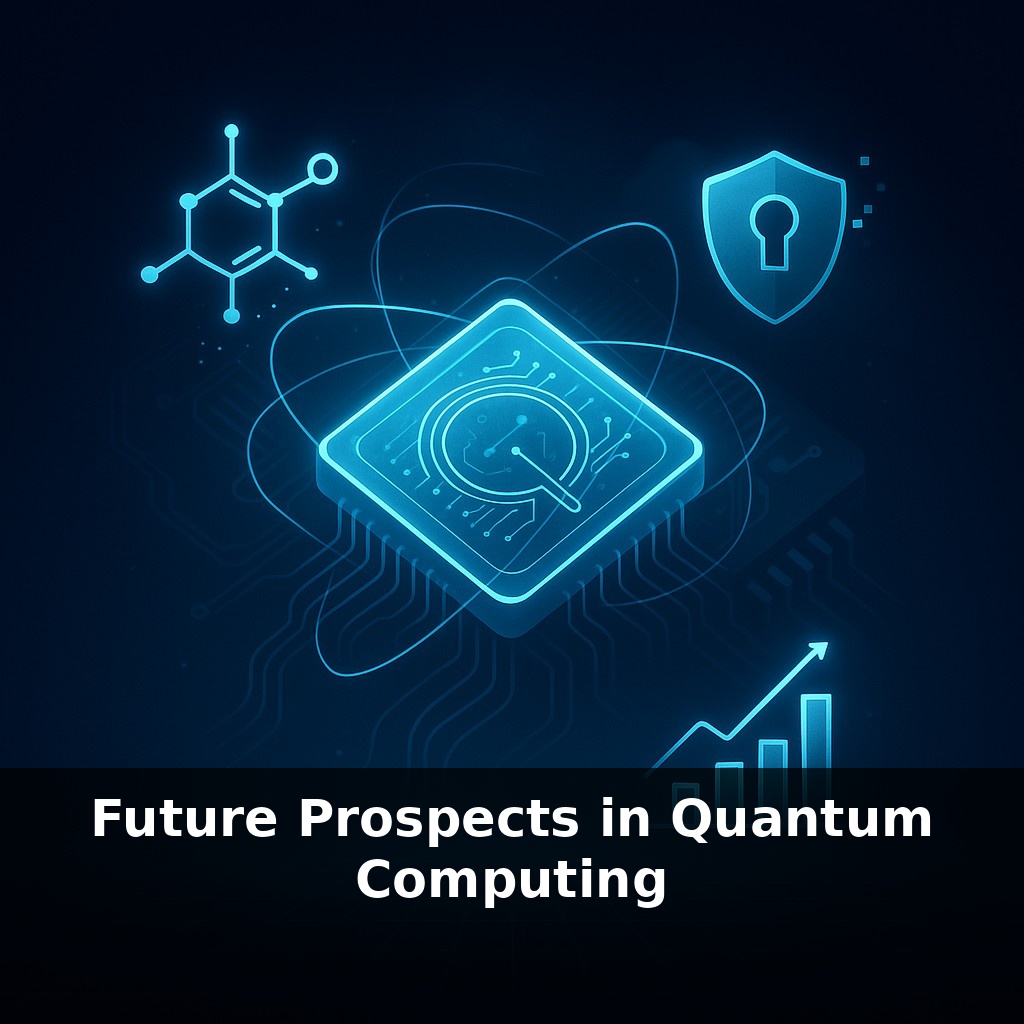
“Quantum computers may kill today’s encryption—and create tomorrow’s new drugs—faster than most boardrooms are planning for. A chemist, a trader, and a cybersecurity lead walk into the same meeting… and for the first time, they all need to care about the same machine.”
By 2033, IBM wants hardware robust enough to support 100,000 logical qubits—essentially a new class of machine sitting beside, not replacing, your classical cloud. That scale doesn’t just tweak existing workflows; it invites you to redesign them. Think less “faster spreadsheet” and more “new kinds of questions are now computable.” Early Quantum Advantage is likely to appear in narrow domains first: optimizing catalysts, pricing complex derivatives, routing fleets through chaotic traffic, accelerating certain AI training loops. Meanwhile, the threat side is maturing in parallel: timelines to break today’s public-key cryptography are uncertain, but no longer hypothetical, which is why “crypto-agility” and post-quantum migration plans are showing up in board packs. For innovators, the real frontier is orchestration—where classical, quantum, and AI systems co‑design solutions.
The transition from lab demo to industry tool will be uneven: some sectors will see payoffs early, others may wait a decade. Expect three overlapping waves. First, “quantum curious” pilots: cloud-access experiments that benchmark today’s devices on narrow use cases like portfolio risk, battery materials, or container loading. Next, hybrid pipelines where quantum routines quietly optimize sub‑problems inside larger AI or simulation workflows. Finally, full‑stack integration, where roadmaps, standards, and even compliance rules assume quantum resources are part of your default compute mix.
A 1,000–1,000,000‑logical‑qubit era doesn’t arrive as a single “ta‑da” moment; it shows up as a series of oddly specific wins that start to bend roadmaps. Think: one logistics provider shaving 2% off global fuel costs by co‑optimizing routes and loading patterns, or one pharma portfolio where a single quantum‑informed catalyst knocks years off a development timeline. None of these headlines say “quantum changed everything,” but when you stack 20 of them, the operating assumptions of an industry are different.
For innovators, the most useful lens is to separate **what depends on scale** from **what depends on maturity**.
Scale questions sound like: “At 10,000 logical qubits, could we simulate an entire battery cell to the level regulators would accept as partial evidence?” or “At 100,000, does a full portfolio risk engine become feasible in overnight cycles?” These are bets on when hardware will be big and clean enough to handle end‑to‑end problems instead of toy subroutines.
Maturity questions are sneakier: “When do we trust cloud providers’ isolation enough to run quantum‑enhanced pricing on shared hardware?” “When does our regulator recognize a quantum‑derived model as auditable?” Here, the bottleneck isn’t qubits; it’s standards, interfaces, governance, and skills.
Expect the stack to stratify into at least four visible layers:
1. **Hardware & control**: competing qubit types and cryogenic infrastructure, with regional clouds differentiating on latency and sovereignty.
2. **Middleware & compilers**: routing high‑level math into whichever back‑end is cheapest and most reliable that day—your code targets an abstract machine, not a specific vendor.
3. **Domain runtimes**: finance, chemistry, logistics, and AI toolkits that hide the quantum guts and expose business concepts like “hedge,” “reaction path,” or “fleet plan.”
4. **Operational guardrails**: quantum‑aware cybersecurity, compliance templates, and observability—proving what ran, where, and with which risk assumptions.
If hardware is the stadium, this stack is the league schedule, rules, and coaching staff that make it worth playing in. Your strategic edge will depend less on owning the fanciest “stadium” and more on joining (or shaping) the right league before everyone else does.
Volkswagen already tested quantum‑inspired routing to cut taxi idle time; now project forward to fleet operators quietly plugging early quantum services into their dispatch stacks. A chemicals company doesn’t wait for perfect hardware—it starts with coarse quantum‑aided screening of catalyst families, then hands the most promising candidates to classical simulation and wet labs. A hedge fund experiments with quantum-accelerated scenario generation, not to replace its models but to explore tail risks regulators increasingly care about. In parallel, cybersecurity teams rehearse “crypto‑break” drills, rotating algorithms the way SRE teams rotate keys and runbooks.
Think of today’s landscape more like the early mobile era than the mainframe age: scrappy teams ship odd, narrow “apps” on fragile platforms, and a few quietly become infrastructure. The opportunity for innovators isn’t predicting the winning qubit technology; it’s spotting where a 1% edge in search, discovery, or risk can compound into a moat once these tools become boring and ubiquitous.
Quantum shifts won’t feel like a single disruption so much as a quiet rewiring of assumptions. Compliance teams may treat quantum services like outsourced auditors, signing off on probabilistic evidence instead of deterministic proofs. Boards will ask not “Do we use quantum?” but “Where would we be exposed if rivals did?” Careers start to look like portfolio plays: one part domain expertise, one part algorithmic literacy, one part fluency in new forms of uncertainty.
Your challenge this week: pick **one** domain you know well—supply chains, portfolio risk, scheduling, materials, whatever you live in day‑to‑day. Now, design a “quantum‑era stress test” for it: assume a rival gets a 1–3% edge in discovery or optimization thanks to quantum tools five years before you do. Where, specifically, would that show up first—in margins, in cycle time, in regulation, in talent? Write down three concrete pressure points, then decide which one you’d want to harden or exploit *now*, before the hardware catches up.
Treat the next decade less like a countdown to a single breakthrough and more like learning a new opening in chess: odd moves at first, then quietly decisive. As prototypes harden into utilities, advantage goes to those who’ve already practiced playing alongside them, long before the rulebook feels final or the board stops shifting under your hands.
To go deeper, here are 3 next steps: Explore IBM Quantum’s free cloud platform (quantum-computing.ibm.com) and work through their “Learning” tutorials to actually run a small circuit on a real quantum device. Pick up “Quantum Computing for Everyone” by Chris Bernhardt and read just Chapters 1–3 this week, following along with the simple math examples using a notebook or Python. Join the Unitary Fund Discord and browse their open-source quantum projects (like Mitiq or qsim) to see where you could contribute or experiment with near-term, error-mitigated quantum algorithms.