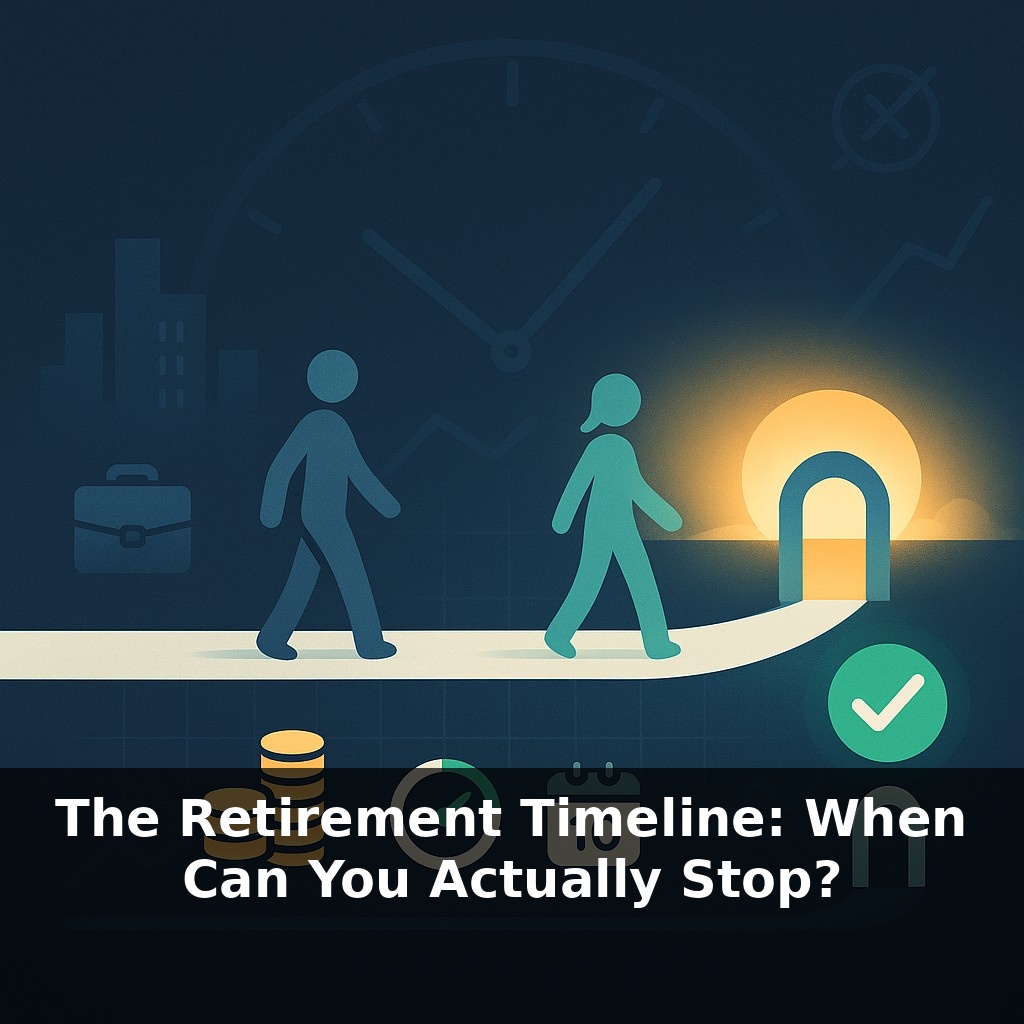
Most people don’t retire on the age they circled in their twenties—but on the day their money finally says, “OK, you’re done.” Meet Sarah and Jim, coworkers sharing the same salary and career length. Sarah retires a decade earlier, not by chance, but by how she managed her time and resources.
In this episode, we zoom in on *when* your money finally gives you permission to stop working. Not the birthday on your calendar, but the moment three numbers quietly click into place: how big your savings pile has grown, how fast you can safely draw it down, and how much it realistically takes to fund your life each year.
Think of these as three dials on a control panel. Turn up your savings rate, and the “finish line” dial can slide earlier. Expect higher spending, and it pushes later. Add in longer lifespans and uncertain markets, and you start to see why two people with the same income can end up retiring a decade apart.
We’ll walk through the typical phases people move through, how planners reverse‑engineer a target date, and why your “real” retirement age is probably a range—not a single number.
Here’s where the timeline gets more practical. Instead of staring at a distant “someday,” you can map your next few decades into phases that each ask you to do something different with your money. In your earlier years, the question is, “How much fuel can I load onto the rocket?” Later on, it shifts to, “How do I keep this thing stable in orbit without burning out the engines?” By the time you’re close to stepping away from work, the focus becomes: “How do I land safely and keep supplies flowing?” Each phase changes how much risk you take, how you use debt, and how you test your lifestyle numbers against reality.
Let’s zoom into those three broad phases and see how they actually change what you do with each dollar.
In the **Accumulation Phase (roughly 25–50)**, the lever that matters most is how much of your income you can consistently redirect toward future you. This is where an extra 5 percentage points of savings can literally erase several working years later. A useful way to think about spending now is the “lifetime trade”: every recurring $100/month lifestyle upgrade might require $30,000–$40,000 more in your eventual nest egg, depending on your withdrawal rate. You don’t have to live like a monk, but you do want to be deliberate about which comforts are truly worth dragging your retirement date for.
The **Consolidation Phase (about 50–60)** is less about acceleration and more about tightening the bolts. Here, people often hit peak earnings while also facing college costs, aging parents, and their own health shifts. The priority becomes simplifying and de‑risking: fewer scattered accounts, more tax‑efficient placement, intentional debt paydown. This is also when “practice runs” matter. Many planners suggest doing a 6–12‑month trial living on your projected retirement budget while you’re still working. If it feels too tight, better to discover that while you can still adjust, not after the paycheck stops.
Once you’re in the **Distribution Phase (60+)**, the question turns from “how much can I save?” to “what’s a withdrawal pattern I can sleep on?” The historical 4% starting rule gives you a rough initial ceiling, but in real life that number flexes. A retiree with a government pension and paid‑off house might safely pull more, while someone relying solely on investments with high medical uncertainty might aim lower, say 3–3.5%, especially if they fear markets underperforming past decades. Think of it more like a dosage range in medicine: you start at a sensible level, monitor how your “patient” (your plan) responds to market and spending shocks, and adjust gradually rather than chasing every bump.
Layered on top of these phases are three wild cards most people underestimate: health, work flexibility, and luck. A single diagnosis can push you out of the workforce earlier than planned. On the flip side, discovering work you actually enjoy may make a part‑time, semi‑retired life appealing—letting you draw less from your portfolio and dramatically extending its life.
This is also where Social Security timing, pension choices, and tax brackets come into play. Claiming Social Security at 62 versus 70 can swing your guaranteed income by 70–80%. That difference can mean needing hundreds of thousands more—or less—in savings to cover the same lifestyle. Similarly, *when* you tap which accounts (taxable, traditional, Roth) affects both how long your money lasts and how much of it you keep after the IRS takes a cut.
The upshot: your “can I retire yet?” answer lives at the crossroads of your assets, your spending reality, and your safety margin for the unknowable. The phases simply give you a structure for when to push hard, when to harden defenses, and when to carefully open the valve.
Think about three different people at 58, all earning roughly the same.
Maria loves her high-pressure job but wants flexibility. She decides on a “glide path”: drops to four days a week at 60, then consults part‑time from 63–68. Because she’s still earning, she taps investments lightly and delays Social Security, so her official “retirement date” barely matters—her lifestyle already feels retired.
Darren, burned out at 55, runs the numbers and sees he’s a bit short. Instead of giving up, he experiments: he rents out his basement, downsizes one car, and shifts to a lower‑paid but enjoyable job at a nonprofit. The combo of smaller expenses and modest income means his portfolio doesn’t have to do all the work.
Leena assumes she’ll retire at 65, but a generous buyout shows up at 60. Her planner tests two paths: take the package and trim travel by 20%, or work two more years and keep the bigger budget. Seeing both side by side, she realizes her question isn’t “Can I retire?” but “Which version of retired do I prefer?”
Your “finish line” may shift again as AI tools start tracking your finances like a fitness app tracks your steps—nudging you when spending creeps up or markets wobble. Retirement itself may feel more like changing lanes than exiting the highway: easing into part‑time work, short sabbaticals, or encore careers. As governments push official retirement ages higher, the real power move is designing a life where work becomes optional well before any law says you’re “allowed” to stop.
Your “stop date” isn’t just about money—it’s also about meaning. As you get closer, test‑drive versions of retired life the way you’d sample dishes at a new restaurant: volunteer for a cause, try a short sabbatical, or project‑based work. The numbers tell you when work is optional; these experiments help you decide what’s worth waking up for afterward.
Try this experiment: For the next 7 days, live like you’re already retired from a *time* perspective, not a money perspective. Block off a 4‑hour “retirement test window” on your calendar (e.g., 5–9pm or Saturday morning) and forbid yourself from doing any work, email, or side‑hustle tasks—only activities you imagine doing in retirement (walks, hobbies, volunteering research, grandkid time, etc.). At the end of each window, rate from 1–10 how satisfied, bored, or anxious you felt, and jot one sentence about what made it feel better or worse. After a week, look at your scores and ask: “Could I happily repeat *this* pattern for the next 10–20 years, or do I need a slower glide‑path or part‑time work in my retirement timeline?”