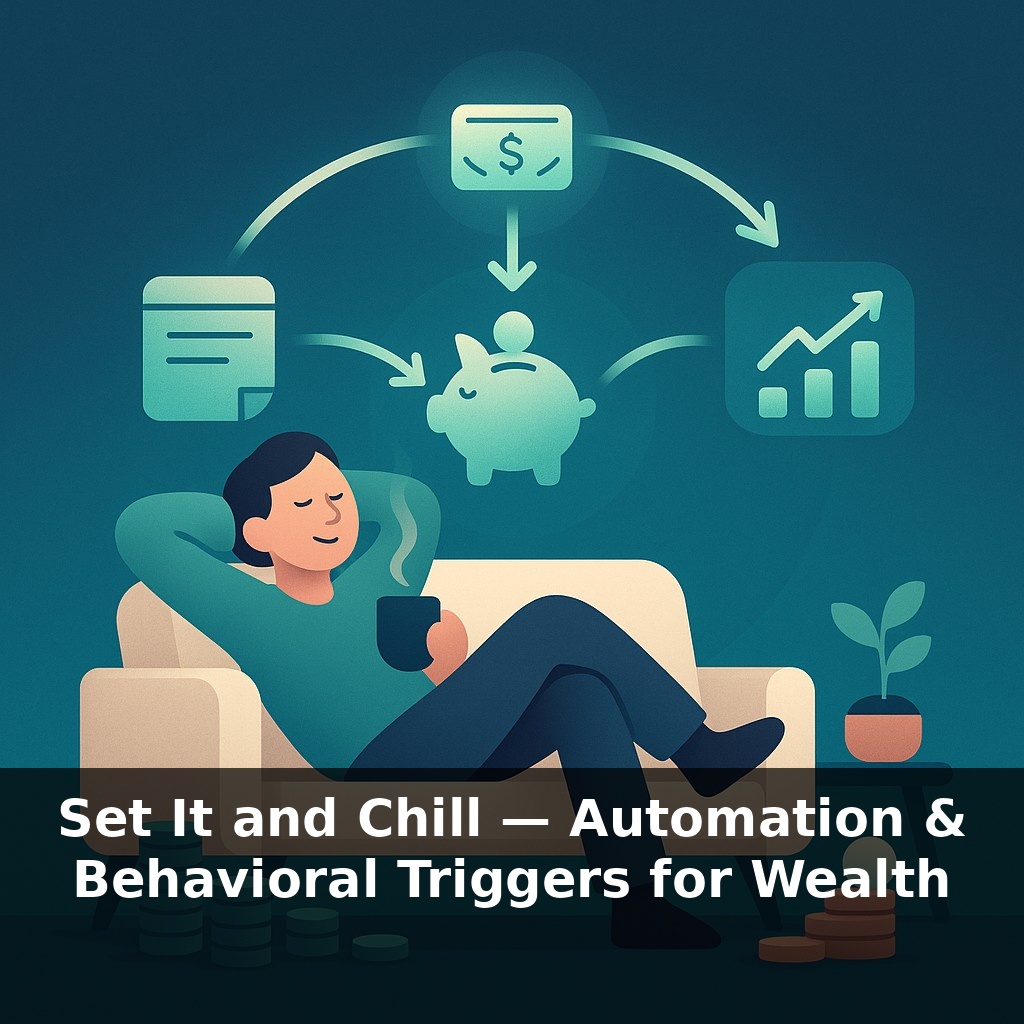
You can triple your savings rate without earning a raise or cutting lattes—by never touching your money at all. Your paycheck hits, bills get paid, investments fill up, and you’re still in the shower. Today we’ll explore how “set it and chill” quietly builds wealth in the background.
A 1% tweak to your automatic contributions at 25 can snowball into roughly $85,000 more by 65—and that’s without you making a single “motivated” decision in between. In earlier episodes, we focused on choosing accounts and dialing up contributions. Now we’re going one layer deeper: wiring your money so it behaves well even when you don’t feel like it.
Behavioral research is blunt about humans: we procrastinate, we forget, we cave to “I’ll start next month.” But those same biases can be flipped in your favor with default settings, calendar-based moves, and tiny nudges that fire on payday. Think: money rules that trigger automatically when your check lands, when the rent clears, even when you open your favorite streaming app.
This isn’t about becoming more disciplined. It’s about designing a system where discipline is optional—and progress still happens.
Think of this as moving from “one big budget” to a series of small, smart tripwires. Instead of asking, “Can I afford to save this month?” you design moments where the answer quietly becomes yes by default. Behavioral research shows we rarely overhaul our habits, but we do respond to cues: payday hits, the gym check‑in pings, your streaming night starts. Each of these can become a switch that routes a few dollars toward Future You. The goal now isn’t just to automate, but to link your system to real-life rhythms you already follow without thinking.
Here’s where this gets fun: you can stack different kinds of automation like layers, each one catching money that would otherwise slip through.
Start with **paycheck-based rules**. If your employer lets you split direct deposit, send a fixed dollar amount to a high-yield savings account and another slice to your Roth or brokerage before the rest hits checking. No app, no transfer—your “spendable” balance just appears smaller. If you change jobs, treat updating these splits as part of your onboarding, right next to filling out HR forms.
Next, add **event triggers**. These ride on specific moments:
- **After big bills clear**: Set a rule in your bank or app: the day after rent or mortgage hits, move $100 to your IRA or brokerage. You’re using the same mental checkpoint you already have (“Okay, rent’s paid”) and turning it into a wealth move. - **When a debt is killed**: The month a car loan or student loan disappears, immediately redirect that exact payment to retirement. Your lifestyle never expands to swallow the freed-up cash.
Then bring in **micro-automation**, especially if your cash flow is choppy:
- Round-ups from purchases into an emergency or investment account - “Every Friday” transfers of $10–$25 into savings - Rules like: “Whenever my balance is over $X at midnight, sweep the extra into savings”
You’re not trying to optimize every penny; you’re building lots of small, reliable drips.
For investing, use **auto-escalation** features where you can, but also build your own version: every time you get a raise, pre‑commit half the increase to higher 401(k) or IRA contributions. Mark raise month in your calendar with a recurring note: “Future You’s share.”
One analogy, then we’re done: a good automation system is like a well-designed medication schedule—correct dose, right timing, and minimal chances to “forget” or talk yourself out of it.
Finally, put **guardrails** around this so it doesn’t run on old assumptions. Once or twice a year, schedule a 30‑minute “automation audit”: check that transfers still fit your income, goals, and any new debts or dependents. You’re not micromanaging—just making sure the machine you built is still pointed at the right target.
Think of this section as testing how far you can push “lazy progress” without breaking anything. For example, say you get paid twice a month and your checking account usually bottoms out around $800 before the next paycheck. You could set a rule: whenever your balance is above $1,200 the day after payday, siphon off the extra into a brokerage account. Now your “oops, I overspent” cushion is preserved, and the surplus gets quietly promoted to long‑term duty.
Or try a streaming‑night trigger: every Sunday before your show, your bank auto‑moves $15 to a vacation fund. You’re pairing a pleasure you already show up for with a tiny, repeatable step toward something you’ll enjoy later.
You can also build “if‑this‑then‑that” rules around life events: if your bonus is above $2,000, send 60% to retirement and 40% to guilt‑free splurges; if your tax refund lands, route a flat slice to extra mortgage principal. Your automation becomes a menu of pre‑decisions you made when you were calm—so future you just orders from it.
Some banks are already testing “self‑driving money” that shuffles cash the moment your paycheck lands—like a helpful storm front quietly refilling lakes, not puddles. Open‑banking rules could let you script cross‑app flows: salary hits → credit card cleared → surplus split between brokerage and a “take‑a‑career‑break” fund. The open question: how far can we outsource choices before we stop noticing slow leaks—like rising fees or mission‑creep subscriptions—that automation keeps politely feeding?
Your challenge this week: run a live “automation drill.” Pick one upcoming cash event—a bonus, tax refund, or side‑gig payment—and pre‑route it before it arrives. For example: 40% to investments, 40% to near‑term goals, 20% to fun. When the money shows up, let the rule fire and notice how little resistance you feel.
Over time, you can chain these drills into a personal money rhythm, more like jazz than a strict march: flexible, but with a steady underlying beat. As tools get smarter—from robo‑advisors to open‑banking scripts—the real skill won’t be pressing buttons; it’ll be deciding which moments you want to lock in ahead of time. Start with one, watch the results, then decide whether to dial it up or back.