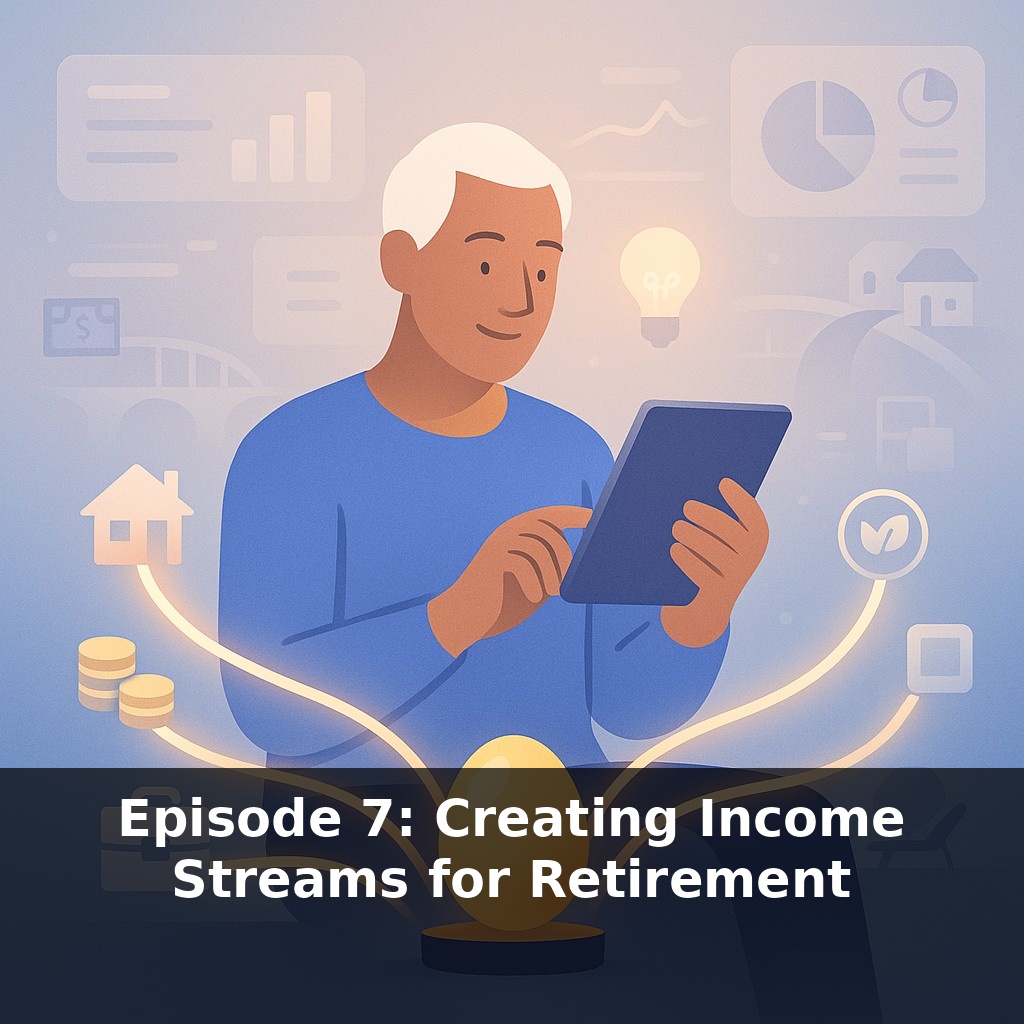
A typical retiree’s Social Security check replaces only about two-fifths of their old paycheck. Now jump ahead to your first month of retirement: the bills look familiar, but the income line doesn’t. The paradox is this—less work, more free time, and yet money suddenly matters more than ever.
Think of this episode as moving from “Will I have enough?” to “How many different ways can money show up for me?” Because depending on a single paycheck all your working life is normal; depending on a single income source in retirement is risky.
Longer lifespans, disappearing traditional pensions, and unpredictable markets mean the old model—stop working Friday, collect one or two fixed checks Monday—no longer fits most real lives. The good news: there are now far more ways to turn your time, skills, savings, and even your spare room into income than there were a decade ago.
We’ll explore how small, layered income streams can add up: dividends that grow, part-time work you actually like, rental and platform income, and how to combine them so that no single stream has to carry the whole load.
In this episode, we’ll zoom out from “What can I earn?” to “How do these pieces actually fit together over 20–30 years?” Your future self won’t just need cash; they’ll need flexibility—income that can rise with prices, adapt if your health changes, and survive market swings. We’ll look at how low-risk tools like bonds or annuities can cover the must-pay bills, while more dynamic options—like royalties, platform earnings, or real-estate cash flow—can fund travel, hobbies, and surprises. The goal isn’t to maximise hustle, but to design a mix that lets you scale effort up or down as life evolves.
Here’s the mindset shift: instead of asking, “What’s the *best* retirement income source?” start asking, “What job does each source do for me?” Every stream can have a specific assignment.
Some streams are built for reliability. Annuities, for example, are often used to cover the bills that simply can’t be skipped: housing costs, utilities, basic food, insurance premiums. You trade a chunk of savings for a predictable monthly amount and longevity protection—if you live longer than expected, the checks keep coming. That doesn’t make them “good” or “bad” in isolation; it just means they’re designed to be your sturdy baseline.
Other streams are built for growth or inflation-fighting. Dividend-growth funds, royalties from a book or app, or a small stake in a real-estate partnership are less about covering this month’s groceries and more about keeping your lifestyle from shrinking in ten or twenty years. They may fluctuate, but over long stretches they can help offset rising prices or unexpected healthcare costs.
Then there are “flexible effort” streams. Consulting a few months a year, exam tutoring during busy seasons, or teaching a short online workshop can be dialed up or down. In your sixties, you might lean on them more to delay drawing down investments; in your eighties, you might phase them out entirely.
The practical question is capacity: time, energy, money, and tech comfort. A spare room plus decent health might point toward short-term hosting. Deep professional experience but limited mobility might favour online mentoring. Limited upfront cash but strong communication skills might push you toward low-cost digital products rather than property-heavy strategies.
Think of your plan like designing a building’s structure: you want load-bearing pillars (guaranteed or highly stable income), secondary supports (market-linked but diversified sources), and then optional add-ons (projects you pursue because they’re interesting and profitable, not because you’re desperate for cash). If one support weakens, the whole thing shouldn’t collapse.
The art is in the combination—matching each stream’s job to your necessities, your appetite for risk, and the way you actually want to spend your days.
A useful way to test this is to walk through a few “mini blueprints.” Picture a retired engineer who enjoys problem‑solving but not rigid schedules. She sets up a small consulting profile on a freelance site, takes on two projects a quarter, and pairs that with a simple course hosted on Udemy that runs on autopilot after the initial build. The consulting covers larger, lumpy expenses—like a new laptop or helping a grandchild with tuition—while the course trickles in modest but steady royalties.
Or consider a retired nurse who’s great with people but not excited about complex tech. He partners with a younger relative to list his in‑law suite on Airbnb, in exchange for a split of the income. He handles hospitality; they manage the digital side. That new stream effectively pays his Medicare premiums and prescriptions.
Notice how both examples lean on skills they already have. The structure works because each person chooses streams that fit their energy, not an idealised version of themselves.
Longer lives and shifting careers mean your “second act” can span decades, not years. The opportunity isn’t just to plug budget gaps, but to design a mix of projects that evolve with you. Think of future tools—AI tutors, niche course platforms, global micro‑gig sites—as levers you can pull selectively, not an all‑or‑nothing hustle. As rules and tech mature, you’ll be able to swap in new options the way you might rotate crops, protecting both your energy and your cash flow.
As you sketch your own mix, remember that your first draft isn’t permanent ink. Tax rules, health, and tech will shift—so can your design. Your challenge this week: list three ways you *might* earn $100 a month in your seventies that you’d actually enjoy testing. Keep it playful, like taste‑testing recipes, and notice which ideas feel energising.