About half of what you did today, you never actually decided to do. Your brain ran a script, and you just… followed it. Walking into your kitchen, reaching for your phone, checking one more email—tiny actions, quietly repeating, while your conscious mind thinks it’s in charge.
Those quiet scripts don’t just appear—they’re built. And your brain is an efficient, slightly ruthless engineer. When it notices you running the same response in the same situation, it starts compressing that sequence to save energy. See a notification, thumb unlocks phone, open the same app: your brain flags that pattern as “standard operating procedure.” Over time, it trims the need for deliberation, so the whole chain fires almost automatically.
Here’s the twist: the brain doesn’t care if the script is helpful or harmful; it optimizes for repetition, not wisdom. That’s why stress, boredom, or fatigue can hard-code patterns you’d never consciously choose. The more consistent the context—same couch, same snack, same show—the more confidently your brain locks in the routine, like a smartphone caching your most-used route and surfacing it before you even tap the map.
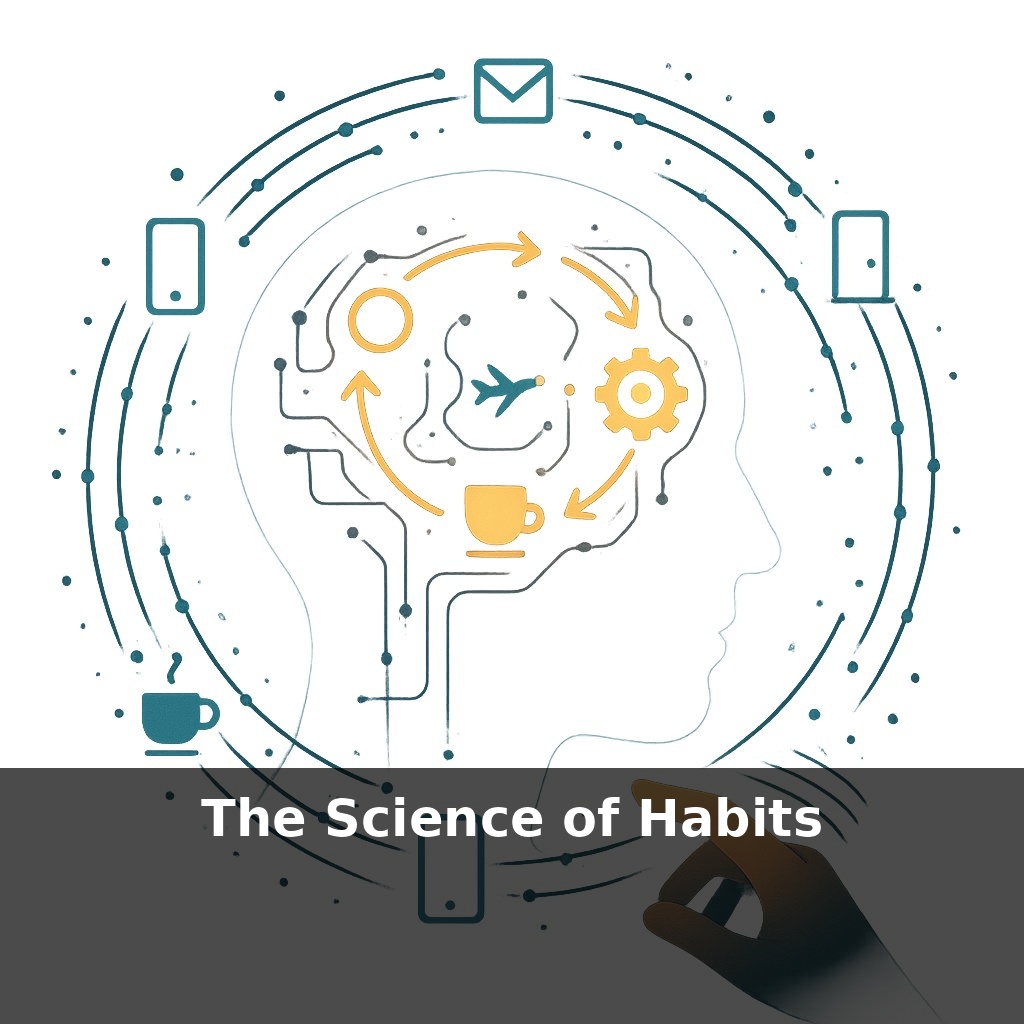
Here’s the catch: once a loop is compacted, it’s no longer stored where you do slow, reflective thinking. It gets handed off to the basal ganglia—deeper structures that specialize in fast, low-effort routines. That’s why habits feel like they “run you” when you’re tired, stressed, or distracted; control quietly shifts from planning circuits to execution circuits. Neuroplasticity is doing the bookkeeping in the background, strengthening whatever you repeatedly “bill” it for. Over weeks, the loop hardens: a cue in your environment, a nearly frictionless action, and a reward your brain has learned to expect before it even arrives.
Look closely at any “stuck” behavior and you’ll almost always find the same architecture underneath: a cue, a routine, and a reward prediction your brain doesn’t want to give up. The cue can be external (the glow of your laptop at 10 p.m.), internal (a spike of anxiety before a meeting), or social (a colleague opening the snack drawer). You don’t have to consciously notice it; your older wiring is listening for it anyway.
Once that cue fires, your brain isn’t asking, “What’s ideal?” It’s asking, “What usually happens now?” That’s where dopamine prediction comes in. The reward doesn’t have to be big or noble. Tiny hits count: a moment of relief, a brief distraction, a feeling of control. Over repetitions, your brain starts releasing dopamine at the cue itself—“Oh, this is the part where we get relief”—which makes the next step in the chain feel oddly magnetic.
This is why breaking a loop by sheer willpower feels so exhausting. You’re not just resisting the action; you’re pushing against a prediction error. Your brain expected a payoff and didn’t get it. That mismatch registers as discomfort and urges you back toward the familiar routine just to “close the loop.”
Here’s the hopeful part: prediction can be edited. The same plasticity that wired in the old pattern can downgrade it if the cue stops leading to the expected reward, or if a new, more reliable reward consistently follows a different response.
Think of it like refactoring legacy code in a massive software system. You rarely rip everything out at once; you intercept one function and point it to a cleaner subroutine. In practice, that means keeping the cue, but swapping the routine while preserving the underlying reward. Still stressed at 3 p.m.? Instead of scrolling, you might take a 5-minute walk that reliably delivers the same “exhale” your brain was seeking from your phone.
Sleep and movement enhance this editing process. Deep sleep consolidates which loops get kept or weakened. Regular exercise, by boosting BDNF, makes it easier for new “if-this-then-that” patterns to stick. So you’re not just fighting old code; you’re upgrading the system that rewrites it.
A practical way to see this in your own life is to zoom in on a single loop and watch how it behaves when you tweak just one element. Say every time you sit at your desk after lunch, your hand “mysteriously” ends up in the snack drawer. You decide not to fight the whole pattern, just the middle. Same desk, same time, but you swap the grab-and-munch for filling a water bottle and doing 10 slow stretches. At first, it feels flat, even annoying. That’s your old reward prediction protesting. But if—crucially—you end those stretches with something genuinely satisfying (a song you love, 2 minutes of guilt-free scrolling, a quick chat with a friend), your brain starts bookmarking the *new* chain as the more reliable payoff.
Over weeks, you may notice something subtle: the original urge for the snack appears a bit later, or weaker. That’s the prediction model updating. You didn’t erase the old loop overnight; you steadily made the new one the easier, more trustworthy option in that same slice of your day.
Nearly half of tomorrow’s behavior is already penciled in by today’s patterns, which makes habit science feel less like self-help and more like infrastructure planning for your life. As biofeedback wearables get smarter, they’ll flag the exact micro-moments when you’re most “rewritable,” like a coach whispering, “Change the play now.” At a societal level, redesigning default options—food, transport, apps—may shape collective behavior more than any campaign or law ever could.
Your challenge this week: Pick ONE recurring context (for example: first thing after waking, after lunch, or right before bed). For 7 days, don’t try to be “disciplined.” Instead, run a live experiment: in that single context, deliberately swap your usual routine for an alternative that delivers a similar payoff (relief, pleasure, connection) but better matches your long-term goals. At the end of the week, note not just what changed, but how strong the original pull still feels.
So the question isn’t “Can I change?” but “Which loop will I train next?” Treat each small shift like tuning an instrument: tiny twists, then listen. You might find that altering one recurring moment nudges neighboring ones, like rearranging furniture and suddenly walking differently through a room. Change one reliable pattern, and your future becomes a bit less pre-written.
Here’s your challenge this week: Pick one daily habit you want to build (like a 10‑minute evening walk or 5 minutes of language practice) and hard‑wire it to a cue you already do every day—specifically, start it immediately after you brush your teeth at night. For the next 7 days, do that habit at the *same time, same place, same cue* and track it with a simple “X” on your calendar right after you finish. To lock in the reward loop the episode talked about, say out loud one concrete benefit you’ll get from this habit as soon as you’re done (for example, “This walk is lowering my stress so I sleep better”).