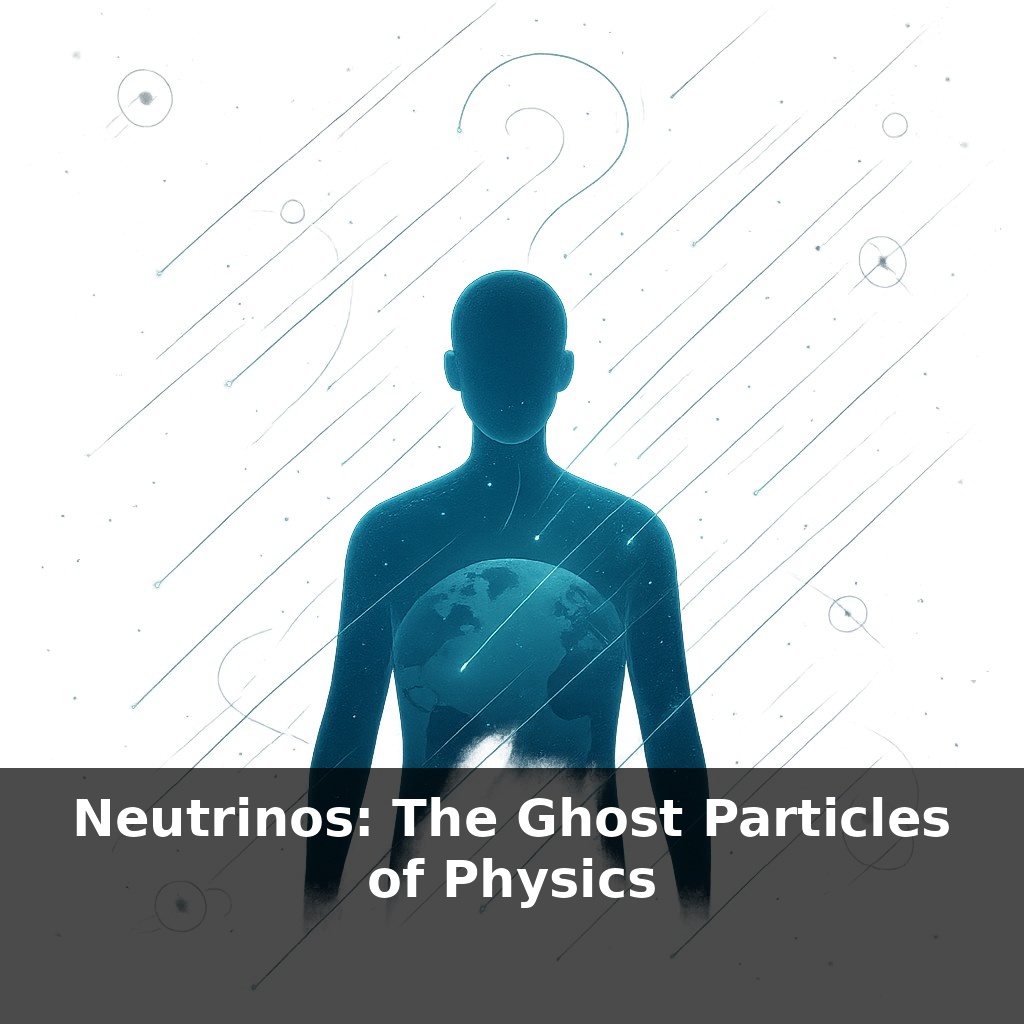
Right now, most of the universe is whispering in a language almost no one can hear. Trillions of ghostly particles are streaming through your body each second, yet you feel nothing. If they barely touch anything, why do physicists think they might rewrite our laws of nature?
Neutrinos are so elusive that early physicists seriously wondered if they were just a mathematical trick. For decades, we couldn’t see them, couldn’t weigh them, and had only indirect hints they were real. Yet today, entire mountains have been turned into observatories to catch the rare moments when one finally bumps into ordinary matter.
In this episode, we’ll follow these particles from the heart of the Sun to colossal detectors buried deep underground and even to the aftermath of exploding stars. We’ll see how they helped confirm that the Sun is powered by nuclear fusion, how they revealed that at least two types have mass, and why that single fact cracked open the “completed” Standard Model like a hairline fracture in a carefully engineered bridge, hinting that something deeper carries the real load.
To follow these particles, we need to think less like astronomers with telescopes and more like detectives setting traps in very odd places. The trouble is background noise: cosmic rays, natural radioactivity, even a passing truck can fake a signal. That’s why some of the most sensitive experiments on Earth are hidden in mines, under mountains, or beneath Antarctic ice, patiently waiting for a single unmistakable flash. Here, the cosmos doesn’t just shine in light; it taps out messages in almost perfect secrecy, and neutrino detectors are the wiretaps listening in.
Start with a puzzle that baffled physicists for decades: when we counted how many neutrinos the Sun should produce, the numbers were clear—but early experiments on Earth saw only about one‑third of that amount. Either our understanding of the Sun was badly wrong, or something strange was happening to the particles on their way to us.
To chase this down, experiments like Homestake in the U.S. and later Super‑Kamiokande in Japan and SNO in Canada didn’t just try to count neutrinos; they tried to distinguish between different *flavors* produced in different processes. That’s where the mystery deepened: the “missing” ones weren’t gone. They seemed to be arriving in other flavors than expected.
The resolution was radical: neutrinos *change identity* as they travel. A solar neutrino born in one flavor can arrive at Earth as another. This behavior, called oscillation, is only possible if the flavors are built from combinations of states with slightly different masses. If all had exactly zero mass, there’d be no rhythm to oscillate with.
Mathematically, it looks a bit like mixing three pure audio tones to create different notes on a synthesizer. The “notes” are the flavors; the underlying tones are the mass states. As neutrinos fly through space—or even through dense matter like the Sun—the phases of those tones shift relative to each other, and the apparent note changes.
Oscillation patterns don’t just say “masses exist”; they encode the *differences* between the squared masses and how strongly each flavor mixes. That’s why long‑baseline experiments fire beams of neutrinos hundreds of kilometers through Earth: by comparing the beam’s flavor makeup at launch and at a distant detector, they map how the mixture has evolved.
This is where the story zooms out to the cosmos. Those tiny mass differences, and the way neutrinos mix, might help explain why the universe has so much matter and so little antimatter. If neutrinos and antineutrinos behave just slightly differently when they oscillate, that asymmetry could be a clue to why anything solid exists at all.
And then there are *cosmic* neutrinos, carrying messages from extreme events. In 1987, detectors caught a brief burst from a supernova in the Large Magellanic Cloud—arriving hours before visible light escaped the collapsing star. Today, IceCube at the South Pole tracks neutrinos with energies millions or billions of times higher, pointing back to violent accelerators like active galaxies.
At Earth’s surface, about 65 billion solar neutrinos pass through every square centimeter every second, yet experiments count only a tiny handful per day or year. That mismatch drives increasingly ambitious designs. One approach is sheer scale: Super‑Kamiokande holds 50,000 tons of ultra‑pure water; DUNE will use tens of thousands of tons of liquid argon. Another approach is going to extremes: Borexino uses exquisitely clean scintillator to see very low‑energy solar neutrinos, while IceCube instruments a cubic kilometer of Antarctic ice to catch rare, ultra‑energetic ones from deep space.
In sports terms, it’s like defending a goal against a team that almost never shoots: you build a huge stadium, darken everything, and then train cameras to recognize a single, perfect ball trajectory. Each confirmed “goal” can pin down cross‑sections as tiny as 10⁻⁴⁴ cm², test how well nuclear reactors behave, and even time the internal stages of a collapsing star before its light fully emerges.
Your challenge this week: whenever you see the Sun, a power plant, or even an old smoke detector, pause and ask, “What hidden particles might be streaming from this?” Then look up one real detector that can see them and note *where* it’s built and *why* that location matters.
Neutrinos may become our early‑warning sirens for the universe. A dense network of future detectors could flag a nearby stellar collapse like a breaking‑news alert, giving telescopes time to swivel before the first photons arrive. If upcoming experiments nail down their mass pattern and possible CP‑violation, they’ll probe why matter won the cosmic “coin toss.” And if neutrinoless double‑beta decay is seen, it would hint that these particles quietly blur the line between matter and antimatter.
As we learn to “listen” better to these particles, we’re not just tuning a new sensor; we’re opening an extra channel on the universe’s control panel. Future maps of the cosmos may include a neutrino layer the way weather apps show wind. Follow that layer long enough, and it could trace both the history of stars and the limits of our current theories.
Try this experiment: Build a simple “cloud chamber” to spot cosmic-ray particles (some created when neutrinos interact in the atmosphere). Line the inside of a clear glass or plastic container with black paper, chill it over a bed of dry ice, and add a small amount of high-proof alcohol (like isopropyl) inside so it evaporates and creates a supersaturated vapor. Turn off the lights, shine a flashlight from the side, and watch for thin, white streaks forming and disappearing—those are particle tracks zipping through the chamber. As you observe, imagine how many neutrinos are streaming through you at the same time, almost never leaving a track at all.