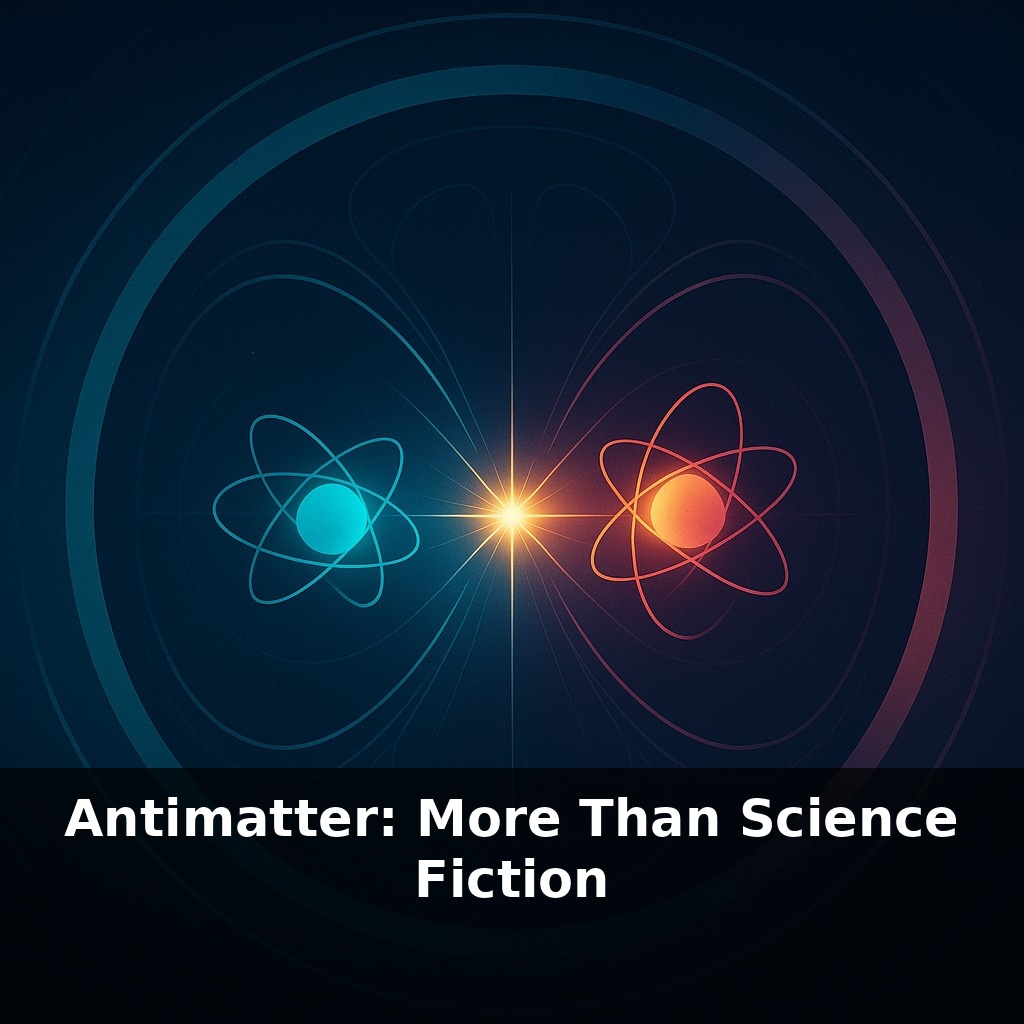
Some of the most expensive material on Earth vanishes the instant we create it. In a hospital scanner, in a collider at CERN, particles of antimatter appear, collide with ordinary matter, and disappear as pure light—raising a quiet question: why does anything solid remain at all?
In science fiction, antimatter is usually a magical fuel or a doomsday switch. In real labs and hospitals, it’s something stranger: a tool. Physicists trap whole anti-atoms in magnetic “bottles,” holding them in place like rare, wild insects long enough to ask precise questions about nature’s rules. Doctors inject tiny amounts of positors into patients, then reconstruct images of the body from the brief flashes that mark their end. Between these extremes lies a deeper mystery: our best theories say the Big Bang should have made matter and antimatter in equal amounts. Yet when we look around, the universe is stubbornly one-sided. Antimatter becomes less a cinematic explosive and more a missing character in the story of why anything—from galaxies to coffee cups—exists the way it does.
So where do we actually meet antimatter beyond colliders and clinics? In some ways, it’s hiding in plain sight. Thunderstorms can launch bursts of gamma rays and briefly spawn pairs of particles and antiparticles high in the atmosphere. Certain radioactive elements in rocks and bananas quietly emit positrons. Above Earth, satellites watch narrow beams of annihilation light streaming from space, tracing regions where extreme magnetic fields and violent jets around black holes can forge antiparticles. Step by step, each of these natural “labs” gives us another way to test our tidy equations against a messy cosmos.
In particle physics, “opposite” has a very precise meaning. Every building block we know—the electron, quarks inside protons and neutrons, whole atoms—has a partner whose electric charge and certain quantum “labels” are flipped. Yet when teams at CERN compare, say, hydrogen to antihydrogen, every measured property so far matches to many decimal places. This near-perfect mirroring is what makes antimatter so scientifically powerful: if even a tiny mismatch shows up, it would signal new physics beyond our current theories.
A lot of the work, then, is about checking whether nature treats matter and antimatter with perfect impartiality. One set of rules, called “CPT symmetry,” predicts that if you reversed charge (C), flipped left and right (P), and ran time backwards (T), the laws would look identical. That sounds abstract, but it turns into very concrete experiments. Physicists measure how antiparticles spin in magnetic fields, how they absorb light, and how precisely their masses match their partners. They then compare those results with the same measurements for ordinary particles, hunting for differences as small as a few parts in a trillion.
Gravity is a special case. Our equations say antimatter should fall down just like anything else, but we’ve never directly checked with neutral anti-atoms until now. That’s the point of experiments like ALPHA‑g: cool antihydrogen, nudge it, and track whether it accelerates the same way a dropped bit of hydrogen would. Any deviation, even a percent-level quirk, could hint at why the cosmos kept a surplus of matter after the early fireball.
Far from being just a theoretical obsession, this precision work already shapes technology. PET scanners rely on the exact energy of annihilation photons to reconstruct internal structures with millimeter accuracy. Future concepts go further: using stored antiparticles as ignition triggers for advanced nuclear fusion, or as ultra-compact energy reservoirs for interstellar probes. None of these are near-term engineering projects—we’re many orders of magnitude away from producing enough antimatter cheaply—but they anchor science fiction speculations in real physics instead of pure fantasy.
Your challenge this week: whenever you encounter a daily technology—phone GPS, medical imaging, even power grids—ask what invisible particles or symmetries it quietly depends on. Then, look up one real experiment that is pushing that same principle to its limit with antimatter.
Engineers are already stress‑testing antimatter ideas in surprisingly down‑to‑Earth ways. NASA’s Marshall Space Flight Center has studied tiny antimatter “spark plugs” to kick‑start fusion pellets, not as a main fuel but as a hyper‑precise trigger. In cancer clinics, researchers explore targeted therapies where annihilation happens inside a tumor, turning the patient’s own tissue into the source of lethal, ultra‑localized radiation. Space physicists, meanwhile, have spotted antiprotons trapped in Earth’s magnetic field—forming a thin, natural antimatter belt that future probes might one day skim for fuel, the way aircraft refuel mid‑air. Think of these projects less as wild bets and more as early prototypes in an architectural sketchbook: partial designs that test which structures reality will actually support. Each new experiment raises the same quiet question in a different context: how far can we push this most concentrated form of energy before nature, engineering, or economics say “enough”?
Antimatter’s future may look less like a doomsday weapon and more like a toolkit of precision instruments. Tiny bursts could act as “surgical strikes” in physics—pinpoint ignition for fusion capsules, or ultra‑clean calibration sources for next‑generation detectors. Space agencies quietly ask whether trapped antiparticles around planets could be “mined” like rare data packets. Even if costs stay huge, each improved trap or beamline is a prototype for technologies we don’t yet know we need.
In the end, antimatter sits where curiosity, danger, and possibility overlap. As detectors sharpen and traps improve, we’re less chasing a miracle fuel and more learning a new engineering language, glyph by glyph. Today it’s hospital scanners and gravity tests; tomorrow it might be navigation beacons or power “handshakes” between distant spacecraft.
Before next week, ask yourself: 1) “If I had access to a tiny, safely contained amount of antimatter like in the episode, what *specific* real-world problem (medical imaging, power, propulsion, etc.) would I most want it to solve, and why that one over all the others they mentioned?” 2) “When I hear about antimatter being used both in PET scans and in sci‑fi doomsday devices, which story do I instinctively believe more, and what does that reveal about how I filter ‘weird’ physics through fear vs. curiosity?” 3) “If funding and politics vanished as obstacles, which antimatter application from the episode would I personally argue society should prioritize first—and what concrete trade‑offs (cost, risk, timelines) would I be honestly willing to accept for that choice?”