Deep under the French–Swiss border, protons race in a ring so large it loops through multiple towns… yet the particles themselves are smaller than a speck of dust by many orders of magnitude. We build a gigantic machine, just to glimpse events that vanish faster than a flash of lightning.
For a long time, nature only let us watch its “show” at everyday energies: lightning bolts, radioactive rocks, cosmic rays from space. Colliders changed the deal. Instead of waiting for rare, high‑energy events to arrive, we manufacture them on demand—and push far beyond anything naturally happening on Earth’s surface.
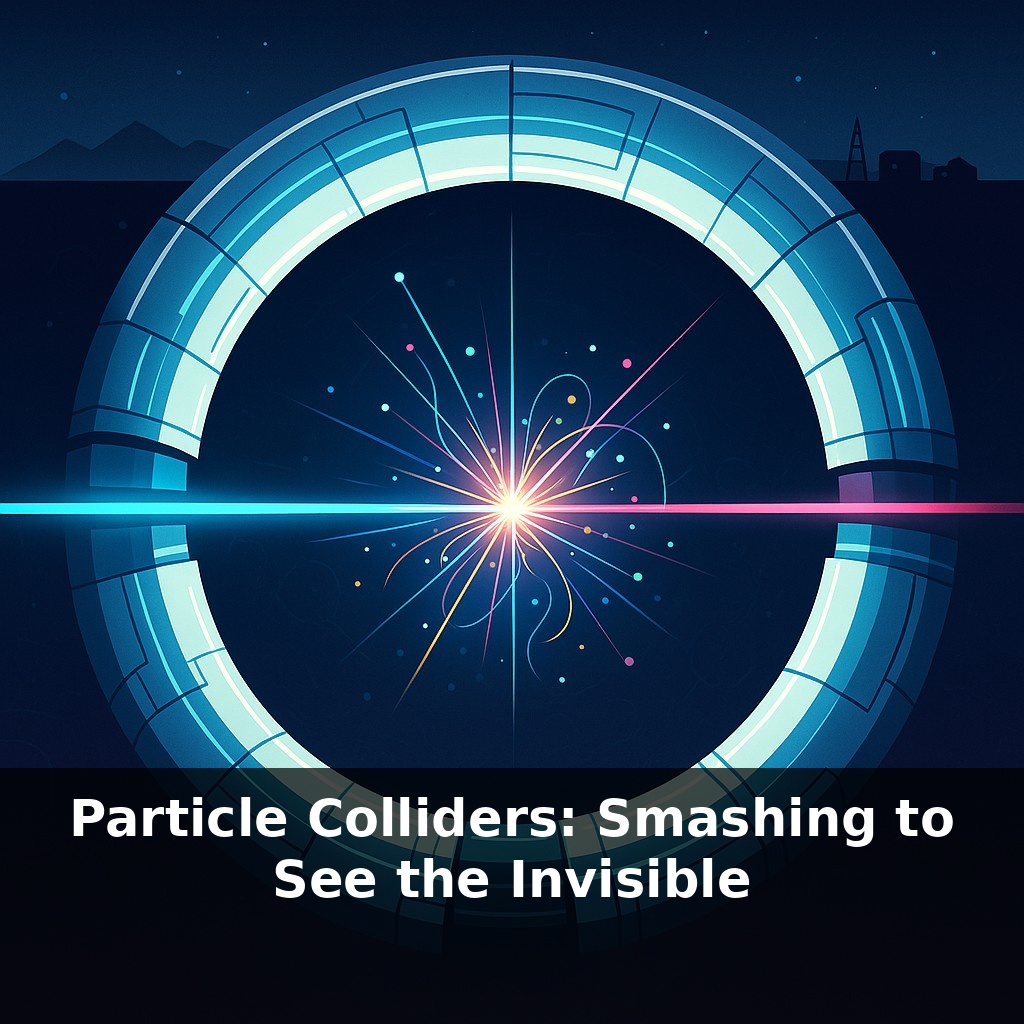
Inside the ring, tightly packed bunches of particles cross paths tens of millions of times per second. Most simply miss; a tiny fraction actually collide head‑on. Those few encounters briefly recreate conditions that last prevailed microseconds after the Big Bang, then vanish in less than a trillionth of a second. To catch them, detectors like ATLAS are built as layered cylinders of ultra‑precise sensors, wrapped around the collision point like a high‑tech stadium focused on a single, microscopic playing field.
At these energies, matter behaves less like solid stuff and more like a set of probabilities waiting to crystallise into outcomes. Each interaction can produce familiar fragments—electrons, photons, jets of hadrons—or, on rare occasions, something entirely unexpected. The trick is that no one collision is special; meaning emerges only from patterns across trillions of events. Computers sift this torrent of data in real time, discarding almost everything. What survives is the tiny subset of interactions that might hint at new fields, new particles, or subtle cracks in the current theory.
The first surprise is that “smashing” is only a tiny part of the story; the real magic is in the choreography that leads up to impact. Before anything meets head‑on, ultra‑cold, ultra‑empty conditions have to be engineered. Inside the LHC beam pipe, the remaining gas molecules are so sparse that it’s emptier than interplanetary space. That matters: a stray atom in the way would nudge a beam off course long before it reaches design energy.
Around the ring, thousands of superconducting magnets form an invisible racetrack. Dipole magnets bend motion into a curve; quadrupoles act like focusing lenses, squeezing bunches until they’re narrower than a human hair where beams cross. Tiny corrections run constantly: the Earth’s tides, passing trains, even minute ground shifts can distort the orbit, so feedback systems keep everything aligned to within fractions of a millimetre over 26.7 km.
By the time two bunches finally intersect, another constraint dominates: data. Each second produces far more raw information than could ever be stored. Layered “triggers” make split‑second judgements about what’s interesting. Simple electronics first reject the obviously mundane; deeper software filters then scrutinise the survivors, searching for tell‑tale combinations of tracks and energy deposits. Only a few hundred events per second are kept from a firehose of tens of millions.
Hidden in that stream are puzzles. The Higgs boson, for example, revealed itself not as a dot on a photograph but as a bump in a graph—slightly too many events forming particular decay products at a specific mass. Today, similar hunts look for missing energy that might hint at dark matter slipping through undetected, or for subtle asymmetries between matter and antimatter products that might explain why the Universe didn’t annihilate itself long ago.
Designing future colliders extends this logic. Do we push to higher energies, to unveil heavier phenomena, or aim for extreme precision at lower energies, to expose tiny deviations from theory? Circular proton machines, linear electron machines, and even plasma‑wakefield concepts each sketch different paths forward. All share the same goal: tune the dance just enough that the next, deeper layer of reality becomes statistically undeniable.
To see how this plays out in practice, look at how the Higgs boson was confirmed. Years before the announcement, theorists had mapped out every plausible way it could appear and vanish—into two photons, into pairs of Z bosons, into heavier quarks and leptons. Experimental teams then built dedicated “channels” in their analyses, each tuned to one of these possible signatures. It wasn’t about a single spectacular event, but about seeing subtle excesses pile up consistently across different decay paths and different detectors, over several years.
A collider run feels less like a one‑off experiment and more like a season of a very long tournament. Different “teams” of analyses compete and collaborate, testing overlapping ideas: one group hunts for supersymmetric partners, another for new heavy gauge bosons, another for hints of compositeness. Occasionally, an unexpected anomaly appears in one corner of the data, triggering a global effort to check, refine, and attempt to break the result before anyone dares to whisper “discovery.”
Future colliders may feel distant, but their spin‑offs arrive quietly in daily life. The need to sort rare events from oceans of noise drives advances in pattern‑spotting algorithms; those same ideas can spot tumours in scans or fraud in markets. Pushing magnets colder and stronger refines materials for cheaper MRI machines and loss‑reduced power grids. As designs scale, so does cooperation: no nation builds these alone, so the “social technology” of running them may be one of their deepest legacies.
Your challenge this week: treat your surroundings like an unseen‑physics scavenger hunt. Note three technologies you use daily—phone, medical scan image online, map routing—and trace each one back (via a quick search) to some advance in accelerator or detector science. By the end, see how often “fundamental curiosity” quietly shapes your routine.