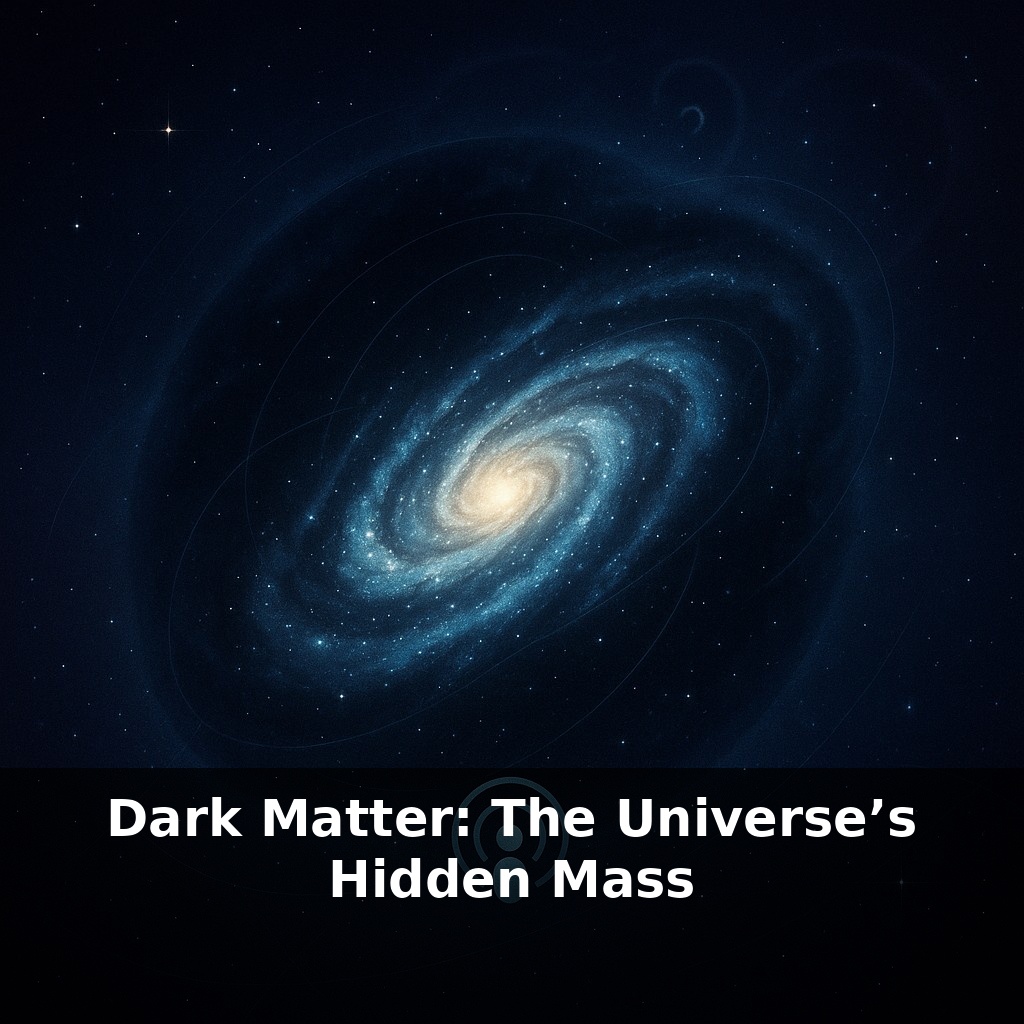
Some of the brightest galaxies in the sky are spinning so fast they should fling themselves apart—yet they don’t. Astronomers mapped the stars, checked the gas, added up everything that shines… and came up short. So what’s doing the holding, if almost nothing we see is enough?
About 100 years ago, astronomers started noticing a quiet mismatch: wherever they carefully weighed the universe, the numbers refused to add up. First in galaxy clusters, then in individual galaxies, then across the entire cosmos, the same pattern appeared—too much gravity for the amount of visible stuff. As telescopes improved, the “accounting error” didn’t shrink; it grew sharper. Precise sky surveys traced filaments of invisible influence stretching between clusters. Satellite missions like WMAP and Planck mapped faint ripples in ancient light and found that even the early universe seemed tuned by something unseen. Instead of a single odd result you might blame on bad data, cosmologists were staring at a consistent, global imbalance. Piece by piece, a picture emerged: whatever is missing isn’t a minor detail—it’s the main ingredient.
So researchers attacked the problem from every angle they could think of. Instead of just staring at single systems, they began assembling a cosmic spreadsheet: how fast different objects move, how hot cluster gas gets, how light is bent as it passes distant structures, how the early universe’s glow is patterned on the sky. Each method is like a separate audit team with its own instruments and blind spots. Yet the totals kept converging on the same strange bottom line: most of the mass is unseen, behaves differently from familiar atoms, and leaves its mark only through gravity and subtle cosmic ripples.
Start with a single galaxy. When astronomers measure how quickly stars orbit near its center and then farther out, they don’t see the smooth slowdown you’d get from most of the material being in the bright core. Instead, the speeds level off and stay high, as if an extended, invisible halo is adding extra pull all the way out. Different telescopes, different galaxies, same pattern: something unseen is outweighing the stars by several to one.
Zoom out to clusters of galaxies—huge associations bound together over millions of light-years. There, astronomers use two independent tricks. One is to watch how fast galaxies zip around inside the cluster; the other is to map how the cluster bends and distorts background galaxies through gravitational lensing. The motions say “lots of hidden mass,” and the warped light sketches the same heavy profile, piled up in regions that only faintly glow in visible or X‑ray light.
The Bullet Cluster takes this a step further by catching a collision in the act. Superheated gas from the two clusters slams together and slows down, lighting up in X‑rays. But the lensing map—our best tracer of total mass—peaks in two separate regions that have already passed through each other. Whatever dominates the mass budget seems to have slipped through the crash largely unaffected, like a swarm of tiny, non‑interacting projectiles sailing past the wreckage.
On the largest scales, surveys such as the Sloan Digital Sky Survey trace out a vast network of filaments and nodes. Computer simulations show that if you start with a universe containing only known particles, you can’t grow this cosmic web in time; structures form too slowly and end up smaller and puffier than observed. Add a cold, slow‑moving, non‑radiating component, and the simulated universe sharpens into one that statistically matches the real one—locations of clusters, typical sizes of galaxies, even the detailed pattern of small structures.
Meanwhile, the fine details in the cosmic microwave background measured by WMAP and Planck lock down how much ordinary matter can exist without spoiling the observed pattern. Those data, combined with light‑element abundances from the early universe, effectively force the missing mass to be of a different type entirely, not just dim stars or cold gas hiding between them.
Astronomers test ideas about this hidden mass in ways that sound almost like engineering a structure you can’t see. They tweak the assumed properties—how clumpy it is, how fast its particles move, whether it very rarely bumps into itself—and then run giant simulations on supercomputers. When the results produce the same mix of dwarf galaxies, cluster mergers, and subtle distortions in background light that surveys actually observe, those particular settings stay on the table; when they fail, entire models are scrapped. The current front‑runners, like WIMPs and axions, each predict slightly different small‑scale patterns: how many satellite galaxies should orbit a big galaxy, how dense their centers should be, how often they should be torn apart. Observers then comb data from surveys such as DES and Euclid, effectively hunting for these patterns the way a structural inspector searches for telltale stress lines that reveal what’s really bearing the load.
Dark matter’s next surprise may come from seemingly unrelated corners: quantum labs chilling devices near absolute zero, timing arrays of millisecond pulsars, or precision maps of how stars drift in our own halo. Each new constraint is like adding security cameras around a locked vault: you don’t see the thief, but you narrow the options. As candidates fall, surviving models could hint at hidden symmetries, new forces, or even unseen sectors mirroring our own.
In the next decade, new detectors and sky surveys will probe this hidden mass with the focus of a city upgrading from a paper map to live GPS. If its particles nudge atoms, flicker in radio timing, or whisper in quantum sensors, we’ll catch the trace. And if they don’t, that silence will be just as revealing—forcing us toward stranger possibilities.
Before next week, ask yourself: 1) The episode compared dark matter to an invisible scaffolding that shapes galaxies—where in your own life do you feel “pulled” or influenced by forces you can’t directly see (habits, assumptions, social pressures), and how might you start “mapping” those the way astronomers infer dark matter from galaxy rotation curves? 2) The scientists talked about building ever-more-sensitive detectors deep underground to catch rare dark matter interactions—if you treated your attention like one of those detectors, what small change could you make today (e.g., turning off one notification stream, changing one nightly ritual) to better notice subtle patterns in your thinking or mood? 3) Astronomers trust the gravitational effects they can measure, even when the matter itself is invisible—what is one concrete piece of “evidence” (data, feedback, repeated outcome) in your life that you’ve been ignoring, and how would your decisions change this week if you took that evidence as seriously as cosmologists take galactic rotation data?